Lovell in Wyandot County, Ohio — The American Midwest (Great Lakes)
to Crawford's Burning
⎯⎯⎯
to Battle Island
Ohio Revolutionary Memorial Trailh
| — | Harrison's March | — |

Image courtesy of the Historical Marker Database
1. to Crawford's Burning / to Battle Island Marker
Revolutionary
Memorial
Trail
Text on South Side :
- - - - -
2
Mile to
Crawford's
Burning
Text on North Side :
- - - - -
6
Miles to
Battle
Island
Erected 1930 by Ohio Revolutionary Memorial Commission. (Marker Number A140.)
Topics and series. This historical marker is listed in these topic lists: Indigenous Peoples and Communities • Roads & Vehicles • War, US Revolutionary. In addition, it is included in the Ohio Revolutionary Memorial Commission series list. A significant historical year for this entry is 1813.
Location. Marker is missing. It was located near 40° 53.454′ N, 83° 19.867′ W. Marker was in Lovell, Ohio, in Wyandot County. It was at the intersection of Ohio Route 199 and County Route 42, on the left when traveling north on Ohio Route 199. Nothing remains of this marker, but according to my vehicle's odometer this marker site is about 2 miles south of the site of the Ohio Revolutionary Memorial Commission marker for Crawford's Burning. Touch for map. Marker was at or near this postal address: 7002 State Route 199, Upper Sandusky OH 43351, United States of America. Touch for directions.

Regionally, this marker was in Ohio’s Till Plains. It was also in the American Midwest and in the Corn Belt. Globally, it was in North America, the Western Hemisphere, the Western World, and the Anglosphere. Historically, it found itself in what was once the Viceroyalty of New France, the Haudenosaunee (Iroquois) Confederacy, the territory of the Mississippian Culture, and the Northwest Territory.
Other nearby markers. At least 8 other markers are within 4 miles of this location, measured as the crow flies: Ohio Buckeye Tree (approx. 0.7 miles away); Colonel William Crawford / The 1782 Sandusky Campaign
this page online
Another marker is no longer nearby. Battle Island (was approx. 3.4 miles away but has been confirmed missing).
More about this marker. This historical marker is part of the Ohio Revolutionary Memorial Trail series (type A) which was put in place in 1930 to celebrate the 150th anniversary of the Ohio's Revolutionary War era Battle of Piqua, by the Ohio Revolutionary Memorial Commission.
In order to accomplish this, in 1929 the state of Ohio created the Ohio Revolutionary Memorial Commission, and then in 1930 this commission created 22 military trails, throughout western Ohio, between Cincinnati, Ohio on the state's southern border and Toledo, Ohio on the state's northern border. Each of these military trails represented the routes, or trails, used by military leaders during either the
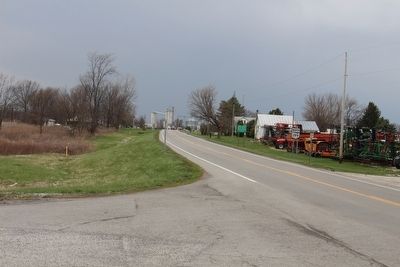
Photographed by Dale K. Benington, April 6, 2016
2. to Crawford's Burning / to Battle Island Marker
View, looking north along State Route 199, of the probable site of the missing marker, on the grassy corner of this intersection
The routes of these military trails were in turn marked by type A and type B Ohio Revolutionary Memorial Commission markers that served as directional (type B) and distance (type A) markers. This particular marker is one of the type A markers of the Ohio Revolutionary Memorial Trail series.
Originally, back in 1930, according to the ORMC 1931 Planning Report, there were erected 168 some of these Ohio Revolutionary Memorial Commission, type A, markers (see page 54). To date, I know of only 3 of these type A markers that have been located and posted on the Historical Marker database (markers A95, A96, and A1340). A large number of them are presently missing, including this particular marker.
Also see . . . Ohio Revolutionary Memorial Trail System. A description of the Revolutionary Memorial Trail System developed by the state of Ohio in 1929 - 1930. (Submitted on April 8, 2016, by Dale K. Benington of Toledo, Ohio.)
Additional commentary.
1.
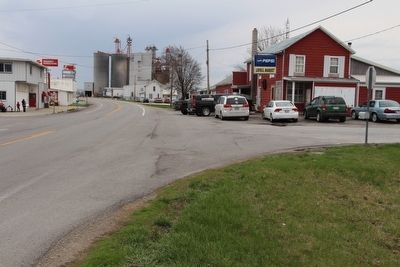
Photographed by Dale K. Benington, April 6, 2016
3. to Crawford's Burning / to Battle Island Marker
View, looking south along State Route 199, of the probable site of the missing marker, on the grassy corner of this intersection
This particular Ohio Revolutionary Memorial Commission (ORMC), Type A marker, once helped to mark the military marches of General Harrison during the War of 1812. According to the ORMC 1931 Planning Report (see page 58), it was used on the portion of the Ohio Revolutionary Memorial Trail System that connected Upper Sandusky to Findlay. According to the Ohio Revolutionary Memorial Trails cartographic map, that was issued by the ORMC in 1930, this marker was situated along the roadway that in 1930 was US 23, but today, it is State Route 199.
Along some portions of the Ohio Revolutionary Memorial Trail System, it is difficult to identify the probable location of these markers because the roadways of 1930 are so much different from the present day roadways. Many of the original roadways have been re-routed or by-passed, or in some cases given new route number designations. However, for this particular marker, the Ohio Revolutionary Memorial Trail System follows a section of roadway that is in much the same condition as it would have been back in 1930. Unfortunately, however, there is no physical
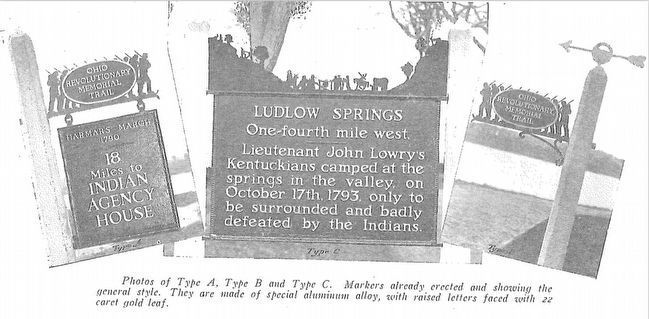
Photographed by Ohio Revolutionary Memorial Commission
4. Ohio Revolutionary Memorial Commission Marker Types
View of the three types of markers used by the Ohio Revolutionary Memorial Commission. The marker on the left is a type A marker (just like our missing marker), the marker in the middle is a type C, and the marker on the right is a type B.
— Submitted April 8, 2016, by Dale K. Benington of Toledo, Ohio.
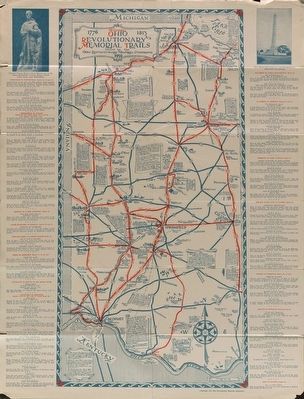
Image courtesy of the MidPointe Library System (www.MidPointeLibrary.org)
5. Ohio Revolutionary Memorial Trail Map
A view of an original Ohio Revolutionary Memorial Trail Map, from 1930. For a better view double click on this picture.
Credits. This page was last revised on July 25, 2022. It was originally submitted on April 8, 2016, by Dale K. Benington of Toledo, Ohio. This page has been viewed 938 times since then and 35 times this year. Photos: 1, 2, 3, 4, 5. submitted on April 8, 2016, by Dale K. Benington of Toledo, Ohio.
