Fort Story in Virginia Beach, Virginia — The American South (Mid-Atlantic)
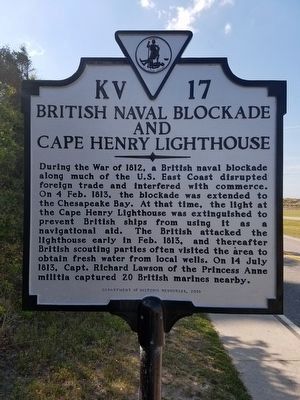
British Naval Blockade and Cape Henry Lighthouse
⎯⎯⎯
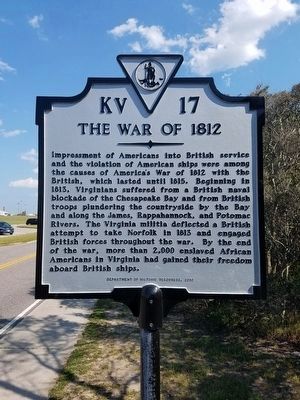
The War of 1812
Photographed by Kevin W., April 26, 2016
1. British Naval Blockade and Cape Henry Lighthouse Marker
British Naval Blockade and Cape Henry Lighthouse. During the War of 1812, a British naval blockade along much of the U.S. East Coast disrupted foreign trade and interfered with commerce. On 4 Feb. 1813, the blockade was extended to the Chesapeake Bay. At that time, the light at the Cape Henry Lighthouse was extinguished to prevent British ships from using it as a navigational aid. The British attacked the lighthouse early in Feb. 1813, and thereafter British scouting parties often visited the area to obtain fresh water from local wells. On 14 July 1813, Capt. Richard Lawson of the Princess Anne militia captured 20 British marines nearby.
The War of 1812. Impressment of Americans into British service and the violation of American ships were among the causes of America’s War of 1812 with the British, which lasted until 1815. Beginning in 1813, Virginians suffered from a British naval blockade of the Chesapeake Bay and from British troops’ plundering the countryside by the Bay and along the James, Rappahannock, and Potomac rivers. The Virginia militia deflected a British attempt to take Norfolk in 1813, and engaged British
this page online
Erected 2015 by Department of Historic Resources. (Marker Number KV-17.)
Topics and series. This historical marker is listed in these topic lists: War of 1812 • Waterways & Vessels. In addition, it is included in the Lighthouses, and the Virginia Department of Historic Resources (DHR) series lists. A significant historical year for this entry is 1813.
Location. 36° 55.545′ N, 76° 0.447′ W. Marker is in Virginia Beach, Virginia. It is in Fort Story. It is on Atlantic Avenue just east of Cape Henry Road, on the right when traveling east. Touch for map. Marker is in this post office area: Virginia Beach VA 23459, United States of America. Touch for directions.

Regionally, this marker is in Hampton Roads, specifically in Coastal Virginia, and in the Hampton Roads Metropolitan Area. It is also in the American South, specifically in the Upper South, in the Tidewater, and on the Eastern Seaboard. Globally, it is in the North Atlantic Region, North America, the Western Hemisphere,
Photographed by Kevin W., April 26, 2016
2. The War of 1812 Marker
Other nearby markers. At least 8 other markers are within walking distance of this marker: Old Cape Henry Lighthouse (within shouting distance of this marker); a different marker also named Old Cape Henry Lighthouse (within shouting distance of this marker); Aids to Navigation (within shouting distance of this marker); Through the Years (within shouting distance of this marker); The Cottages of Cape Henry at Fort Story (within shouting distance of this marker); First Public Works Project of the United States Government (within shouting distance of this marker); Expanding Military Operations at Fort Story (within shouting distance of this marker); Cape Henry 1881: Retirement and Replacement (within shouting distance of this marker). Touch for a list and map of all markers in Virginia Beach.
Also see . . .
1. O! Say Can You See? . . . The War of 1812 in the Chesapeake. National Park
Photographed by Kevin W., April 26, 2016
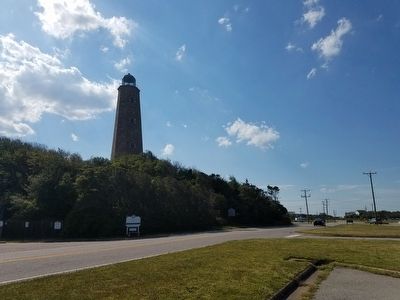
3. British Naval Blockade and Cape Henry Lighthouse / The War of 1812 Marker
2. Star-Spangled Banner Byway, Maryland Scenic Byways. Maryland Tourism Website entry (Submitted on August 19, 2019.)
Photographed by Larry Gertner, May 25, 2021
4. Cape Henry Lighthouse
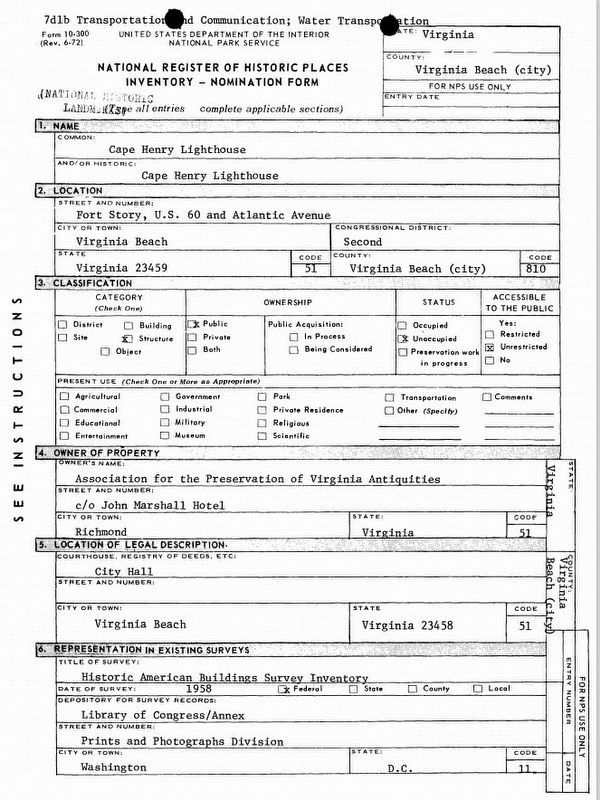
NPS National Register of Historic Places registration form
Click for more information.
Click for more information.
Credits. This page was last revised on February 1, 2023. It was originally submitted on April 28, 2016, by Kevin W. of Stafford, Virginia. This page has been viewed 1,349 times since then and 66 times this year. Photos: 1, 2, 3. submitted on April 28, 2016, by Kevin W. of Stafford, Virginia. 4. submitted on May 25, 2021, by Larry Gertner of New York, New York.
