Florence Spearing Randolph
Women’s Heritage Trail
| — | Wallace Chapel AME Zion Church | — |
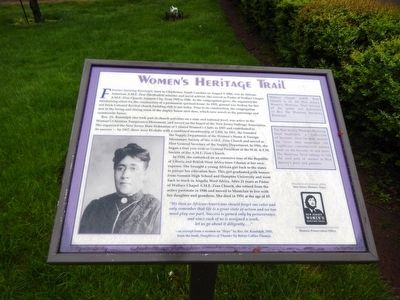
Rev. Dr. Randolph also took part in church activities on a state and national level, was active in the Woman’s Christian Temperance Movement, and served on the board of the New Jersey Suffrage Association. She organized the New Jersey State Federation of Colored Women’s Clubs in 1915 and contributed to its success---by 1917, there were 85 clubs with a combined membership of 2,616. In 1911, she founded the Supply Department of the Women’s Home & Foreign Missionary Society of the Supply Department. In 1916, she
this page online
In 1920, she embarked on an extensive tour of the Republic of Liberia and British West Africa (now Ghana) at her own expense. She brought a young African girl back to the states to pursue her education here. This girl graduated with honors from Summit High School and Hampton University and went back to teach in Angola, West Africa. After 21 years as Pastor of Wallace Chapel A.M.E. Zion Church, she retired from the active pastorate in 1946 and moved to Montclair to live with her daughter and grandson. She died in 1951 at the age of 85.
“We then as African-Americans should forget our color and only remember that life is a great state of action and we too must play our part. Success is gained only by perseverance, and since each of us is assigned a work, let us go about it diligently…” –an excerpt from a sermon on “Hope”
by Rev. Dr. Randolph, 1945, from the book, Daughters of Thunder by Bettye Collier-Thomas.
(Inscription in the boxes on the right) (Top box)
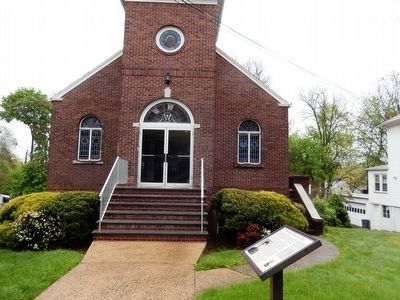
Wallace Chapel A.M. E. Zion Church is on the
(Bottom box)
The New Jersey Women’s Heritage Trail highlights a collection of historic sites located around the state that represent the significant contributions women made to the history of our state. The Heritage Trail brings to life the vital role of women in New Jersey’s past and present.
Erected by New Jersey Historic Trust-Historic Preservation Office.
Topics and series. This historical marker is listed in these topic lists: African Americans • Religion & Religious Structures • Women. In addition, it is included in the African Methodist Episcopal Zion (AME Zion) Church, and the New Jersey Women’s Heritage Trail series lists. A significant historical date for this entry is August 9, 1866.
Location. 40° 42.831′ N, 74° 20.609′ W. Marker is in Summit, New Jersey, in Union County. It is at the intersection of Broad Street and Orchard Street on Broad Street. The marker is on the right side of the path to the front entrance to the church. Touch for map. Marker is in this post office area: Summit NJ 07901, United States

Regionally, this marker is in North Jersey, in Greater Newark, and in the New York City Metropolitan Area. It is also in the American Northeast, in the Mid-Atlantic, and on the Eastern Seaboard. Globally, it is in the North Atlantic Region, North America, the Western Hemisphere, the Western World, and the Anglosphere. Historically, it finds itself in what was once New Netherland and also one of the original Thirteen Colonies.
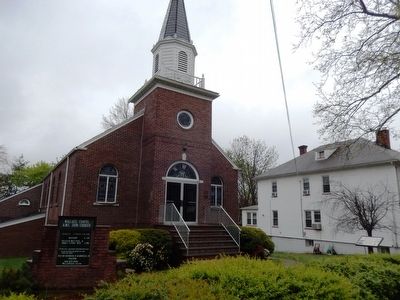
Other nearby markers. At least 8 other markers are within 2 miles of this marker, measured as the crow flies: Wallace Chapel A.M.E. Zion Church (here, next to this marker); Rahway Valley Railroad (approx. 0.4 miles away); Briant Pond Park (approx. 0.4 miles away); Summit Downtown Historic District (approx. ¾ mile away); Signal Beacon and the “Old Sow” (approx. 0.9 miles away); Summit Opera House (approx. one mile away); Marjorie Cranstoun Jefferson (approx. 1.1 miles away); Summit Playhouse (approx. 1.1 miles away). Touch for a list and map of all markers in Summit.
Credits. This page was last revised on June 16, 2016. It was originally submitted on May 7, 2016, by Don Morfe of Baltimore, Maryland. This page has been viewed 953 times since then and 47 times this year. Photos: 1, 2, 3. submitted on May 7, 2016, by Don Morfe of Baltimore, Maryland. • Bill Pfingsten was the editor who published this page.
