Death Valley National Park in Inyo County, California — The American West (Pacific Coastal)
Old Stovepipe Wells
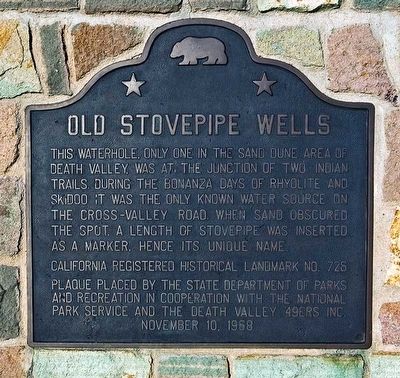
Photographed by Alvis Hendley, February 19, 2007
1. Old Stovepipe Wells Marker
Erected 1968 by California Department of Parks and Recreation; National Park Service; and Death Valley 49ers Inc. (Marker Number 826.)
Topics and series. This historical marker is listed in these topic lists: Exploration • Indigenous Peoples and Communities • Settlements & Settlers. In addition, it is included in the California Historical Landmarks series list.
Location. 36° 39.544′ N, 117° 4.749′ W. Marker is in Death Valley National Park, California, in Inyo County. It is on Stovepipe Wells Road 0.8 miles west of Scotty's Castle Road, on the right when traveling west. Touch for map. Marker is in this post office area: Death Valley CA 92328, United States of America. Touch for directions.

Regionally, this marker is in California’s Sierra
this page online
Other nearby markers. At least 8 other markers are within 8 miles of this marker, measured as the crow flies: Transportation Traces (approx. ¾ mile away); Devil’s Cornfield (approx. 3 miles away); McLean Spring (approx. 5 miles away); Death Valley’s First Tourist Resort (approx. 5.1 miles away); Burned Wagons Point (approx. 5.2 miles away); Road To Adventure (approx. 5.2 miles away); Eichbaum Toll Road (approx. 5.3 miles away); Death Valley National Park (approx. 7.2 miles away). Touch for a list and map of all markers in Death Valley National Park.
Another marker is no longer nearby. Wagon Wheel History (was approx. ¾ mile away).
More about this marker. Old Stovepipe Wells is California Historical Landmark 826, not 726. The marker has a typo. Landmark 726 is the Sebastian Store in San Luis Obispo County.
Regarding Old Stovepipe Wells. These
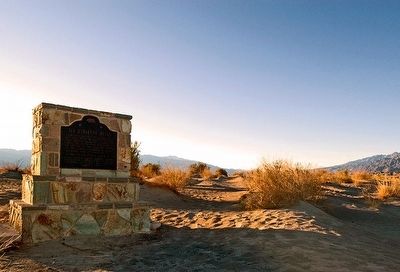
Photographed by Alvis Hendley, February 19, 2007
2. Old Stovepipe Wells Marker
Related marker. Click here for another marker that is related to this marker. — Wagon tracks of the cross-valley road near Stovepipe Wells.
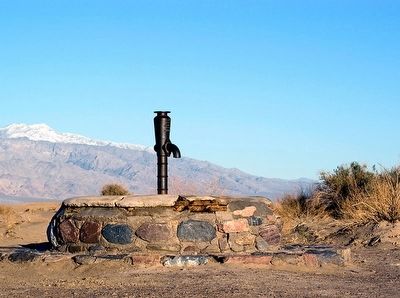
Photographed by Alvis Hendley, February 19, 2007
3. Old Stovepipe Well
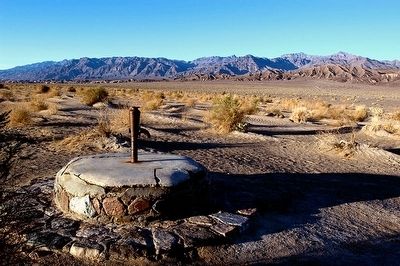
Photographed by Alvis Hendley, March 12, 2014
4. Old Stovepipe Well
Credits. This page was last revised on August 7, 2024. It was originally submitted on May 12, 2016, by Alvis Hendley of San Francisco, California. This page has been viewed 1,066 times since then and 51 times this year. Photos: 1, 2, 3, 4. submitted on May 12, 2016, by Alvis Hendley of San Francisco, California. • Syd Whittle was the editor who published this page.
