Radford, Virginia — The American South (Mid-Atlantic)
New River Bridge
Attack on the Virginia & Tennessee Railroad
Photographed by Linda Walcroft, July 16, 2008
1. New River Bridge Marker
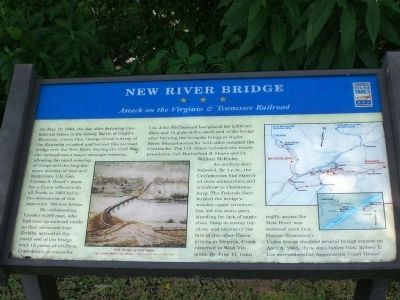
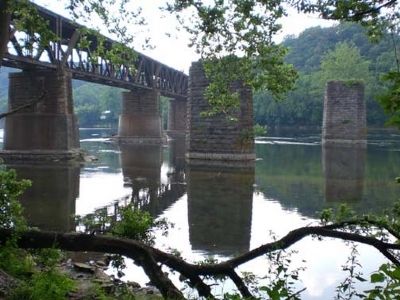
On May 10, 1864, the day after defeating Confederate forces in the bloody battle of Cloyd's Mountain, Union Gen. George Crook's Army of the Kanawha attacked and burned this railroad bridge over the New River. During the Civil War, the railroad was a major strategic resource, allowing the rapid massing of troops and the long-distance delivery of food and munitions. U.S. Gen. Ulysses S. Grant's plans for a Union offensive on all fronts in 1864 led to the destruction of this important 780-foot bridge.
By mid-morning, Crook's 6,000 men, who had torn up railroad tracks as they advanced from Dublin, arrived at the north end of the bridge with 12 pieces of artillery. Confederate commander Col. John McCausland had placed his 2,000 soldiers and 14 guns at the south end of the bridge after burning the turnpike bridge at Ingles Ferry. Sharpshooters for both sides occupied the riverbanks. The U.S. forces included two future presidents: Col. Rutherford B. Hayes and Lt. William McKinley.
An artillery duel followed. By 1 p.m., the Confederates had expended their ammunition and withdrew to Christiansburg. The Federals then burned the bridge's
this page online
[Caption:]
R.R. Bridge at New River, by Louis Miller ca. 1853 - Virginia Historical Society
Erected by Virginia Civil War Trails.
Topics and series. This historical marker is listed in these topic lists: Bridges & Viaducts • Railroads & Streetcars • War, US Civil. In addition, it is included in the Former U.S. Presidents: #25 William McKinley, and the Virginia Civil War Trails series lists. A significant historical date for this entry is April 6, 1865.
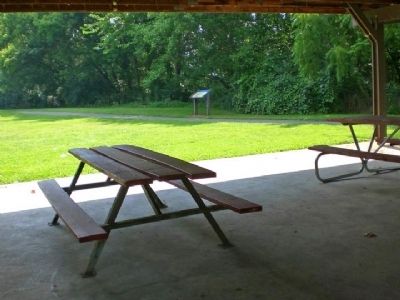
Location. This marker has been replaced by another marker nearby. It was located near 37° 8.057′ N, 80° 34.827′ W. Marker was in Radford, Virginia. It could be reached from Berkley Williams Drive 0.7 miles Charlie Coles Drive. Marker is on pathway that runs
Photographed by Linda Walcroft, July 16, 2008
2. Marker Seen through Picnic Shelter

Regionally, this marker was in Southwest Virginia and in the Blue Ridge Highlands. It was also in the American South, specifically in the Upper South, in Appalachia, and specifically in Southern Appalachia. Globally, it was in North America, the Western Hemisphere, the Western World, and the Anglosphere. Historically, it found itself in what was once the territory of the Mississippian Culture, one of the original Thirteen Colonies, one of the Confederate States of America, and the Antebellum South.
Other nearby markers. At least 8 other markers are within walking distance of this location: A different marker also named New River Bridge (here, next to this marker); The City by the River (about 400 feet away, measured in a direct line); Northern Catalpa (about 500 feet away);
Photographed by Linda Walcroft, July 16, 2008
3. The New River Railroad Bridge, 2008
More about this marker. Illustration on the marker is a drawing of the R.R. Bridge at New River by Louis Miller ca. 1853 (Va. Historical Society). On the right side of the marker is a map of the area detailing the unit movements described in the text.
Regarding New River Bridge. Radford was known as Central Depot.
Also see . . . Geology and the Civil War: Union Raiders in the New River Valley. Student of the American Civil War website entry (Submitted on July 25, 2008, by Linda Walcroft of Woodstock, Virginia.)
Photographed by Kevin W., February 14, 2021
4. Stone from Bridge Abutment
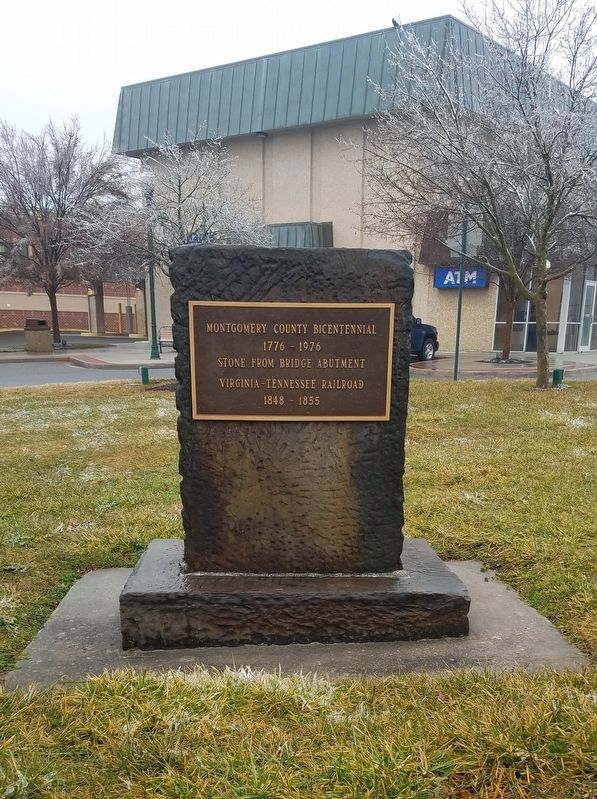
In downtown Christiansburg, across from the Post Office, this stone from the Virginia Tennessee Railroad celebrates the U.S. Bicentennial.
Credits. This page was last revised on July 6, 2026. It was originally submitted on July 24, 2008, by Linda Walcroft of Woodstock, Virginia. This page has been viewed 6,651 times since then and 118 times this year. Photos: 1, 2, 3. submitted on July 25, 2008, by Linda Walcroft of Woodstock, Virginia. 4. submitted on May 29, 2021, by Kevin W. of Stafford, Virginia. • Craig Swain was the editor who published this page.
