Shasta in Shasta County, California — The American West (Pacific Coastal)
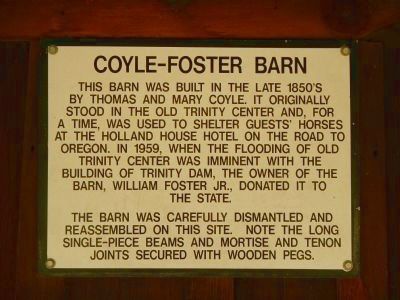
Coyle-Foster Barn
Photographed by Barry Swackhamer, October 25, 2013
1. Coyle-Foster Barn Marker
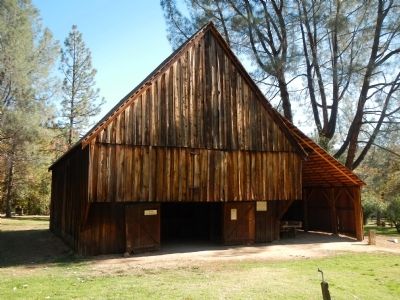
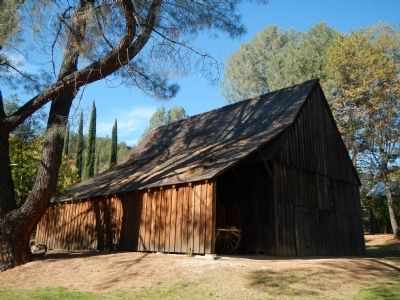
The barn was carefully dismantled and reassembled on this site. Note the long single-piece beams and mortise and tenon joints secured with wooden pegs.
Erected by Shasta State Historic Park.
Topics. This historical marker is listed in this topic list: Agriculture. A significant historical year for this entry is 1859.
Location. 40° 35.967′ N, 122° 29.454′ W. Marker is in Shasta, California, in Shasta County. It can be reached from Mackley Alley, on the left when traveling north. Touch for map. Marker is in this post office area: Shasta CA 96087, United States of America. Touch for directions.

Regionally, this marker is in California’s Sacramento Valley, specifically in the Central Valley, and in the Shasta Cascade. It is also on the American
this page online
Other nearby markers. At least 8 other markers are within walking distance of this marker: The Coyle-Foster Barn in its Heyday (a few steps from this marker); Gallows (within shouting distance of this marker); “Stage Drivers’ Plaque” (about 300 feet away, measured in a direct line); Western Star Lodge No. 2 (about 300 feet away); a different marker also named Western Star Lodge No. 2 (about 400 feet away); Noble’s Trail (about 400 feet away); Shasta County Court House (about 400 feet away); Survivors of the Gold Rush (about 400 feet away). Touch for a list and map of all markers in Shasta.
More about this marker. The Coyle-Foster Barn is located at Shasta State Historic Park in the area behind the Visitors Center.
Additional keywords. barns
Photographed by Barry Swackhamer, October 25, 2013
2. Coyle-Foster Barn Marker
Photographed by Barry Swackhamer, October 25, 2013
3. Coyle-Foster Barn
Photographed by Barry Swackhamer, October 25, 2013
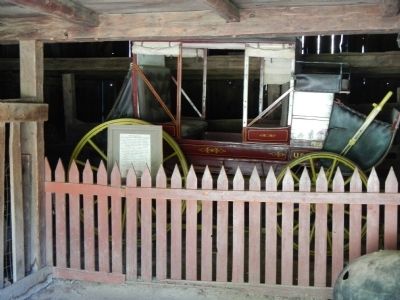
4. Coyle-Foster Barn exhibit
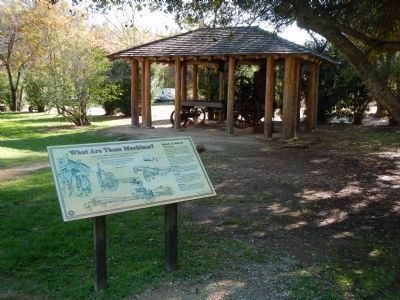
Photographed by Barry Swackhamer, October 25, 2013
5. Farm equipment exhibit
Back in the 1880s, necessity was indeed the mother of invention, and of startling innovation. Match each of these tools to their description. It took remarkable ingenuity and craftsmanship to create these useful contraptions with the resources at hand!
Which is Which?
Arrastra Stones These stones were used in a simple grinding mechanism powered by a mule. The large stones were dragged over smaller ones in a circular motion, while quartz rock was added. The quartz was pulverized into a powder, which enabled miners to extract the gold from it.
Core Drill Steam-powered core drills allowed hard-rock miners to pull samples of rock from below the earth’s surface. Rocks were examined for traces of quartz, gold or other minerals. The steam engines from these drills were modified for other uses after the gold rush.
Feed Wagon This wagon once had tall slatted sides and was filled with hay to feed animals. With the sides removed, the wagon could be used to haul supplies and equipment on the farm.
Hay Baler To use this portable hay baler, the wheels were first removed and draft animals hitched to the extended arm in the center. The animals powered the device by walking in a circle. Hay was fed into it, compacted and ready to be hand-tied with wire.
Hay Press This press would shape bulky hay into three hundred pound blocks that could be stored easily. Hay was fed into it, then compacted and baled, ready to be hand-tied with wire.
1-Hay Press, 2-Core Drill, 3-Hay Baler, 4-Feed Wagon, 5-Arrastra Stones
Click on image to enlarge
Credits. This page was last revised on August 17, 2016. It was originally submitted on December 4, 2013, by Barry Swackhamer of Brentwood, California. This page has been viewed 904 times since then and 30 times this year. Last updated on August 16, 2016, by Alvis Hendley of San Francisco, California. Photos: 1, 2, 3, 4, 5. submitted on December 4, 2013, by Barry Swackhamer of Brentwood, California. • Syd Whittle was the editor who published this page.
