Mosby in Garfield County, Montana — The American West (Mountains)
Kerchival City
Photographed by Dawn Bowen, July 23, 2008
1. Kerchival City Marker
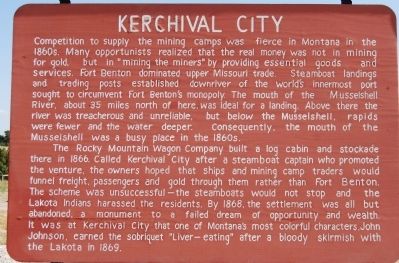
Competition to supply the mining camps was fierce in Montana in the 1860s. Many opportunists realized that the real money was not in mining for gold, but in “mining the miners” by providing essential goods and services. Fort Benton dominated upper Missouri trade. Steamboat landings and trading posts established downriver of the world’s innermost port sought to circumvent Fort Benton’s monopoly. The mouth of the Musselshell River, about 35 miles north of here, was ideal for a landing. Above there the river was treacherous and unreliable, but below the Musselshell, rapids were fewer and the water deeper. Consequently, the mouth of the Musselshell was a busy place in the 1860s.
The Rocky Mountain Wagon Company built a log cabin and stockade there in 1866. Called Kerchival City after a steamboat captain who promoted the venture, the owners hoped that ships and mining camp traders would funnel freight, passengers and gold through them rather than Fort Benton. The scheme was unsuccessful – the steamboats would not stop and the Lakota Indians harassed the residents. By 1868, the settlement was all but abandoned, a monument
this page online
Topics. This historical marker is listed in these topic lists: Indigenous Peoples and Communities • Industry & Commerce • Settlements & Settlers. A significant historical year for this entry is 1866.
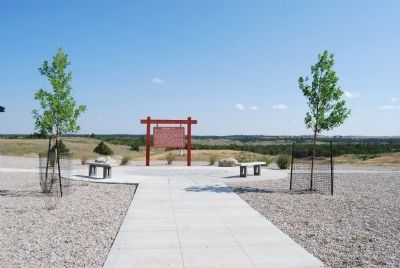
Location. 46° 59.394′ N, 107° 51.576′ W. Marker is in Mosby, Montana, in Garfield County. It is on State Highway 200 1.4 miles east of Garfield/Petroleum County line. At the Mosby Rest Area. Touch for map. Marker is in this post office area: Mosby MT 59058, United States of America. Touch for directions.

Regionally, this marker is in the American Mountain West, in the Lewis & Clark Corridor, on the prairies, on the Great Plains, and specifically on the Northern Plains. Globally, it is in North America, the Western Hemisphere, the Western World, and the Anglosphere. Historically, it finds itself in what was once Rupert’s Land and also the Louisiana Purchase.
Other nearby markers. At least 2 other markers
Photographed by Dawn Bowen, July 23, 2008
2. Kerchival City Marker
Credits. This page was last revised on December 27, 2024. It was originally submitted on July 29, 2008, by Dawn Bowen of Fredericksburg, Virginia. This page has been viewed 3,009 times since then and 158 times this year. Photos: 1, 2. submitted on July 29, 2008, by Dawn Bowen of Fredericksburg, Virginia. • Kevin W. was the editor who published this page.
