Augusta in Richmond County, Georgia — The American South (South Atlantic)
Fort Augusta ~ Fort Cornwallis
⎯⎯⎯
St. Paul's Episcopal Church
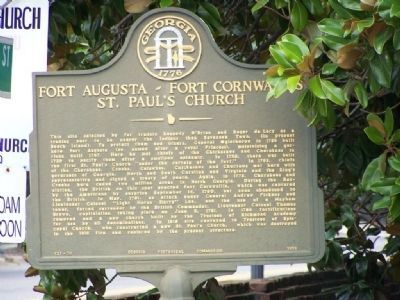
Photographed by Mike Stroud, July 2008
1. Fort Augusta ~ Fort Cornwallis / St. Paul's Episcopal Church Marker
this page online
Erected 1956 by Georgia Historical Commission. (Marker Number 121-30.)
Topics and series. This historical marker is listed in these topic lists: Colonial Era • Industry & Commerce • Notable Places • Religion & Religious Structures • Settlements & Settlers • War, US Revolutionary. In addition, it is included in the Georgia Historical Society series list. A significant historical month for this entry is May 1781.
Location. 33° 28.531′ N, 81° 57.658′ W. Marker is in Augusta, Georgia, in Richmond County. It is at the intersection of Washington St. (6th St,) and Reynolds Street, on the left when traveling north on Washington St. (6th St,). Touch for map. Marker is in this post office area: Augusta GA 30901, United States of America. Touch for directions.

Regionally, this marker is in the American South and specifically in the Deep South. Globally, it is in North America, the Western Hemisphere, the Western World, and the Anglosphere. Historically,
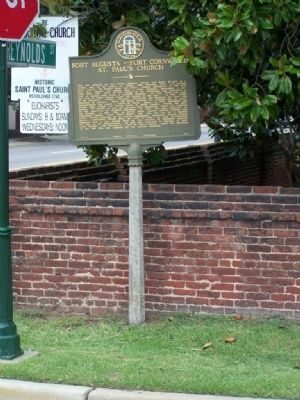
Photographed by Mike Stroud, 2008
2. Fort Augusta ~ Fort Cornwallis / St. Paul's Episcopal Church Marker
Other nearby markers. At least 8 other markers are within walking distance of this marker: Kiwanis Club of Augusta Centennial (within shouting distance of this marker); U.S. Marshal Robert Forsyth (within shouting distance of this marker); Washington's Southern Tour (within shouting distance of this marker); Colonel William Few, Jr. (within shouting distance of this marker); Major Ferdinand Phinizy (about 300 feet away, measured in a direct line); Five Indian Nations (about 300 feet away); Fort Augusta (about 400 feet away); The Colonial Church of Augusta (about 400 feet away). Touch for a list and map of all markers in Augusta.
Also see . . . Fort Augusta & Fort Cornwallis. The site is marked by a monument in the form of a Celtic cross on the grounds of St. Paul's Church. The churchyard also was the site of Fort Cornwallis, an important British post of the American Revolution. (Submitted on January 21, 2013, by Mike Stroud of Bluffton, South Carolina.)
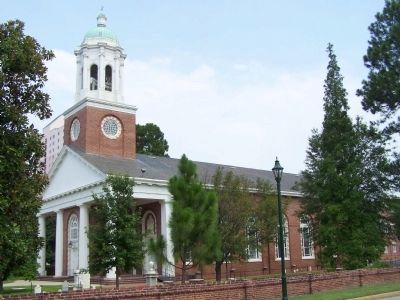
Photographed by Mike Stroud, 2008
3. St. Paul's Episcopal Church
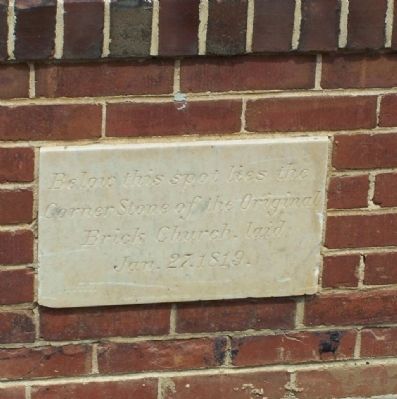
Photographed by Mike Stroud, 2008
4. St. Paul's Episcopal Church
Below this spot lies the Corner Stone of the Original Brick Church, laid Jan.27. 1819
Photographed by Mike Stroud, January 31, 2010
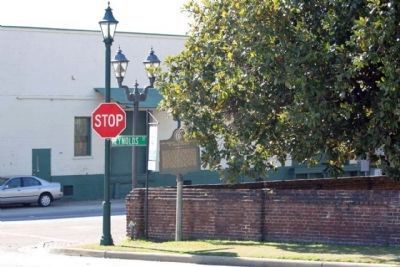
5. Fort Augusta ~ Fort Cornwallis / St. Paul's Episcopal Church Marker
At the intersection of 6th and Reynolds Streets
Credits. This page was last revised on June 16, 2016. It was originally submitted on July 30, 2008, by Mike Stroud of Bluffton, South Carolina. This page has been viewed 4,392 times since then and 58 times this year. Photos: 1, 2, 3, 4. submitted on July 30, 2008, by Mike Stroud of Bluffton, South Carolina. 5. submitted on February 25, 2010, by Mike Stroud of Bluffton, South Carolina. • Kevin W. was the editor who published this page.
