Near Sundance in Crook County, Wyoming — The American West (Mountains)
Custer Expedition
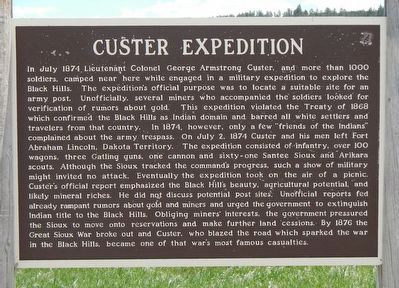
Photographed by Barry Swackhamer, June 6, 2016
1. Custer Expedition Marker
this page online
Erected by Wyoming State Historic Preservation Office.
Topics. This historical marker is listed in these topic lists: Exploration • Wars, US Indian. A significant historical month for this entry is July 1874.
Location. Marker has been reported missing. It was located near 44° 13.08′ N, 104° 16.254′ W. Marker was near Sundance, Wyoming, in Crook County. It was on State Highway 585 near Cold Springs Road, on the left when traveling south. Touch for map. Marker was at or near this postal address: 1258 Wyoming HIghway 585, Sundance WY 82729, United States of America. Touch for directions.

Regionally, this marker was in the Powder River Basin. It was also in the American Mountain
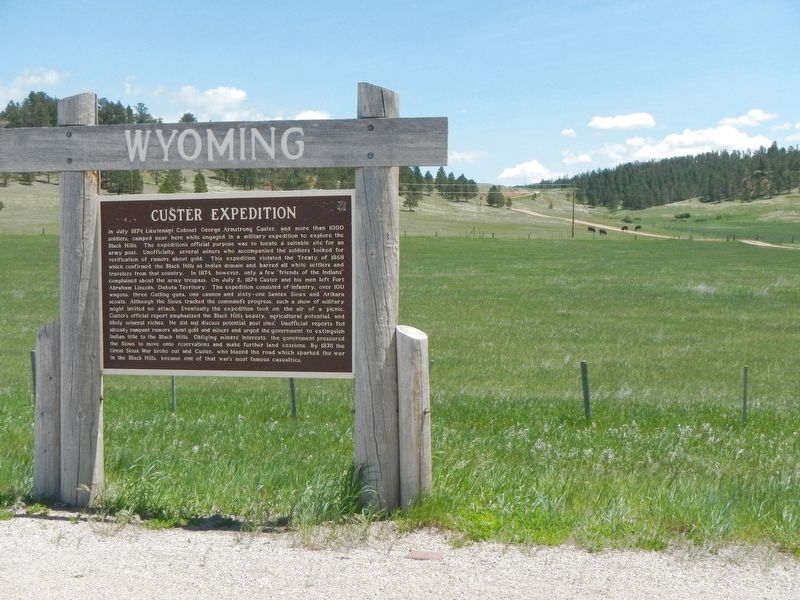
Photographed by Barry Swackhamer, June 6, 2016
2. Custer Expedition Marker
Other nearby markers. At least 7 other markers are within 14 miles of this location, measured as the crow flies: Inyan Kara Methodist Episcopal Church (approx. 4.3 miles away); Canyon Springs Station: (approx. 11.7 miles away); Sundance Nature Area (approx. 13.9 miles away); Crook County (approx. 13.9 miles away); Black Hills (approx. 13.9 miles away); a different marker also named Custer Expedition (approx. 13.9 miles away); The "Sundance Kid" (approx. 14 miles away). Touch for a list and map of all markers in Sundance.
Another marker is no longer nearby. Canyon Springs Stage Station (was approx. 11.8 miles away but has been permanently removed).
Also see . . . Black Hills Expedition - Wikipedia. Custer embarked on his expedition with 1000-1200 men, in 110 wagons with numerous horses and cattle of the 7th Cavalry, along with artillery and two months food supply.The expedition also took a number of Native American scouts led by Bloody Knife and Lean Bear. At the time, the Black Hills were relatively unknown, with few white expeditions ever returning from them.
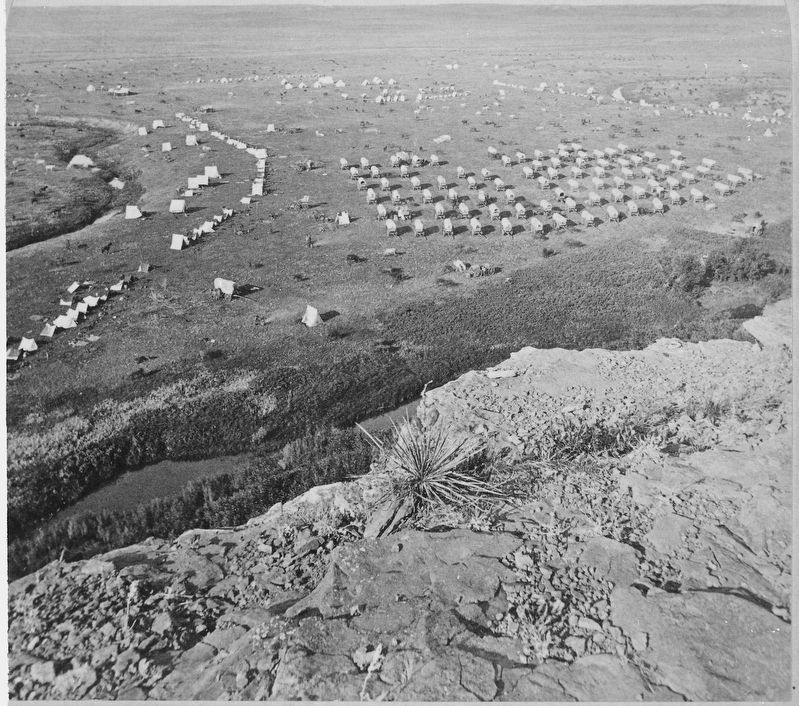
Photographed by William H. Illingworth, July, 1874
3. Custer Expedition, the camp at Hidden Wood Creek
Photographed by Jimmy Emerson, Sept 2022
4. Custer Expedition Marker
Credits. This page was last revised on October 15, 2025. It was originally submitted on September 24, 2016, by Barry Swackhamer of Brentwood, California. This page has been viewed 1,550 times since then and 76 times this year. Photos: 1, 2, 3. submitted on September 24, 2016, by Barry Swackhamer of Brentwood, California. 4. submitted on October 12, 2025, by Jimmy Emerson of Dalton, Georgia.
