
Santiago de Querétaro in Querétaro, Mexico — The Central Highlands (North America)
Temple of San Felipe Neri
Cathedral of Queretaro
Photographed by J. Makali Bruton, July 26, 2018
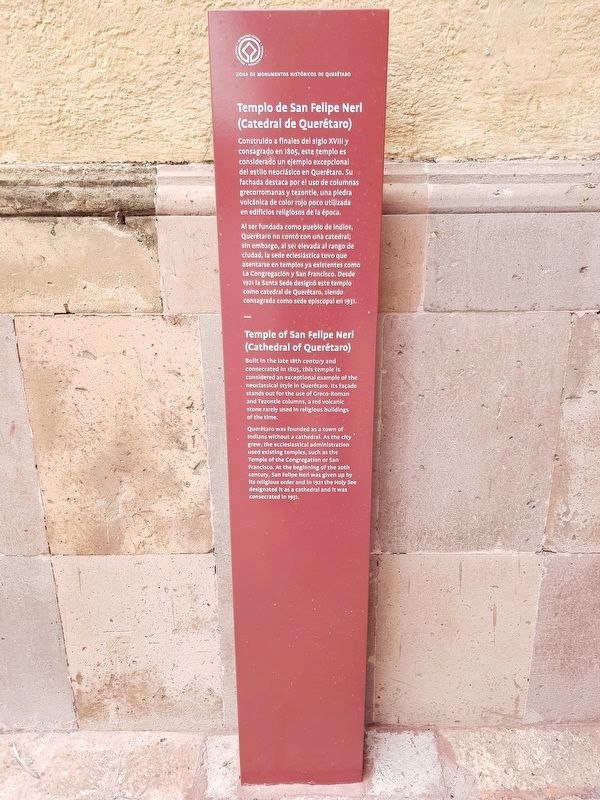
1. Temple of San Felipe Neri Marker
This marker replaced an earlier marker in 2018.

Templo de San Felipe Neri
(Catedral de Querétaro)
Construido a finales del siglo XVIII y consagrado en 1805, este templo es considerado un ejemplo excepcional del estilo neoclásico en Querétaro. Su fachada destaca por el uso de columnas grecorromanas y tezontle, una piedra volcánica de color rojo poco utilizada en edificios religiosos de la época.
Al ser fundada como pueblo de indios, Querétaro no contó con una catedral; sin embargo, al ser elevada al rango de ciudad, la sede eclesiástica tuvo que asentarse en templos ya existentes como La Congregación y San Francisco. Desde 1921 la Santa Sede designó este templo como catedral de Querétaro, siendo consagrada como sede episcopal en 1931.
Temple of San Felipe Neri
(Cathedral of Querétaro)
Built in the late 18th century and consectrated in 1805, this temple is considered an exceptional example of the neoclassical style in Querétaro. Its façade stands out for the use of Greco-Roman and Tezontle columns, a red volcanic stone rarely used in religious buildings of the time.
Querétaro was founded as a town of Indians without a cathedral. As the city grew, the ecclesiastical administration used existing temples, such as the Temple of the Congregation or San Francisco. At the beginning of the 20th century, San Felipe Neri was given up by its religious order and in 1921 the Holy See designated it as a cathedral and it was consecrated in 1931.
Erected 2018
this page online
Topics. This historical marker is listed in these topic lists: Charity & Public Work • Colonial Era • Religion & Religious Structures. A significant historical date for this entry is May 16, 1760.
Location. 20° 35.462′ N, 100° 23.796′ W. Marker is in Santiago de Querétaro, Querétaro. It is on Calle Francisco I. Madero just west of Calle Melchor Ocampo, on the right when traveling west. Touch for map. Marker is in this post office area: Santiago de Querétaro QUE 76000, Mexico. Touch for directions.

Regionally, this marker is in Central Mexico and in the Bajío. Globally, it is in North America, specifically in Mesoamerica, on the Ring of Fire, and in the Western Hemisphere. Historically, it finds itself in what was once New Spain, a Spanish colony, and the Aztec Empire.
Other nearby markers. At least 8 other markers are within walking distance of this marker: Benito Juárez in Querétaro (within shouting distance of this marker); Birthplace of Manuel Montes Collantes (about 90 meters away, measured in a direct line); Temple and former Convent of the Carmelites (about 120 meters away); Fountain of Santo Domingo
Photographed by J. Makali Bruton, October 2, 2016
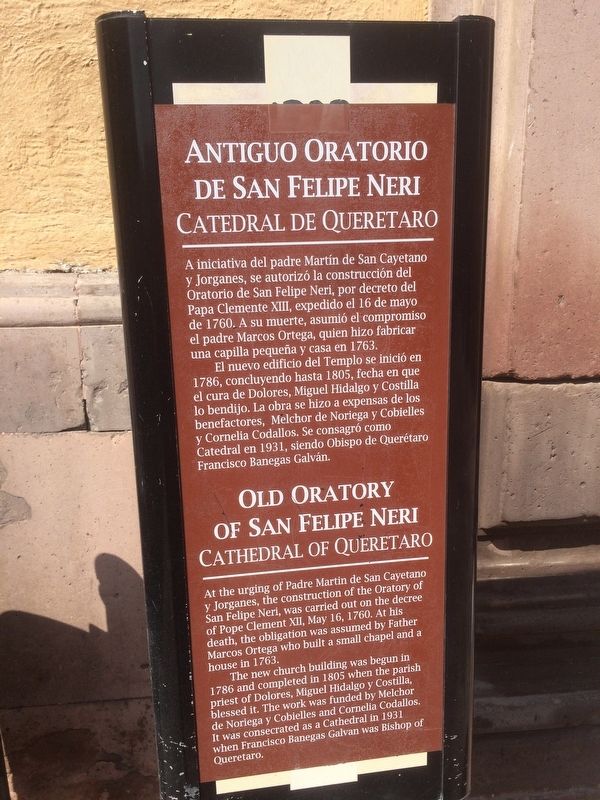
2. The previous Old Oratory of San Felipe Neri Marker
This marker was replaced in 2018. It read:
Antiguo Oratorio de San Felipe Neri
Catedral de Queretaro
El nuevo edificio del Templo se inició en 1786, concluyendo hasta 1805, fecha en que el cura de Dolores, Miguel Hidalgo y Costilla lo bendijo. La obra se hizo a expensas de los benefactores, Melchor de Noriega y Cobielles y Cornelia Codallos. Se consagró como Catedral en 1931, siendo Obispo de Querétaro Francisco Banegas Galván.
English:
Old Oratory of San Felipe Neri
Cathedral of Queretaro At the urging of Padre Martin de San Cayetano y Jorganes, the construction of the Oratory of San Felipe Neri, was carried out on the decree of Pope Clement XIII, May 16, 1760. At his death, the obligation was assumed by Father Marcos Ortega who built a small chapel and a house in 1763.
The new church building was begun in 1786 and completed in 1805 when the parish priest of Dolores, Miguel Hidalgo y Costilla, blessed it. The work was funded by Melchor de Noriega y Cobielles and Cornelia Codallos. It was consecrated as a Cathedral in 1931 when Francisco Banegas Galvan was Bishop of Queretaro.
Catedral de Queretaro
El nuevo edificio del Templo se inició en 1786, concluyendo hasta 1805, fecha en que el cura de Dolores, Miguel Hidalgo y Costilla lo bendijo. La obra se hizo a expensas de los benefactores, Melchor de Noriega y Cobielles y Cornelia Codallos. Se consagró como Catedral en 1931, siendo Obispo de Querétaro Francisco Banegas Galván.
Cathedral of Queretaro
The new church building was begun in 1786 and completed in 1805 when the parish priest of Dolores, Miguel Hidalgo y Costilla, blessed it. The work was funded by Melchor de Noriega y Cobielles and Cornelia Codallos. It was consecrated as a Cathedral in 1931 when Francisco Banegas Galvan was Bishop of Queretaro.
Photographed by J. Makali Bruton, October 2, 2016
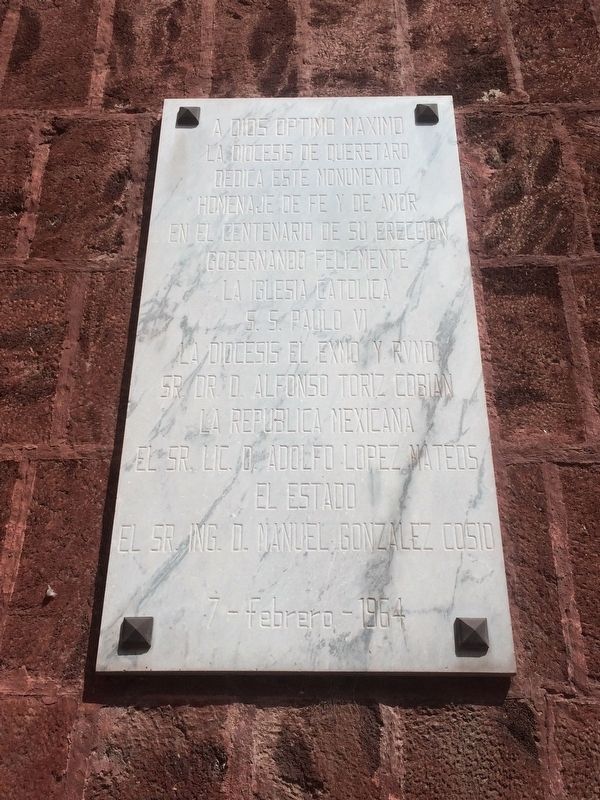
3. Cathedral of Querétaro additional marker from 1964 on the 100th anniversary of its construction
This additional marker located to the left of the entry to the Cathedral reads:
A Dios Optimo Maximo, la Diocesis de Queretaro dedica este monumento homenaje de fe y amor en el centenario de su ereccion gobernando felizmente la iglesia catolica, S.S. Paulo VI, la Diocesis el Exmo. y Rvmo. Sr. Dr. D. Alfonso Toriz Cobian, la Republica Mexicana, el Sr. Lic. D. Adolfo Lopez Mateos, el Estado, el Sr. Ing. D. Manuel Gonzalez Cosio, 7-febrero-1964
Photographed by J. Makali Bruton, July 26, 2018
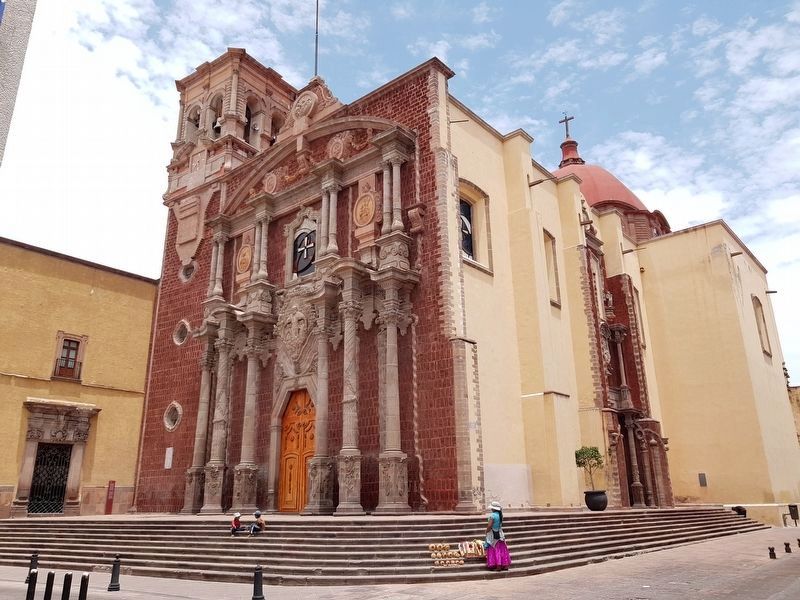
4. Temple of San Felipe Neri and Marker
The marker is now to the right of the entrance of the building to the left of the Cathedral.
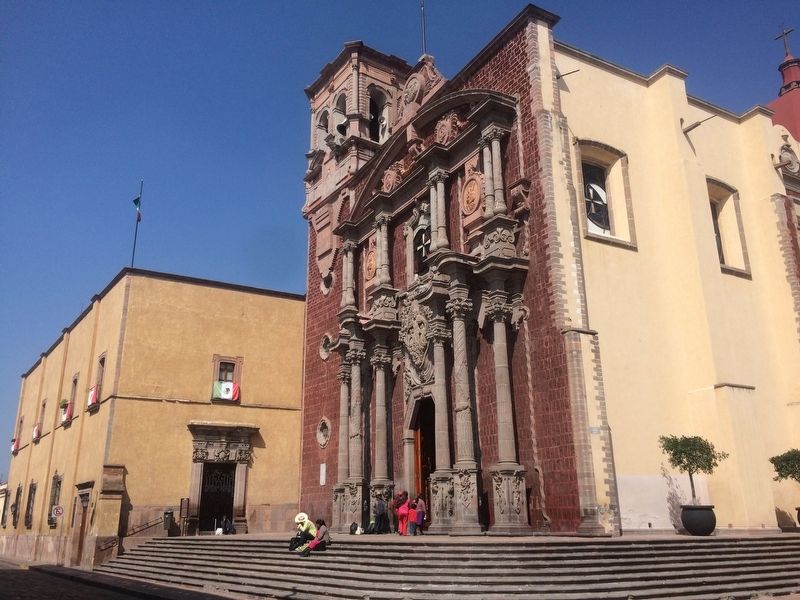
Photographed by J. Makali Bruton, October 2, 2016
5. The previous Old Oratory of San Felipe Neri Marker
The earlier marker was to the left of the doorway of the yellow building to the left of the Cathedral.
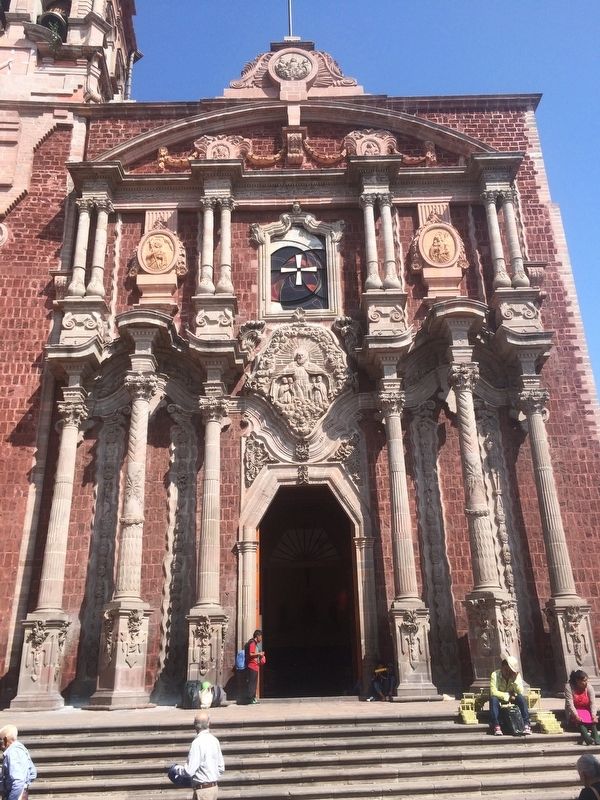
Photographed by J. Makali Bruton, October 2, 2016
6. The Old Oratory of San Felipe Neri, the Cathedral of Querétaro
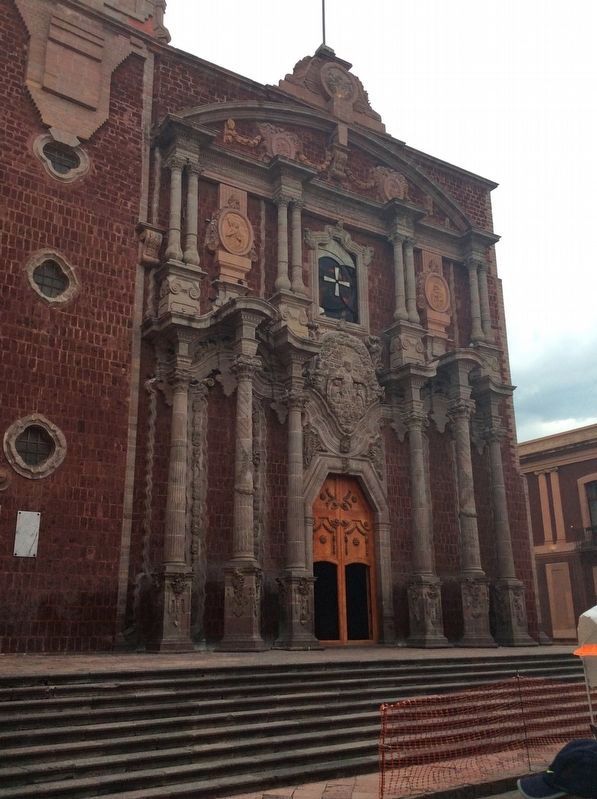
Photographed by J. Makali Bruton, July 12, 2017
7. Old Oratory of San Felipe Neri
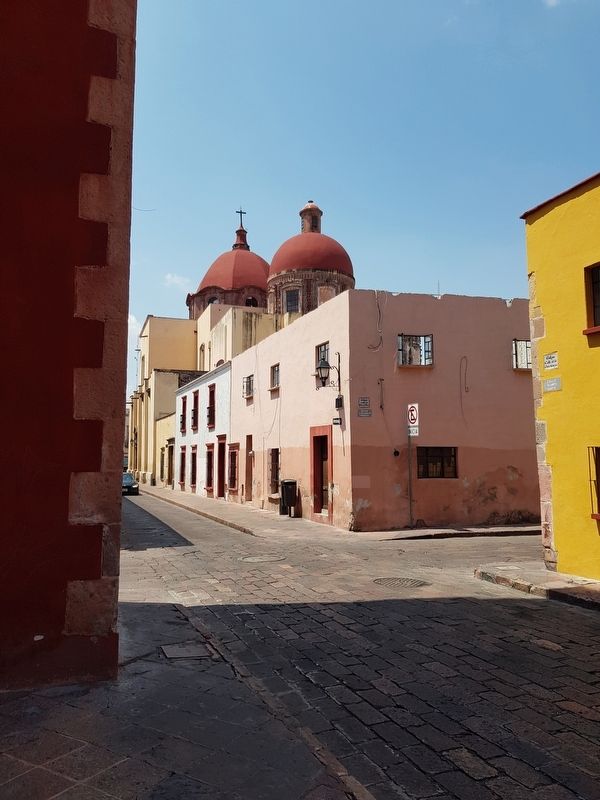
Photographed by J. Makali Bruton, May 9, 2020
8. The domes of the Temple of San Felipe Neri
This view is towards the south from near the Temple of the Carmelites.
Credits. This page was last revised on May 25, 2020. It was originally submitted on October 5, 2016, by J. Makali Bruton of Washington, District of Columbia. This page has been viewed 430 times since then and 15 times this year. Photos: 1. submitted on August 6, 2018, by J. Makali Bruton of Washington, District of Columbia. 2, 3. submitted on October 5, 2016, by J. Makali Bruton of Washington, District of Columbia. 4. submitted on August 6, 2018, by J. Makali Bruton of Washington, District of Columbia. 5, 6. submitted on October 5, 2016, by J. Makali Bruton of Washington, District of Columbia. 7. submitted on July 22, 2017, by J. Makali Bruton of Washington, District of Columbia. 8. submitted on May 25, 2020, by J. Makali Bruton of Washington, District of Columbia.
