Hampton in Henry County, Georgia — The American South (South Atlantic)
Kilpatrick's Raid
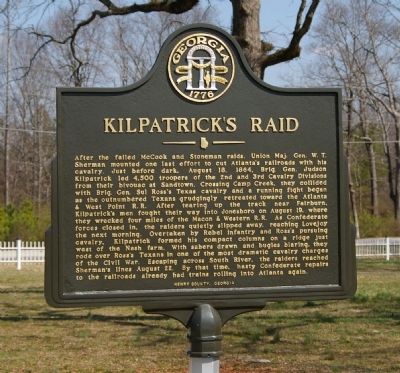
Photographed by David Seibert, March 1, 2008
1. Kilpatrick's Raid Marker
Inscription.
Kilpatrick's Raid. . After the failed McCook and Stoneman raids, Union Maj. Gen. W. T. Sherman mounted one last effort to cut Atlanta's railroads with his cavalry. Just before dark, August 18, 1864, Brig. Gen. Judson Kilpatrick led 4,500 troopers of the 2nd and 3rd Cavalry Divisions from their bivouac at Sandtown. Crossing Camp Creek they collided with Brig. Gen. Sul Ross's Texas cavalry and a running fight began as the outnumbered Texans grudgingly retreated toward the Atlanta and West Point R.R. After tearing up the track near Fairburn, Kilpatrick's men fought their way into Jonesboro on August 19, where they wrecked four miles of the Macon and Western R.R. As Confederate forces closed in, the raiders quietly slipped away, reaching Lovejoy the next morning. Overtaken by Rebel infantry and Ross's pursuing cavalry, Kilpatrick formed his compact columns on a ridge just west of the Nash farm. With sabers drawn and bugles blaring, they rode over Ross's Texans in one of the most dramatic cavalry charges of the Civil War. Escaping across South River, the raiders reached Sherman's lines on August 22. By that time, hasty Confederate repairs to the railroads already had trains rolling into Atlanta again.
After the failed McCook and Stoneman raids, Union Maj. Gen. W. T. Sherman mounted one last effort to cut Atlanta's railroads with his cavalry. Just before dark, August 18, 1864, Brig. Gen. Judson Kilpatrick led 4,500 troopers of the 2nd and 3rd Cavalry Divisions from their bivouac at Sandtown. Crossing Camp Creek they collided with Brig. Gen. Sul Ross's Texas cavalry and a running fight began as the outnumbered Texans grudgingly retreated toward the Atlanta & West Point R.R. After tearing up the track near Fairburn, Kilpatrick's men fought their way into Jonesboro on August 19, where they wrecked four miles of the Macon & Western R.R. As Confederate forces closed in, the raiders quietly slipped away, reaching Lovejoy the next morning. Overtaken by Rebel infantry and Ross's pursuing cavalry, Kilpatrick formed his compact columns on a ridge just west of the Nash farm. With sabers drawn and bugles blaring, they rode over Ross's Texans in one of the most dramatic cavalry charges of the Civil War. Escaping across South River, the raiders reached Sherman's lines on August 22. By that time, hasty Confederate repairs to the railroads already had trains rolling into Atlanta again.
Erected by Henry County, Georgia.
Topics and series. This historical marker is listed in this topic list: War, US Civil
Click or scan to see this page online
. In addition, it is included in the Georgia Historical Society series list. A significant historical date for this entry is August 18, 1864.
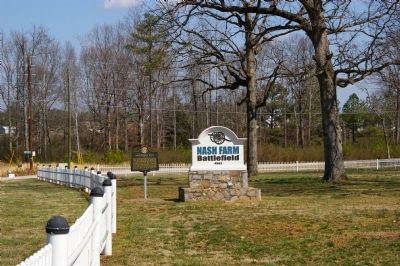
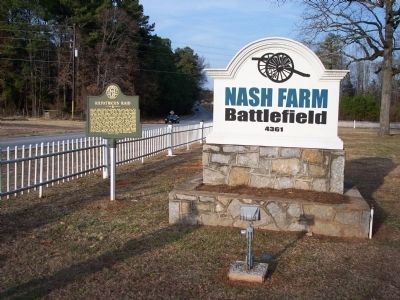
Location. 33° 27.559′ N, 84° 17.47′ W. Marker is in Hampton, Georgia, in Henry County. It is on Jonesboro Road 0 miles west of Babbs Mill Road, on the right when traveling east. Marker is at the Nash Farm Battlefield Park. Touch for map. Marker is at or near this postal address: 4361 Jonesboro Rd, Hampton GA 30228, United States of America. Touch for directions.

Regionally, this marker is in Georgia’s Piedmont and in Metro Atlanta. It is also in the American South and specifically in the Deep South. Globally, it is in the North Atlantic Region, North America, the Western Hemisphere, the Western World, and the Anglosphere. Historically, it finds itself in what was once the territory of the Mississippian Culture, one of the original Thirteen Colonies, one of the Confederate States of America, and the Antebellum South.
Credits. This page was last revised on November 4, 2024. It was originally submitted on August 2, 2008, by David Seibert of Sandy Springs, Georgia. This page has been viewed 4,210 times since then and 277 times this year. Photos:1, 2. submitted on August 2, 2008, by David Seibert of Sandy Springs, Georgia. 3. submitted on January 1, 2011, by Michael Dover of Ellerslie, Georgia. 4. submitted on August 2, 2008, by David Seibert of Sandy Springs, Georgia. • Craig Swain was the editor who published this page.