Centro Cívico in Ciudad de Guatemala in Guatemala Department, — Central America
Mobile Military Police
Photographed by J. Makali Bruton, August 5, 2016
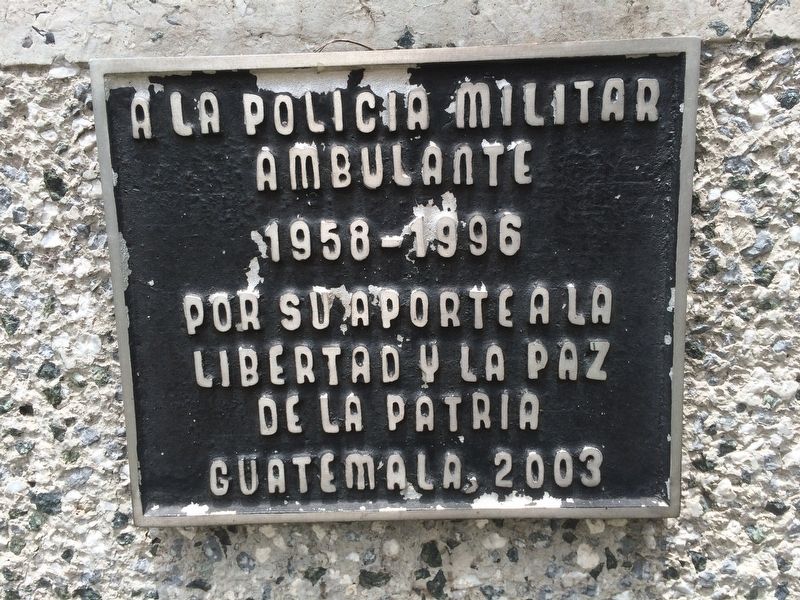
1. Mobile Military Police Marker

A la policia militar
ambulante
1958-1996
Por su aporte a la libertad y la paz
Guatemala, 2003
To the Mobile Military Police (PMA)
1958-1996
For their support of liberty and peace
Guatemala, 2003
Erected 2003.
Topics. This memorial is listed in this topic list: Wars, Non-US.
Location. 14° 37.692′ N, 90° 30.976′ W. Memorial is in Ciudad de Guatemala, Guatemala (Guatemala Department). It is in Centro Cívico. It can be reached from 19a Calle close to 6a Avenida. The marker is on the grounds of the Guatemalan Military Museum. The entrance to the museum is on 19a Calle, just a few meters before the intersection with 6a Avenida heading towards the south. Touch for map. Memorial is in this post office area: Ciudad de Guatemala, Guatemala 01001, Guatemala. Touch for directions.

Regionally, it is in North America, specifically in Central America, in Mesoamerica, on the Ring of Fire, on the Pacific Rim, and in the Western Hemisphere. Historically, it finds itself in what was once New Spain and also a Spanish colony.
Other nearby markers. At least
this page online
Another marker is no longer nearby. Municipal Headquarters of Guatemala City (was about 120 meters away, measured in a direct line but has been confirmed missing).
Regarding Mobile Military Police. Guatemala's Mobile Military Police (PMA, for its initials in Spanish) infamously played a role in consolidating and maintaining state control in rural Guatemala, providing surveillance, apprehending and interrogating suspected "subversives" and guerrillas,
Photographed by J. Makali Bruton, August 5, 2016
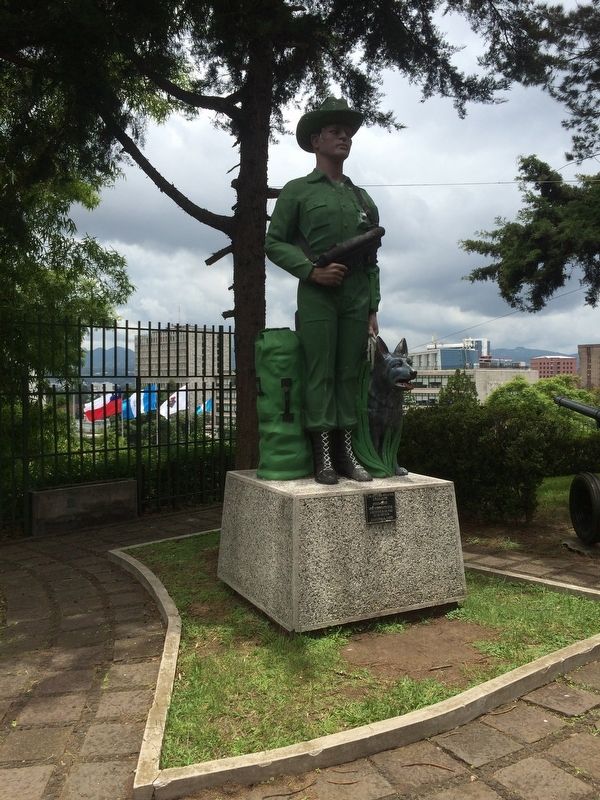
2. Mobile Military Police Marker
The marker and statue are located on the lower terrace of the Guatemalan Military Museum, surrounded by military hardware used by the Guatemalan military during the armed conflict from 1960-1996.
During the Guatemalan armed conflict, the PMA was particularly notorious for systematic and widespread human rights violations, including abduction, torture, extrajudicial killings and disappearances. A 1976 Latin American Newsletters article described the PMA as "a particularly vicious arm of the security forces." A 1981 Amnesty International report stated that the PMA was "named in many reports of abuses on and around large plantations in rural areas, and of seizure and 'disappearances' of trade union leaders at factories where the PMA
Photographed by J. Makali Bruton, August 5, 2016
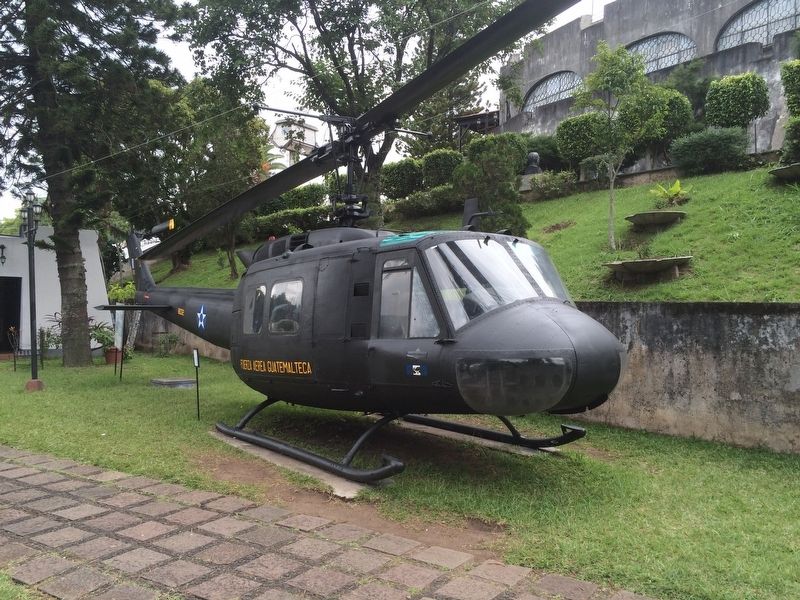
3. Nearby UH1H (Huey) Helicopter, used by Guatemalan military
A nearby marker mentions that the helicopter, of 1962 fabrication, was used in operations against guerrillas and was hit by enemy fire. The helicopter was awarded the "Roble de Oro" and "Placa del Combatiente" medals (seen near the left pilot's door in this photo) because of these actions.
Credits. This page was last revised on January 31, 2025. It was originally submitted on October 9, 2016, by J. Makali Bruton of Washington, District of Columbia. This page has been viewed 479 times since then and 33 times this year. Photos: 1, 2, 3. submitted on October 9, 2016, by J. Makali Bruton of Washington, District of Columbia.
