West Village in Manhattan in New York County, New York — The American Northeast (Mid-Atlantic)
General Philip Henry Sheridan
Photographed by Andrew Ruppenstein, October 3, 2016
1. General Philip Henry Sheridan Marker
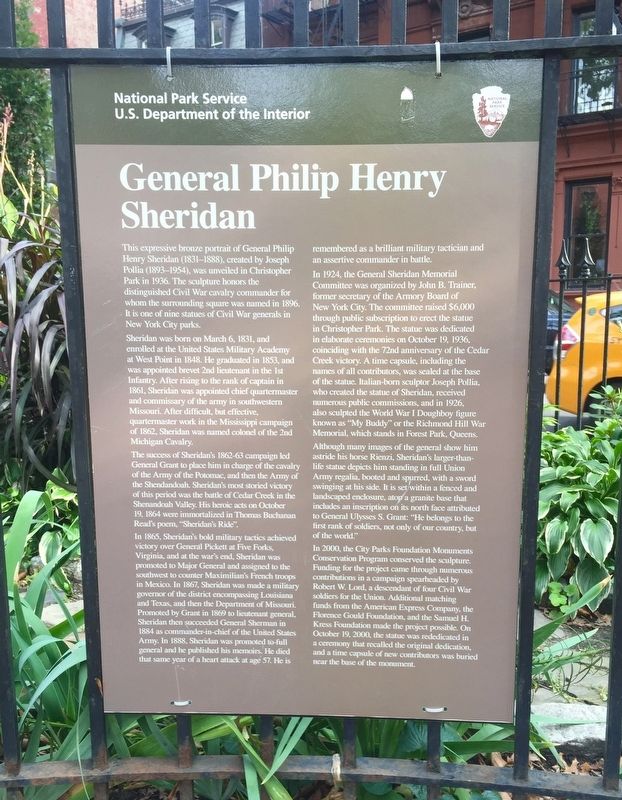
This expressive bronze portrait of General Philip Henry Sheridan (1831-1888), created by Joseph Pollia (1893-1954), was unveiled in Christopher Park in 1936. The sculpture honors the distinguished Civil War cavalry commander for whom the surrounding square was named in 1896. It is one of nine statues of Civil War generals in New York City parks.
Sheridan was born on March 6, 1831, and enrolled at the United States Military Academy at West Point in 1848. He graduated in 1853, and was appointed brevet 2nd lieutenant in the 1st Infantry. After rising to the rank of captain in 1861, Sheridan was appointed chief quartermaster and commissary of the army in southwestern Missouri. After difficult, but effective, quartermaster work in the Mississippi campaign of 1862, Sheridan was named colonel of the 2nd Michigan Cavalry.
The success of Sheridan’s 1862-63 campaign led General Grant to place him in charge of the cavalry of the Army of the Potomac, and then the Army of the Shendandoah. Sheridan’s most storied victory of this period was the battle of Cedar Creek in the Shenandoah Valley. His heroic acts on October 19, 1864
this page online
In 1865, Sheridan’s bold military tactics achieved victory over General Pickett at Five Forks, Virginia, and at the war’s end, Sheridan was promoted to Major General and assigned to the southwest to counter Maximilian’s French troops in Mexico. In 1867, Sheridan was made a military governor of the district encompassing Louisiana and Texas, and then the Department of Missouri. Promoted by Grant in 1869 to lieutenant general, Sheridan then succeeded General Sherman in 1884 as commander-in-chief of the United States Army. In 1888, Sheridan was promoted to full general and he published his memoirs. He died that same year of a heart attack at age 57. He is remembered as a brilliant military tactician and an assertive commander in battle.
In 1924, the General Sheridan Memorial Committee was organized by John B. Trainer, former secretary of the Armory Board of New York City. The committee raised $6,000 through public subscription to erect the statue in Christopher Park. The statue was dedicated in elaborate ceremonies on October 19, 1936, coinciding with the 72nd anniversary
Photographed by Andrew Ruppenstein, October 3, 2016
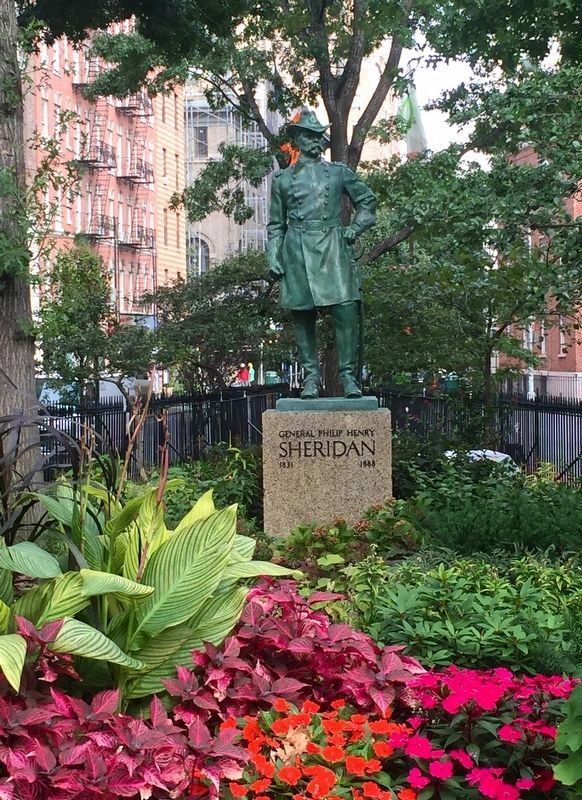
2. General Philip Henry Sheridan Statue and Monument - West-facing Side
General Philip Henry
Sheridan
1831 • 1888
Sheridan
1831 • 1888
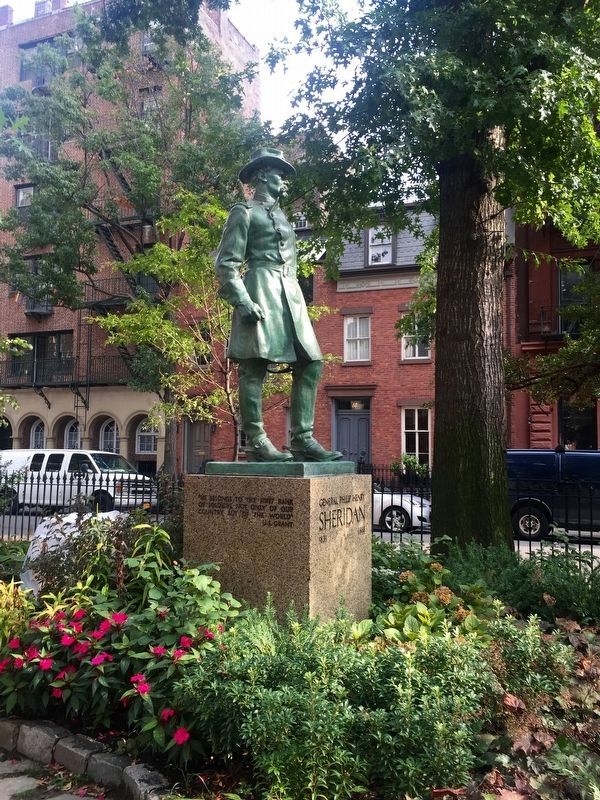
Although many images of the general show him astride his horse Rienzi, Sheridan’s larger-than-life statue depicts him standing in full Union Army regalia, booted and spurred, with a sword swinging at his side. It is set within a fenced and landscaped enclosure, atop a granite base that includes an inscription on its north face attributed to General Ulysses S. Grant: “He belongs to the first rank of soldiers, not only of our country, but of the world.”
In 2000, the City Parks Foundation Monuments Conservation Program conserved the sculpture. Funding for the project came through numerous contributions in a campaign spearheaded by Robert W. Lord, a descendant of four Civil War soldiers for the Union. Additional matching funds from the American Express Company,
Photographed by Andrew Ruppenstein, October 3, 2016
3. General Philip Henry Sheridan Statue and Monument - North-facing side
“He belongs to the first rank of soldiers, not only of our country, but of the world.”
U.S. Grant
U.S. Grant
Erected by National Park Service, U.S. Department of the Interior.
Topics and series. This historical marker is listed in these topic lists: Arts, Letters, Music • War, US Civil. In addition, it is included in the Former U.S. Presidents: #18 Ulysses S. Grant, and the Time Capsules series lists. A significant historical date for this entry is March 6, 1831.
Location. Marker has been reported permanently removed. It was located near 40° 44.017′ N, 74° 0.131′ W. Marker was in Manhattan, New York, in New York County. It was in West Village. It was on Christopher Street near 7th Avenue South, on the left when traveling west. Touch for map. Marker was at or near this postal address: 53 Christopher Street, New York NY 10014, United States of America.
We have been informed that this marker is no longer there and will not be replaced. This page is an archival view of what was.
Regionally,
Photographed by Andrew Ruppenstein, October 3, 2016
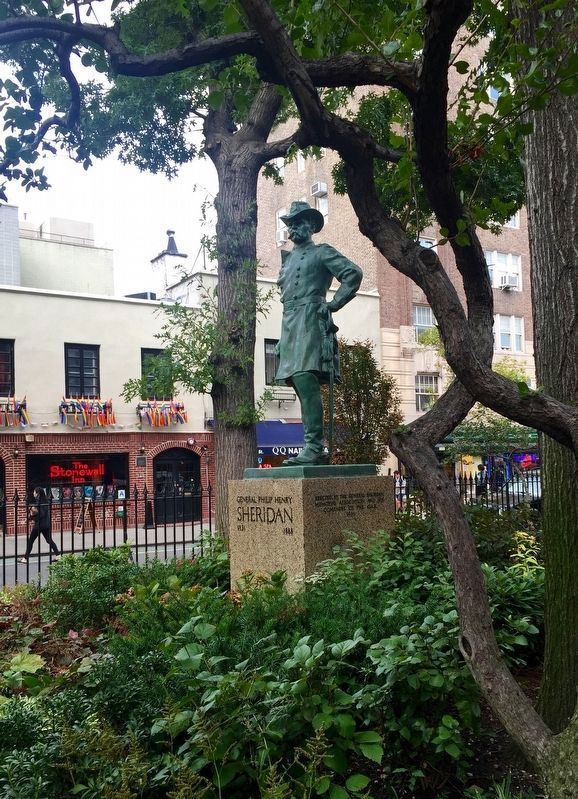
4. General Philip Henry Sheridan Statue and Monument - South-facing Side
Erected by the General Sherman
Memorial Association and his
comrades of the G.A.R
1936
The Stonewall Inn is visible in the background. Christopher Park is now part of the Stonewall National Monument.
Memorial Association and his
comrades of the G.A.R
1936
The Stonewall Inn is visible in the background. Christopher Park is now part of the Stonewall National Monument.

Other nearby markers. At least 8 other markers are within walking distance of this location: General Sheridan (here, next to this marker); Stonewall Forever (a few steps from this marker); a different marker also named Stonewall Forever (a few steps from this marker); Gay Liberation Monument (a few steps from this marker); a different marker also named Stonewall Forever (a few steps from this marker); a different marker also named Stonewall Forever (a few steps from this marker); The Stonewall Inn (a few steps from this marker); a different marker also named Stonewall Inn (a few steps from this marker). Touch for a list and map of all markers in Manhattan.
Another marker is no longer nearby. General Philip Henry Sheridan (was here, next to this marker but has been
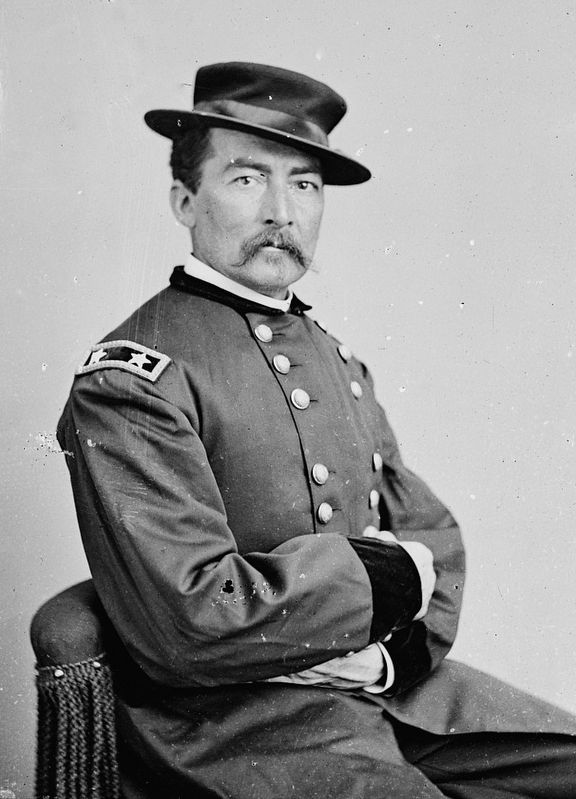
Brady-Handy Photograph Collection (Library of Congress)., circa 1864
5. Major General Phillip H. Sheridan
More about this marker. The marker and monument are in the middle of Christopher Park, which is part of both Stonewall National Monument and Sheridan Square.
Also see . . .
1. The Gen'l Philip Henry Sheridan Statue - Christopher Park. "Daytonian in Manhattan" entry. (Submitted on February 25, 2020, by Larry Gertner of New York, New York.)
2. Civil War Soldiers March into Christopher Park (The Daily Plant, October 20, 2000). Yesterday, Parks celebrated the rededication of one of New York City’s great statues, of General Philip Henry Sheridan. The sculpture, located in Christopher Park, honors the distinguished Civil War cavalry commander for whom the surrounding square was named in 1896; it is one of nine statues of Civil War generals in New York City parks. The monument was originally unveiled on October 19, 1936, the 72nd anniversary of General Sheridan’s heroic victory at the battle of Cedar Creek in the Shenandoah Valley. (Submitted on October 14, 2016.)
3. Christopher Park. NYC Parks website entry:
Christopher Park, the Stonewall Inn, and the surrounding neighborhood
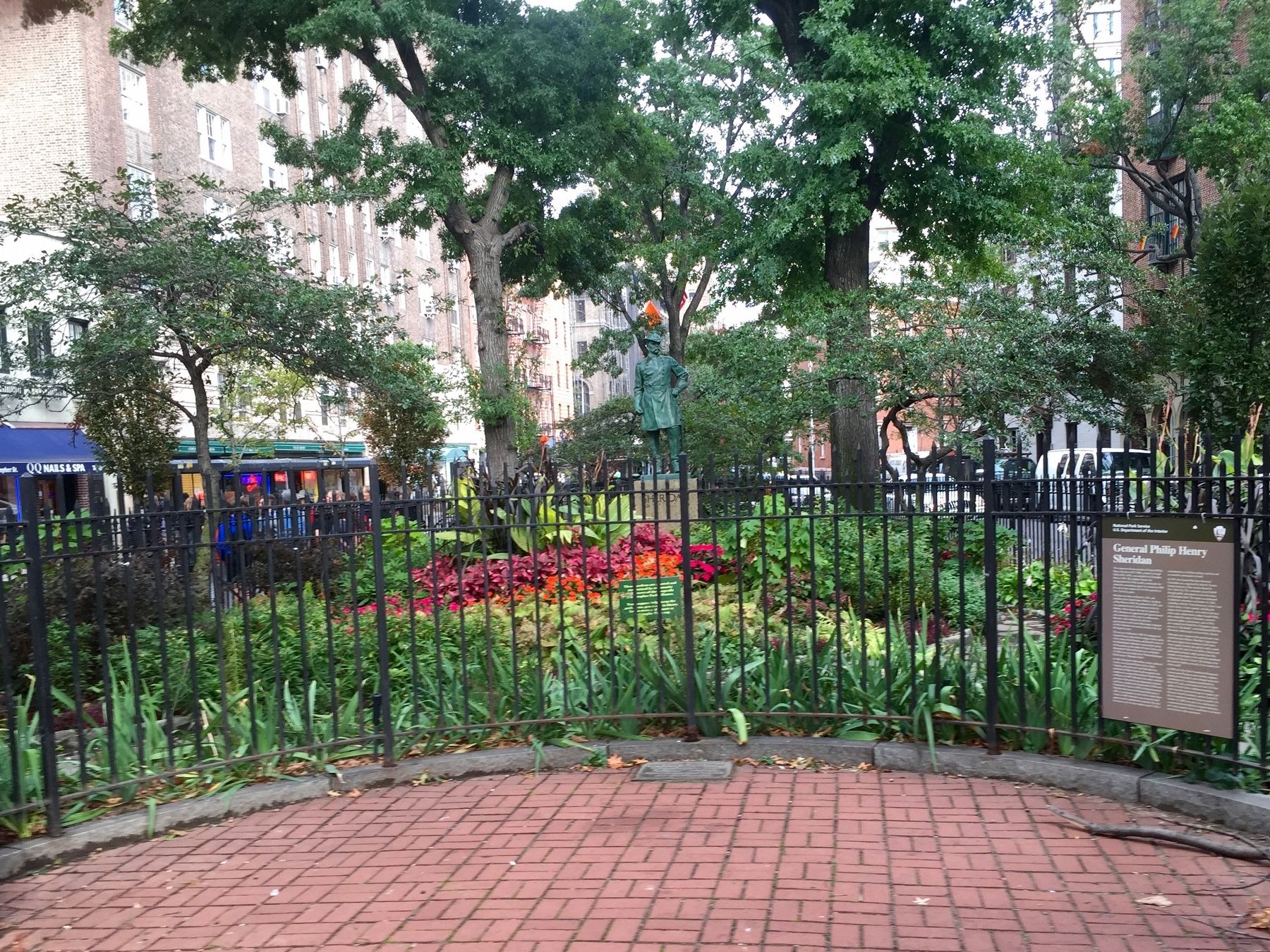
Photographed by Andrew Ruppenstein, October 3, 2016
6. General Philip Henry Sheridan Statue, Monument, and Marker - Wide View
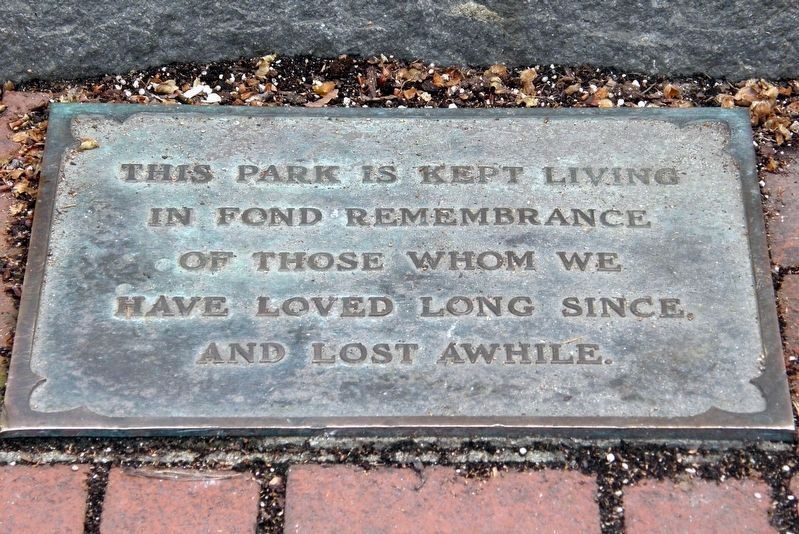
Photographed by Larry Gertner, April 23, 2017
7. This plaque near the fence has more to do with the park than with the general.
Credits. This page was last revised on July 5, 2025. It was originally submitted on October 13, 2016, by Andrew Ruppenstein of Lamorinda, California. This page has been viewed 1,052 times since then and 64 times this year. Last updated on June 9, 2025, by Ian Lefkowitz of New York, New York. Photos: 1, 2, 3, 4, 5, 6. submitted on October 14, 2016, by Andrew Ruppenstein of Lamorinda, California. 7. submitted on August 15, 2019, by Larry Gertner of New York, New York. • Devry Becker Jones was the editor who published this page.
