Near Arcadia in Iron County, Missouri — The American Midwest (Upper Plains)
Taum Sauk Mountain State Park Overlook
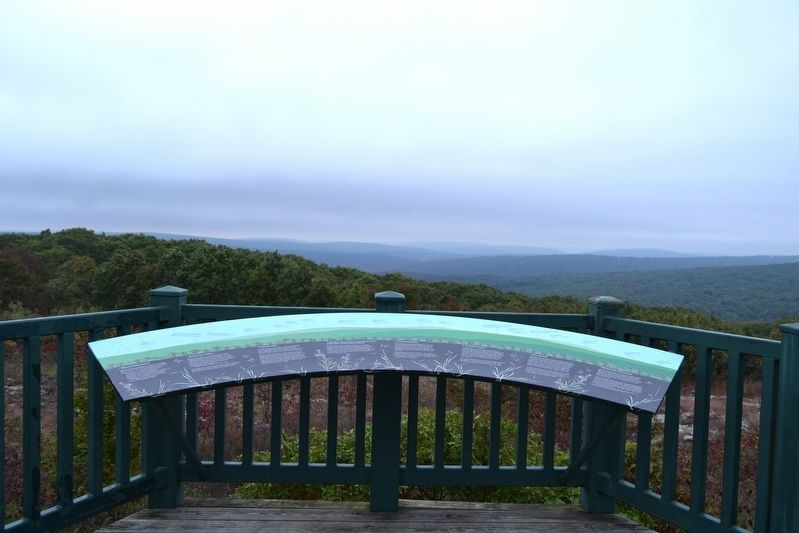
Photographed by Duane Hall, October 14, 2016
1. Taum Sauk Mountain State Park Overlook Marker
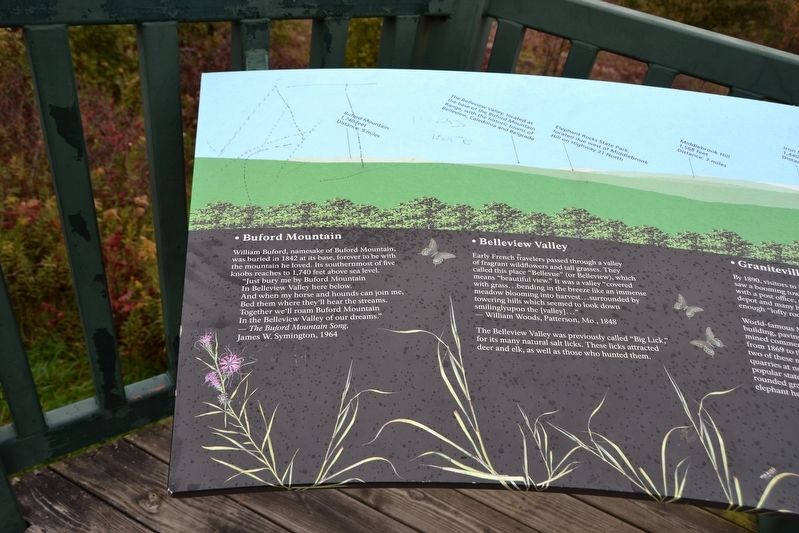
Buford Mountain
William Buford, namesake of Buford Mountain, was buried in 1842 at its base, forever to be with the mountain he loved. Its southernmost of five knobs reaches to 1,740 feet above sea level.
“Just bury me by Buford Mountain
In Belleview Valley here below.
And when my horse and hounds can join me,
Bed them where they’ll hear the streams.
Together we’ll roam Buford Mountain
In the Belleview Valley of our dreams.”
— The Buford Mountain Song,
James W. Symington, 1964
Belleview Valley
Early French travelers passed through a valley of fragrant wildflowers and tall grasses. They called this place “Bellevue” (or Belleview), which means “beautiful view.” It was a valley “covered with grass … bending in the breeze like an immense meadow booming into harvest … surrounded by towering hills which seemed to look down smilinglyupon the [valley] …”
— William Woods, Patterson, Mo., 1848
The Belleview Valley was previously called “Big Lick,” for its many natural salt licks. These licks attracted deer and elk, as well as those who hunted them.
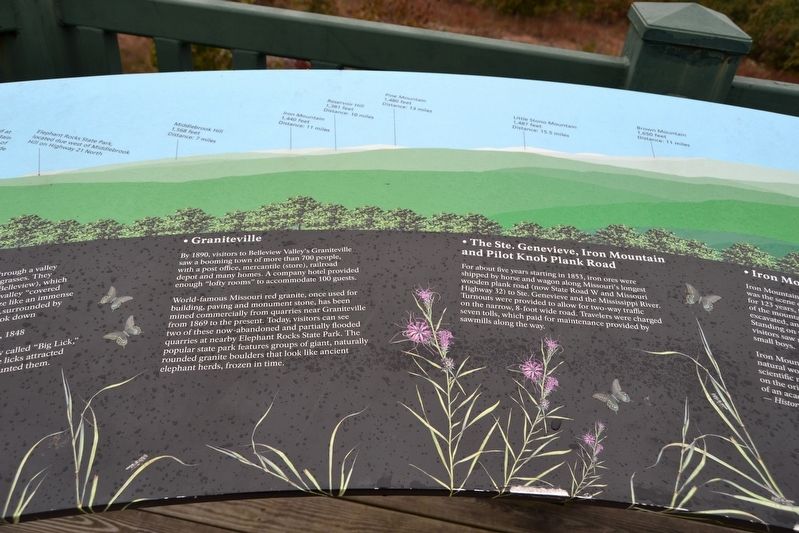
Graniteville
By 1890, visitors to Belleview Valley’s
this page online
World-famous Missouri red granite, once used for building, paving and monument stone, has been mined commercially from quarries near Graniteville from 1869 to the present. Today, visitors can see two of these now-abandoned and partially flooded quarries at nearby Elephant Rocks State Park. The popular state park features groups of giant, naturally rounded granite boulders that look like ancient elephant herds, frozen in time.
The Ste. Genevieve, Iron Mountain and Pilot Knob Plank Road
For about five years starting in 1853, iron ores were shipped by horse and wagon along Missouri’s longest wooden plank road (now State Road W and Missouri Highway 32) to Ste. Genevieve and the Mississippi River. Turnouts were provided to allow for two-way traffic on the narrow, 8-foot wide road. Travelers were charged seven tolls, which paid for maintenance provided by sawmills along the way.
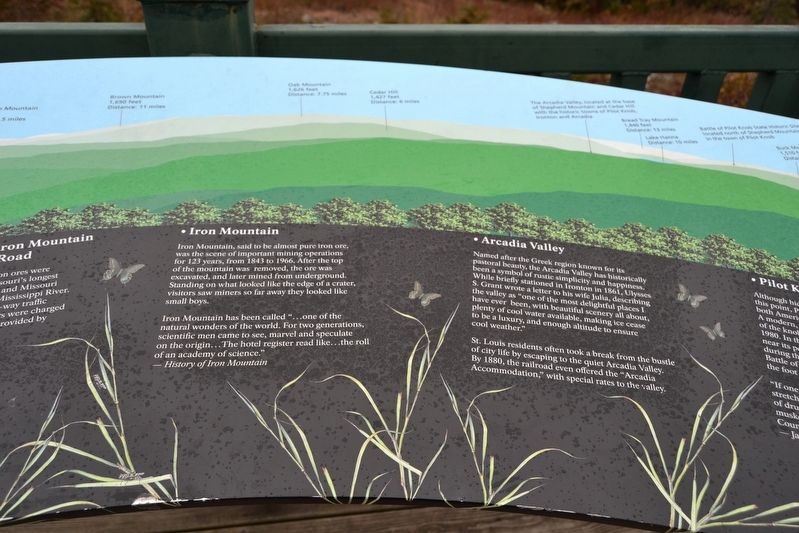
Iron Mountain
Iron Mountain, said to be almost pure
Photographed by Duane Hall, October 14, 2016
2. Taum Sauk Mountain State Park Overlook Marker
Iron Mountain has been calle “... one of the natural wonders of the world. For two generations, scientific men came to see, marvel and speculate on the origin … The hotel register read like … the roll of an academy of science.”
— History of Iron Mountain
Arcadia Valley
Named after the Greek region known for its pastoral beauty, the Arcadia Valley has historically been a symbol of rustic simplicity and happiness. While briefly stationed in Ironton in 1861, Ulysses S. Grant wrote a letter to his wife Julia, describing the valley as “one of the most delightful places I have ever been, with beautiful scenery all about, plenty of cool water available, making ice cease to be a luxury, and enough altitude to ensure cool weather.”
St. Louis residents often took a break from the bustle of city life by escaping to the quiet Arcadia Valley.
Photographed by Duane Hall, October 14, 2016
3. Taum Sauk Mountain State Park Overlook Marker
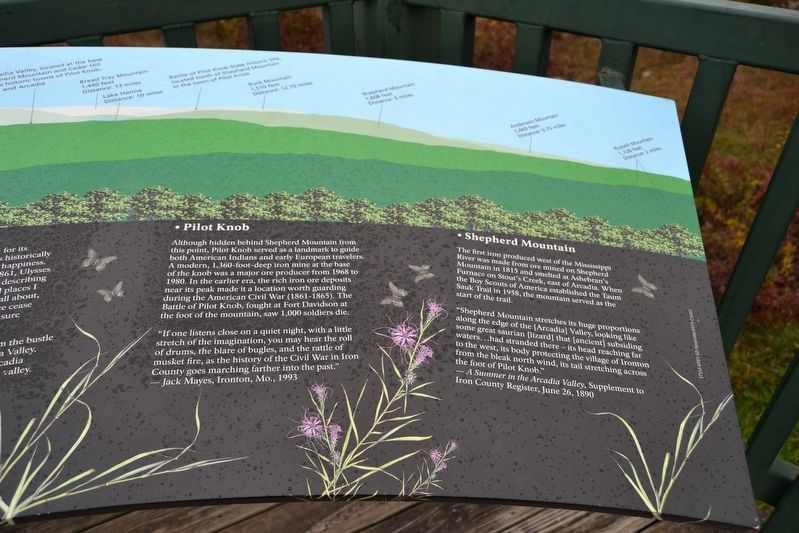
Pilot Knob
Although hidden behind Shepherd Mountain from this point, Pilot Knob served as a landmark to guide both American Indians and early European travelers. A modern, 1,360-foot-deep iron mine at the base of the knob was a major ore producer from 1968 to 1980. In the earlier era, the rich iron ore deposits near its peak made it a location worth guarding during the American Civil War (1861-1865). The Battle of Pilot Knob, fought at Fort Davidson at the foot of the mountain, saw 1,000 soldiers die.
“If one listens close on a quiet night, with a little stretch of the imagination, you may hear the roll of drums, the blare of bugles, and the rattle of musket fire, as the history of the Civil War in Iron County goes marching farther into the past.”
— Jack Mayes, Ironton, Mo., 1993
Shepherd Mountain
The first iron produced west of the Mississippi River was made from ore mined on Shepherd Mountain in 1815 and smelted at Ashebran’s Furnace on Stout’s Creek, east of Arcadia. When the Boy Scouts of America established the Taum
Photographed by Duane Hall, October 14, 2016
4. Taum Sauk Mountain State Park Overlook Marker
“Shepherd Mountain stretches its huge proportions along the edge of the [Arcadia] Valley, looking like some great saurian [lizard] that [ancient] subsiding waters … had stranded there - its head reaching far to the west, its body protecting the village of Ironton from the bleak north wind, its tail stretching across the foot of Pilot Knob.”
— A Summer in the Arcadia Valley, Supplement to Iron County Register, June 26, 1890
Erected by Missouri State Parks.
Topics. This historical marker is listed in these topic lists: Environment • Industry & Commerce • Settlements & Settlers. A significant historical date for this entry is June 26, 1890.
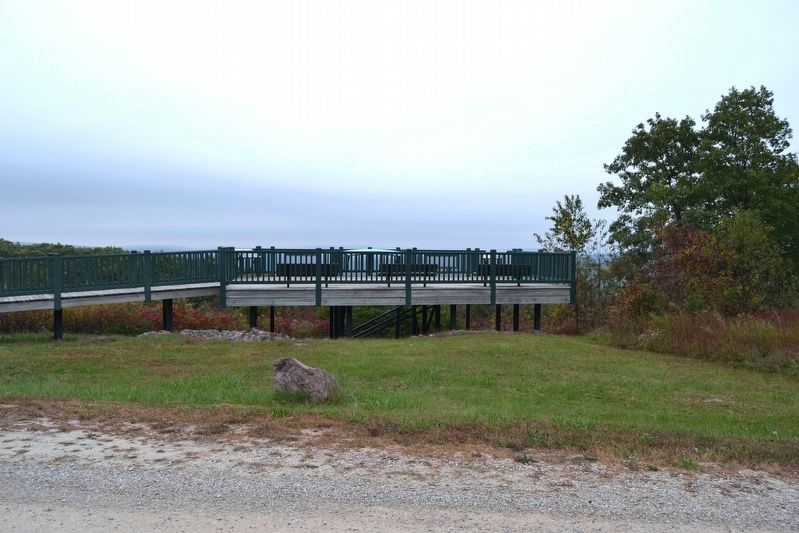
Location. 37° 34.386′ N, 90° 43.469′ W. Marker is near Arcadia, Missouri, in Iron County. It can be reached from State Park Road 0.7 miles north of Highway CC. Marker is located at the Taum Sauk Mountain State Park Overlook. Touch for map. Marker is in this post office area: Ironton MO 63650, United States of America. Touch for directions.

Regionally, this marker is in Southeast Missouri. It is also in the American Ozarks,
Photographed by Duane Hall, October 14, 2016
5. Taum Sauk Mountain State Park Overlook Marker
Other nearby markers. At least 8 other markers are within 6 miles of this marker, measured as the crow flies: Welcome to the Top of Missouri (here, next to this marker); St. Francois Mountain Glades (here, next to this marker); General Grant Commission Commemorative (approx. 5½ miles away); Fort Curtis (approx. 5½ miles away); Knob Creek (approx. 5½ miles away); Shepherd Mountain (approx. 5½ miles away); Iron County Missouri Courthouse Complex (approx. 5.6 miles away); Iron County - The "Birthplace of 4-H" in Missouri (approx. 5.6 miles away). Touch for a list and map of all markers in Arcadia.
Also see . . . Taum Sauk Mountain State Park. The official website of this state park. (Submitted on October 26, 2016.)
Photographed by Duane Hall, October 14, 2016
6. Taum Sauk Mountain Overlook
Credits. This page was last revised on November 22, 2024. It was originally submitted on October 26, 2016, by Duane Hall of Abilene, Texas. This page has been viewed 925 times since then and 85 times this year. Photos: 1, 2, 3, 4, 5, 6. submitted on October 26, 2016, by Duane Hall of Abilene, Texas.
