Near Newark in New Castle County, Delaware — The American Northeast (Mid-Atlantic)
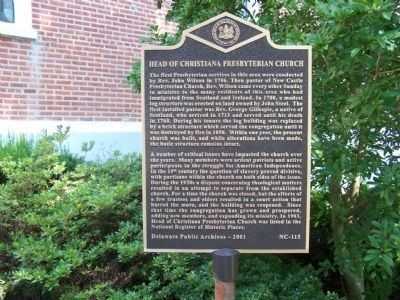
Head of Christiana Presbyterian Church
Photographed by William Pfingsten, August 3, 2008
1. Head of Christiana Presbyterian Church Marker
The first Presbyterian services in this area were conducted by Rev. John Wilson in 1706. Then pastor of New Castle Presbyterian Church, Rev. Wilson came every other Sunday to minister to the many residents of this area who had immigrated from Scotland and Ireland. In 1708, a modest log structure was erected on land owned by John steel. The first installed pastor was Rev. George Gillespie, a native of Scotland, who arrived in 1713 and served until his death in 1760. During his tenure the log building was replaced by a brick structure which served the congregation until it was destroyed by fire in 1858. Within one year, the present church was built, and while alterations have been made, the basic structure remains intact.
A number of critical issues have impacted the church over the years. Many members were ardent patriots and active participants in the struggle for American Independence. In the 19th century the question of slavery proved divisive, with partisans within the church on both sides of the issue. During the 1930s a dispute concerning theological matters resulted in an attempt to separate from the established
this page online
Erected 2001 by Delaware Public Archives. (Marker Number NC-115.)
Topics and series. This historical marker is listed in these topic lists: Colonial Era • Religion & Religious Structures • War, US Revolutionary. In addition, it is included in the Delaware Public Archives, and the National Register of Historic Places (NRHP) series lists. A significant historical year for this entry is 1706.
Location. 39° 41.513′ N, 75° 47.193′ W. Marker is near Newark, Delaware, in New Castle County. It is on W. Church Road, on the left when traveling south. Touch for map. Marker is at or near this postal address: 1100 W Church Road, Newark DE 19711, United States of America. Touch for directions.

Regionally, this marker is in Greater Wilmington and in Greater Philadelphia.
Photographed by William Pfingsten, August 3, 2008
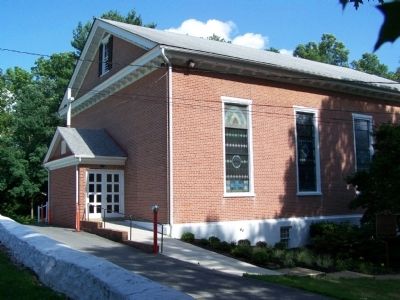
2. Christiana Presbyterian Church
Other nearby markers. At least 8 other markers are within 2 miles of this marker, measured as the crow flies: Revolutionary War Patriots in Head of Christiana Cemetery (within shouting distance of this marker); The Wedge (approx. 0.2 miles away); New London Avenue School (approx. 1.4 miles away); Newark's New London Community (approx. 1½ miles away); Forgotten Heroes (approx. 1½ miles away); Mt. Zion Union American Methodist Episcopal (UAME) Church (approx. 1½ miles away); St. John African Methodist Church (approx. 1.6 miles away); New London Road Community (approx. 1.6 miles away). Touch for a list and map of all markers in Newark.
Also see . . . Head of Christiana United Presbyterian Church - National Register of Historic Places Nomination Form.
Established in 1708 for members of a Scotch-Irish settlement located in the western part of White Clay Creek Hundred, its first structure constructed of log was replaced by a brick meeting house in 1750. The present Church, built in 1859, is located on the site of the 1750 structure which burned in 1858.(Submitted on April 23, 2025, by Pete Skillman of Wilmington, Delaware.)
Credits. This page was last revised on February 5, 2026. It was originally submitted on August 5, 2008, by Bill Pfingsten of Bel Air, Maryland. This page has been viewed 4,873 times since then and 60 times this year. Photos: 1, 2. submitted on August 5, 2008, by Bill Pfingsten of Bel Air, Maryland.
