Near Ararat in Patrick County, Virginia — The American South (Mid-Atlantic)
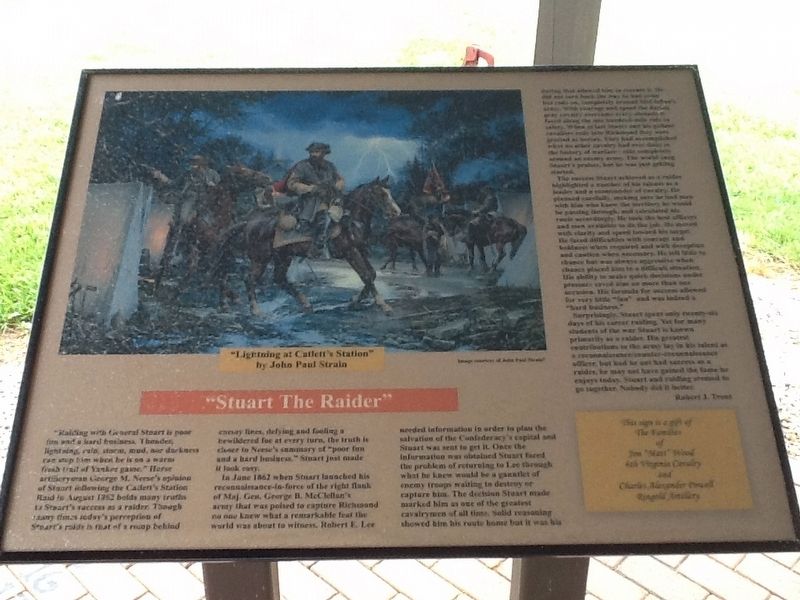
"Stuart the Raider"
Photographed by Michael C. Wilcox, April 21, 2012
1. "Stuart the Raider" Marker
In June 1862 when Stuart launched his reconnaissance-in-force of the right flank of Maj. Gen. George B. McClellan's army that was poised to capture Richmond no one knew what a remarkable feat the world was about to witness. Robert E. Lee needed information in order to plan the salvation of the Confederacy's capital and Stuart was sent to get it. Once the information was obtained Stuart faced the problem of returning to Lee through what he knew would be a gauntlet of enemy troops waiting to destroy or capture him. The decision Stuart made marked
this page online
The success Stuart achieved as a raider highlighted a number or his talents as a leader and a commander of cavalry. He planned carefully, making sure he had men with him who the territory he would be passing through, and calculated his route accordingly. He took the best officers and men available to do the job. He moved with clarity and speed toward his target. He faced difficulties with courage and boldness when required and with deception and caution when necessary. He left little to chance but was
Photographed by Michael C. Wilcox, April 21, 2012
2. "Stuart the Raider" Marker
Surprisingly, Stuart spent only twenty-six days of his career raiding. Yet for many students of the war Stuart is known primarily as a raider. His greatest contributions to the army lay in his talent as a reconnaissance/counter-reconnaissance officer, but had he not had success as a raider, he may not have gained the fame he enjoys today. Stuart and raiding seemed to go together. Nobody did it better.
This sign is a gift of
The Families of Jim "Matt" Wood - 6th Virginia Cavalry and
Charles Alexander Powell - Ringold Artillery
Topics. This historical marker is listed in this topic list: War, US Civil. A significant historical year for this entry is 1861.
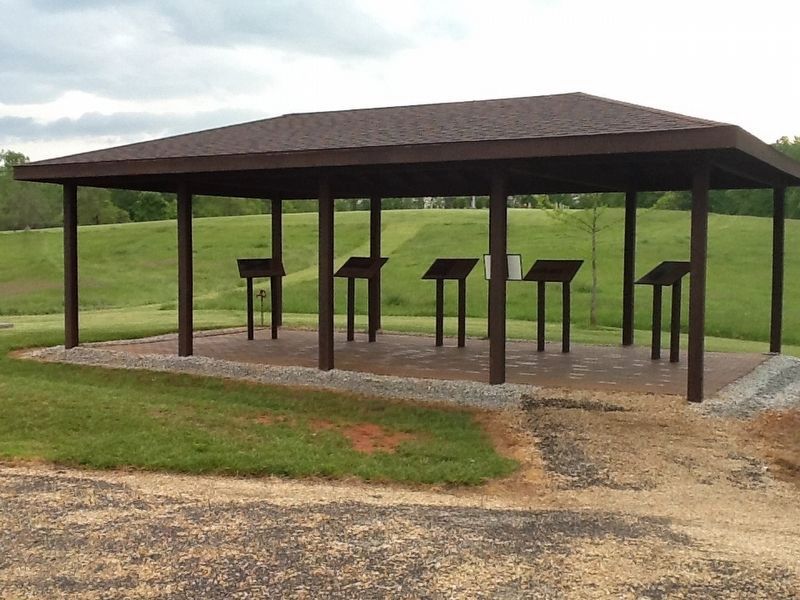
Location. 36° 33.777′ N, 80° 33.132′ W. Marker is near Ararat, Virginia, in Patrick County. It can be reached from Ararat Highway. Located on the grounds of the Jeb Stuart Birthplace (Laurel Hill). Touch for map. Marker
Photographed by Michael C. Wilcox, April 21, 2012
3. "Stuart the Raider" Marker

Regionally, this marker is in Southern Virginia and in the Blue Ridge Highlands. It is also in the American South, specifically in the Upper South, in Appalachia, and specifically in Southern Appalachia. Globally, it is in North America, the Western Hemisphere, the Western World, and the Anglosphere. Historically, it finds itself in what was once the territory of the Mississippian Culture, one of the original Thirteen Colonies, one of the Confederate States of America, and the Antebellum South.
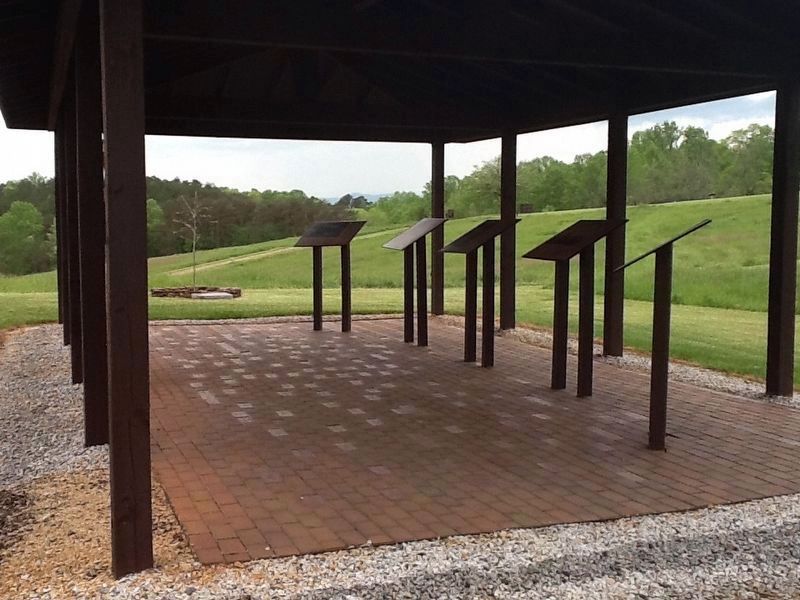
Other nearby markers. At least 8 other markers are within walking distance of this marker: "Stuart the Scout" (here, next to this marker); "Stuart the Commander" (here, next to this marker); "Stuart the Leader" (here, next to this marker); The "Lee" Tree (here, next to this marker); "Flora and Jeb" (here, next to this marker); Stuart's Birthplace Marker (a few steps from this marker); Stuart's Birthplace (a few steps from this marker); The Mount Airy & Eastern Railway (a few steps from this marker). Touch for a list and map of all markers in Ararat.
Credits. This page was last revised on May 6, 2026. It was originally submitted on November 22, 2016, by Michael C. Wilcox of Winston-Salem, North Carolina. This page has been viewed 505 times since then and 17 times this year. Photos: 1, 2, 3. submitted on November 22, 2016, by Michael C. Wilcox of Winston-Salem, North Carolina.
