Colfax in Grant Parish, Louisiana — The American South (West South Central)
Colfax Riot
Photographed by Richard E. Miller, August 6, 2010
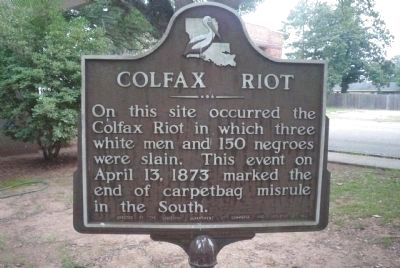
1. Colfax Riot Marker
On this site occurred the Colfax Riot in which three white men and 150 negroes were slain. This event on April 13, 1873, marked the end of carpetbag misrule in the South.
Erected 1950 by Louisiana Department of Commerce and Industry.
Topics. This historical marker is listed in these topic lists: African Americans • Civil Rights. A significant historical date for this entry is April 13, 1873.
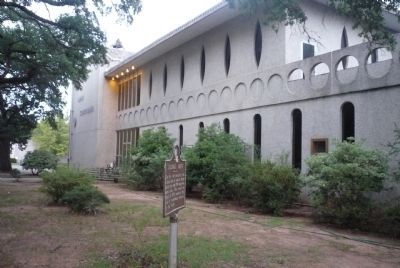
Location. Marker has been permanently removed. It was located near 31° 30.998′ N, 92° 42.771′ W. Marker was in Colfax, Louisiana, in Grant Parish. It was at the intersection of Main Street (State Highway 8) and 2nd Street (State Route 8) on Main Street. Marker was at the southeast corner of Main and 2nd Streets (both La. Hwy 8), on the lawn near the west end of the Grant Parish Court House Building. Touch for map. Marker was at or near this postal address: 300 Main St, Colfax LA 71417, United States of America.
We have been informed that this marker is no longer there and will not be replaced. This page is an archival view of what was.
Regionally, this marker was in Central Louisiana. It was also in the American South, specifically

this page online
Other nearby markers. At least 8 other markers are within 17 miles of this location, measured as the crow flies: The Famous Burning Well of Colfax (a few steps from this marker); Grant Parish and Town of Colfax (approx. 0.4 miles away); Mary E. Graham High School (approx. 0.8 miles away); Battle of Calhoun's Landing (approx. 0.9 miles away); Village of Dry Prong (approx. 11.7 miles away); Verda (approx. 13.1 miles away); Montgomery, Louisiana (approx. 14.8 miles away); LTV Aerospace Vought A-7D Corsair II (approx. 17 miles away). Touch for a list and map of all markers in Colfax.
Also see . . .
1. Colfax Massacre. Wikipedia entry:
Easter Sunday, April 13, 1873 (Submitted on August 19, 2010, by Richard E. Miller of Oxon Hill, Maryland.)
2. John McEnery (Louisiana politician).
Photographed by Richard E. Miller, August 6, 2010
2. Colfax Riot Marker at the Grant Parish courthouse
3. Colfax Riot Memorial for Whites Killed. Waymarking entry:
Stephen Decatur Parish, James West Hadnot, Sidney Harris -
who fell in the Colfax Riot fighting for white supremacy, April 13, 1873.
4. Removing the White Supremacy Marker at Colfax, Louisiana: A 2021 Success Story. The Journal of the Civil War Era Article written by Tom Barber and Jeff Crawford, at the time doctoral students at Louisiana State University, about their efforts to get this marker removed.
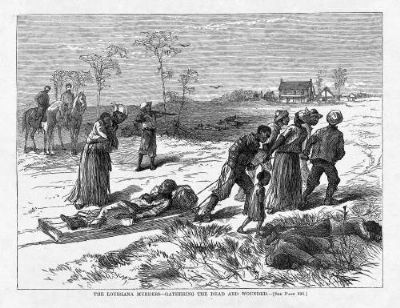
The small marker’s removal represented years of effort from activists and students. In 1989, Black convict-journalists of The Angolite first challenged the “Riot” sign’s white supremacist roots. They first gave voice to the Black victims of what they titled the “Tragedy at Colfax.” Local activists continued the fight for the sign’s removal. As Louisiana State University graduate students Jeff Crawford and I participated in the latest, and what(Submitted on April 14, 2026, by Daniel Barriball of Chesterton, Indiana.)would be, final attempt to have the marker removed.Photographed by Wikipedia3. "The Louisiana Murders—Gathering The Dead And Wounded" published in Harper's Weekly May 10, 1873
Additional commentary.
1. Marker removed as factually inaccurate.
This marker was removed on May 15th, 2021 by the State of Louisiana Economic Development Agency, as the agency responsible for historical markers. Plans are to eventually place it in a museum. A concession to Grant Parish is that any new marker will not be put on parish-owned land as this one was.
It is reported that in the ensuing day of slaughter, a White mob killed somewhere between 62 and 81 Black men, most after they had surrendered. Three White men lost their lives — two of whom were probably shot by their own comrades in the chaos.
President Grant's administration tried to prosecute, but the Supreme Court overturned what few convictions the government obtained. That precedent weakened civil rights enforcement for decades, during which Louisiana disenfranchised Black people and falsified the Colfax events as a “Negro Riot.”
— Submitted June 17, 2021, by Mark Hilton of Montgomery, Alabama.

Photographed by Jimmy Emerson, April 13, 2008
4. Colfax Riot Marker on courthouse lawn
Credits. This page was last revised on June 17, 2026. It was originally submitted on August 19, 2010, by Richard E. Miller of Oxon Hill, Maryland. This page has been viewed 7,562 times since then and 171 times this year. Last updated on April 14, 2026, by Daniel Barriball of Chesterton, Indiana. Photos: 1. submitted on August 19, 2010, by Richard E. Miller of Oxon Hill, Maryland. 2, 3. submitted on August 20, 2010, by Richard E. Miller of Oxon Hill, Maryland. 4. submitted on June 17, 2026, by Jimmy Emerson of Dalton, Georgia. • Devry Becker Jones was the editor who published this page.
