North Rosslyn in Arlington in Arlington County, Virginia — The American South (Mid-Atlantic)
Fort Corcoran
February 2, 2008
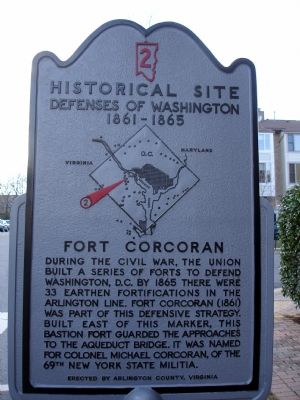
1. Fort Corcoran Marker
Defenses of Washington
1861-1865
Fort Corcoran
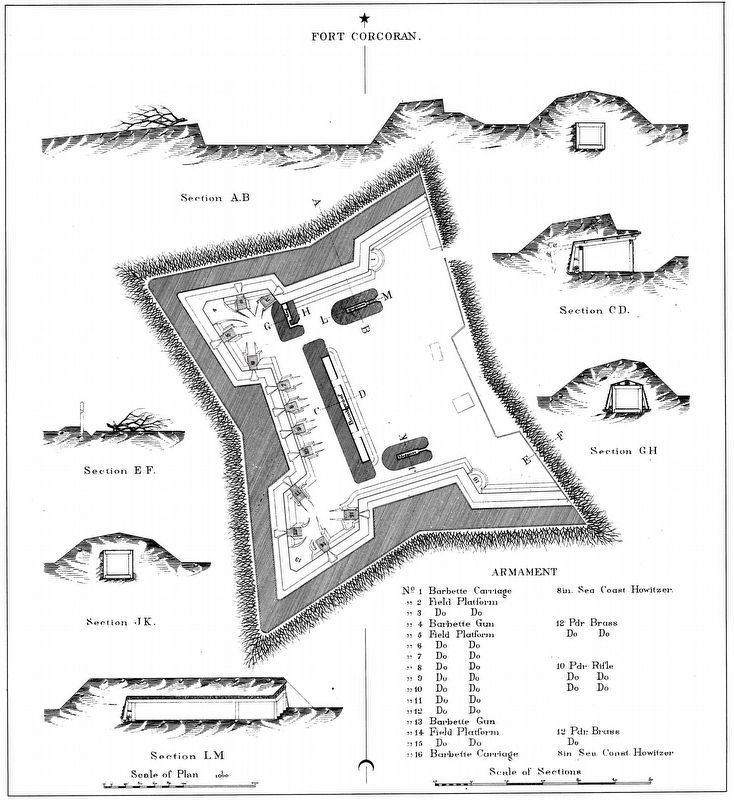
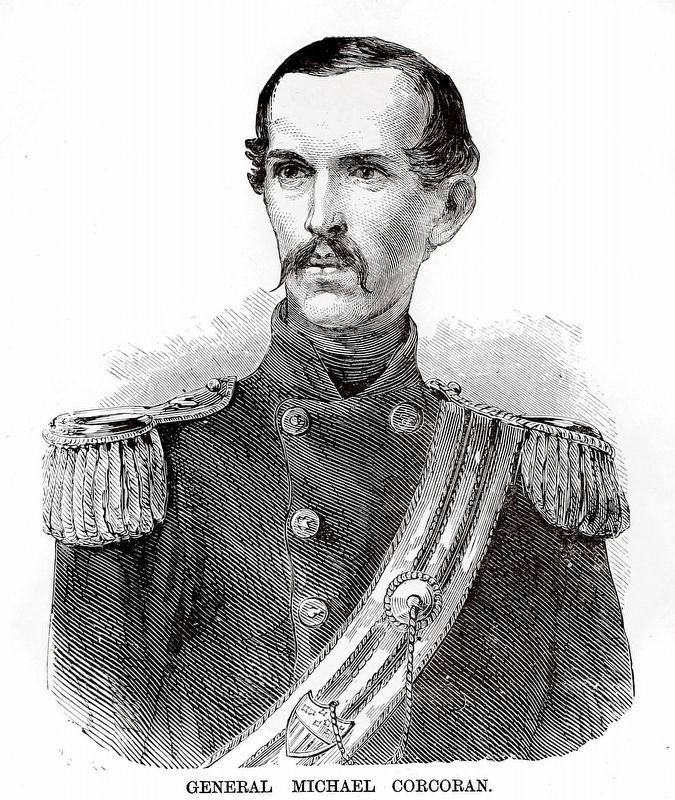
During the Civil War, the Union built a series of forts to defend Washington, D.C. By 1865 there were 33 earthen fortifications in the Arlington Line. Fort Corcoran (1861) was part of this defensive strategy. Built east of this marker, this bastion fort guarded the approaches to the Aqueduct Bridge. It was named for Colonel Michael Corcoran, of the 69th New York State Militia.
Erected by Arlington County, Virginia. (Marker Number 2.)
Topics and series. This historical marker is listed in these topic lists: Forts and Castles • War, US Civil. In addition, it is included in the Defenses of Washington series list. A significant historical year for this entry is 1861.
Location. 38° 53.78′ N, 77° 4.547′ W. Marker is in Arlington, Virginia, in Arlington County. It is in North Rosslyn. It is at the intersection of Key Boulevard and North Ode Street, on the right when traveling west on Key Boulevard. Touch for map. Marker is in this post office area: Arlington VA 22209, United States of America. Touch for directions.

Regionally, this marker is in the Washington
this page online
Other nearby markers. At least 8 other markers are within walking distance of this marker: Watergate Investigation (about 800 feet away, measured in a direct line); ARPANET (approx. 0.2 miles away); Cupid's Garden / Fort Corcoran (approx. 0.2 miles away); Purple Heart Memorial (approx. ¼ mile away); Rosslyn (approx. ¼ mile away); Fort Bennett (approx. ¼ mile away); Colonial Village (approx. 0.3 miles away); Luminous Bodies (approx. 0.3 miles away). Touch for a list and map of all markers in Arlington.
More about this marker. In the center of the marker is a map of the Washington Defenses, with a red arrow pointing out the location of Fort
February 2, 2008
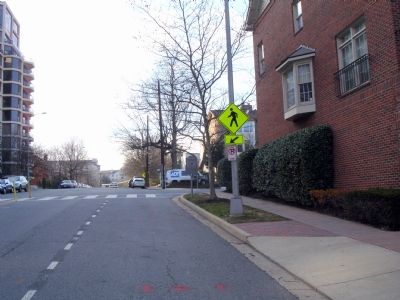
2. Fort Corcoran Marker
Additional commentary.
1. Fort Corcoran Particulars
From "Mr. Lincoln's Forts: A Guide to the Civil War Defenses of Washington," by Benjamin Franklin Cooling III and Walton H. Owen II:
Named for Colonel Michael Corcoran, 69th New York State Militia, who helped construct the fort in 1861. Fort Bennett and Haggerty were auxiliary works for Fort Corcoran. This complex defended the Aqueduct Bridge across the Potomac. Fort Corcoran had a perimeter of 576 yards, with positions for 10 guns. Armament included two 8-inch howitzers and three 20-pdr Parrott rifles.
Units stationed at Fort Corcoran included the 69th and 97th New York Infantry, 3rd and 4th New York Heavy Artillery, 16th Maine Infantry, 1st Massachusetts Heavy Artillery, and the 2nd Pennsylvania Heavy Artillery.
— Submitted February 3, 2008, by Craig Swain of Leesburg, Virginia.
2. Lincoln at Fort Corcoran
The writers of "Mr. Lincoln's Forts" also relate an interesting anecdote from a visit by President Lincoln to the fort. Recorded by the 4th New York Heavy Artillery historian, Lincoln was visiting the fort to watch artillery practice. First he witnessed
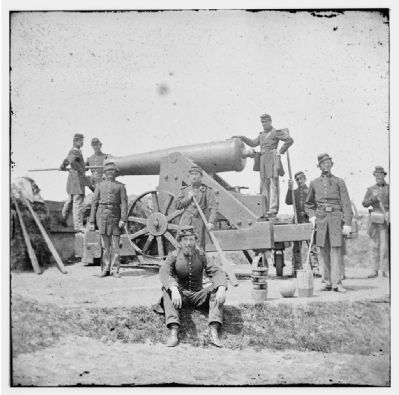
3. Soldiers at Fort Corcoran
"Soldiers with 24-pdr. siege gun on wooden barbette carriage at Fort Corcoran."
(Civil War photographs, 1861-1865 / compiled by Hirst D. Milhollen and Donald H. Mugridge, Washington, D.C. : Library of Congress, 1977. No. 0757)
(Civil War photographs, 1861-1865 / compiled by Hirst D. Milhollen and Donald H. Mugridge, Washington, D.C. : Library of Congress, 1977. No. 0757)
— Submitted February 3, 2008, by Craig Swain of Leesburg, Virginia.
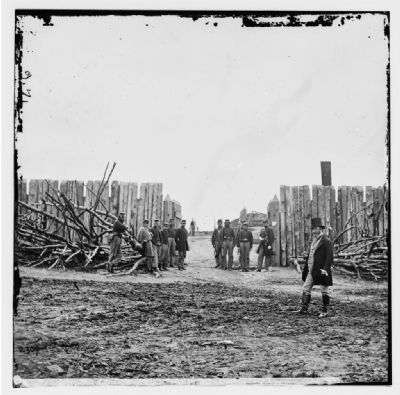
4. "Rear entrance - Fort Corcoran"
(Library of Congress Prints and Photographs Division)
http://hdl.loc.gov/loc.pnp/cwpb.01491)
http://hdl.loc.gov/loc.pnp/cwpb.01491)
National Archives
5. Fort Corcoran
NAID: 117886553, Drawer 169, Sheet 076, Maps and Charts
Internet Archive
6. General Michael Corcoran
From Frank Leslie's Scenes and Portraits of the Civil War... by Frank Leslie, 1894, Page 198.
Credits. This page was last revised on September 18, 2025. It was originally submitted on February 2, 2008. This page has been viewed 4,696 times since then and 166 times this year. Last updated on September 18, 2025. Photos: 1, 2. submitted on February 3, 2008. 3, 4. submitted on February 9, 2008. 5, 6. submitted on March 21, 2024, by Allen C. Browne of Silver Spring, Maryland. • Bernard Fisher was the editor who published this page.
