Sutton in Braxton County, West Virginia — The American South (Appalachia)
The War and Suttonville
Changing Occupations
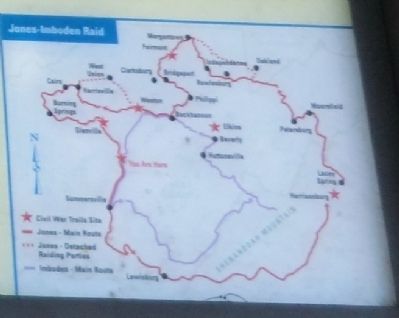
| — | Jones-Imboden Raid | — |
Photographed by Don Morfe, August 2, 2012
1. The War and Suttonville Marker
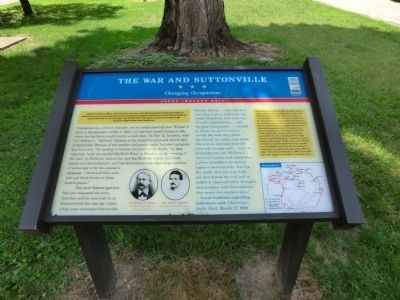
Confederate Gen. John D. Imboden and his cavalry men left Gen. William E. Jones at Buckhannon on May 6, 1863, and marched toward Summerville, where the two forces would reunite a week later. On May 12, Imboden, with Col. William L. “Mudwall” Jackson and his second-in-command struck here at Suttonville. Because of bad weather and muddy roads, Imboden’s progress had been slow. “No incident of interest occurred on the march,” he later reported, “until we reached Big Birch River, in Braxton, on the evening of the 12th. At Bulltown,
this page online
The small Federal garrison had just evacuated the town. Imboden and his men rode on to Summersville the next day. Union troops soon reoccupied Suttonville.
"Phoebe Hefner ... came [to Suttonville] to get a doctor for her sister, Elizabeth, who was very ill with typhoid fever, ... but the post commander ... refused to allow the girl to return ... [until] the next day [when she found] her sister was dead. She was so incensed that she planned revenge and ... went to [Confederate Col. William L.] Jackson's camp and asked that a force of soldiers be sent to capture Sutton[ville]. During the night that she was held ... she had heard the roll call of soldiers, observed their strength and position and this information made the capture easy."
- Local tradition regarding Imboden's raid, Charleston Daily Mail, March 27, 1938
(Sidebar) The Weston and Gauley Bridge Turnpike was one of the better roads in a section of the state with difficult terrain and few roads of any kind. It was macadamized (hard-surfaced) in parts, and farmers used it to transport grain and timber to the gristmills and sawmills in Suttonville. During the war, both Union and Confederate forces considered the turnpike to be of strategic importance for moving men and supplies north and south. Suttonville's location on the turnpike guaranteed that the contending forces would occupy or march through the community several times. In the summer of 1861, Union Gen. William S. Rosecrans and his 10,000-man army camped here, the largest force that ever bivouacked in Suttonville or marched through central West Virginia. They left on September 7, 1861. Three days later they fought ib the Battle of Carnifix Ferry.
Erected by West
Photographed by J. J. Prats, July 26, 2021
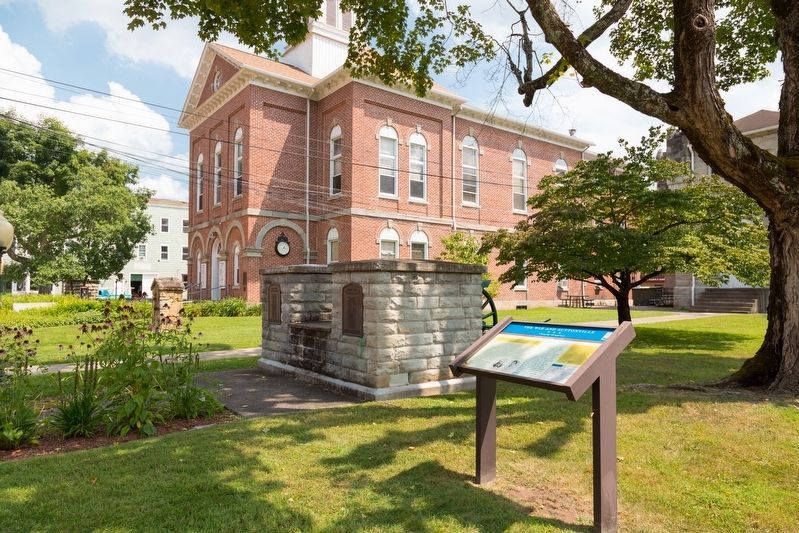
2. Marker near World War I Memorial and Courthouse
Topics and series. This historical marker is listed in this topic list: War, US Civil. In addition, it is included in the West Virginia Civil War Trails series list. A significant historical date for this entry is May 12, 1863.
Location. This marker has been replaced by another marker nearby. It was located near 38° 39.863′ N, 80° 42.512′ W. Marker was in Sutton, West Virginia, in Braxton County. It was at the intersection of Main Street and 3rd Street, on the right when traveling east on Main Street. On the grounds of the Braxton County Courthouse. Touch for map. Marker was at or near this postal address: 300 Main Street, Sutton WV 26601, United States of America. Touch for directions.

Regionally, this marker was in North Central West Virginia. It was also in the American South, specifically in the Upper South, in Appalachia, and specifically in Southern Appalachia. Globally, it was in North America, the Western Hemisphere, the Western World, and the Anglosphere. Historically, it found itself in what was once the territory of the Mississippian Culture.
Other nearby markers. At least 8 other markers are
Photographed by Don Morfe, August 2, 2012
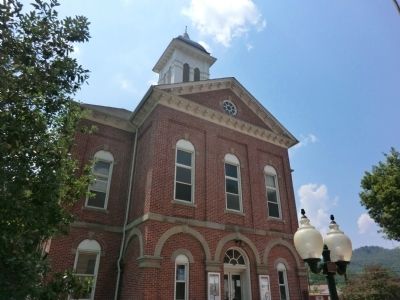
3. Braxton County Courthouse
Another marker is no longer nearby. The Burning of Suttonville (was approx. 0.4 miles away but has been replaced with another marker now near it).
Related marker. Click here for another marker that is related to this marker. This marker has been replaced by another at this location.
Photographed by Don Morfe, August 2, 2012
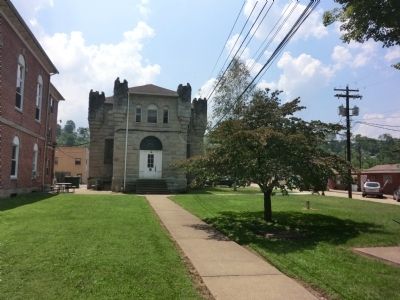
4. Old County Jail
Photographed by Don Morfe, August 2, 2012
5. The War and Suttonville Marker
Credits. This page was last revised on August 9, 2025. It was originally submitted on August 24, 2012, by Don Morfe of Baltimore, Maryland. This page has been viewed 1,668 times since then and 78 times this year. Last updated on July 25, 2024, by Carl Gordon Moore Jr. of North East, Maryland. Photos: 1. submitted on August 24, 2012, by Don Morfe of Baltimore, Maryland. 2. submitted on August 16, 2021, by J. J. Prats of Powell, Ohio. 3, 4. submitted on August 24, 2012, by Don Morfe of Baltimore, Maryland. 5. submitted on September 10, 2012, by Don Morfe of Baltimore, Maryland. • Bernard Fisher was the editor who published this page.
