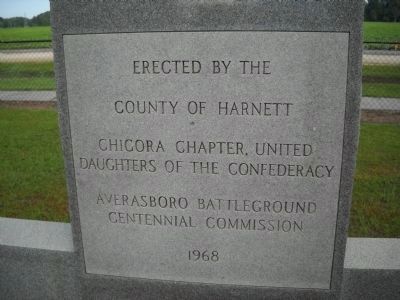
In memory of the North Carolina Troops that so valiantly resisted the advance of a superior Federal army at the Battle of Averasboro March 15-16, 1865 Fiftieth North Carolina Regiment Seventy Seventh North Carolina Regiment Tenth Battalion North . . . — — Map (db m15760) HM
(preface)
The Carolinas Campaign began on February 1, 1865, when Union Gen. William T. Sherman led his army north from Savannah, Georgia, after the March to the Sea. Sherman’s objective was to join Gen. Ulysses S. Grant in Virginia to crush . . . — — Map (db m222841) HM
The Town of Smithfield was founded ten months after the signing of the Declaration of Independence in 1776. Its origins, however, date back to the 1750s with the arrival of John Smith, one of the area’s earliest settlers.
Neuse River Ferry . . . — — Map (db m70389) HM
Formed 1758 & named for Gov. Arthur Dobbs. From it were formed Wayne, 1779, Lenoir and Glasgow (now Greene), 1791. Courthouse was 3 miles S. — — Map (db m64801) HM
The Carolinas Campaign began on February 1, 1865, when Union Gen. William T. Sherman led his army north from Savannah, Georgia, after the “March to the Sea.” Sherman’s objective was to join Gen. Ulysses S. Grant in Virginia to crush Gen. . . . — — Map (db m160759) HM
(Preface): The Carolinas Campaign began on February 1, 1865, when Union Gen. William T. Sherman led his army north from Savannah, Georgia, after the “March to the Sea.” Sherman's objective was to join Gen. Ulysses S. Grant in Virginia . . . — — Map (db m222866) HM
The Carolinas Campaign began on February 1, 1865, when Union Gen. William T. Sherman led his army north from Savannah, Georgia, after the “March to the Sea.” Sherman's objective was to join Gen. Ulysses S. Grant in Virginia to crush Gen. . . . — — Map (db m217504) HM
The Carolinas Campaign began on February 1, 1865, when Union Gen. William T. Sherman led his army north from Savannah, Georgia, after the “March to the Sea.” Sherman's objective was to join Gen. Ulysses S. Grant in Virginia to crush Gen. . . . — — Map (db m222854) HM
Thin black lines indicate changes in relevance. Between each pair of lines entries are ordered geographically but all have the same relevance.
* Inflectional forms of words are their plurals, singulars, and possessives as well as gramatical tenses and similar variations.