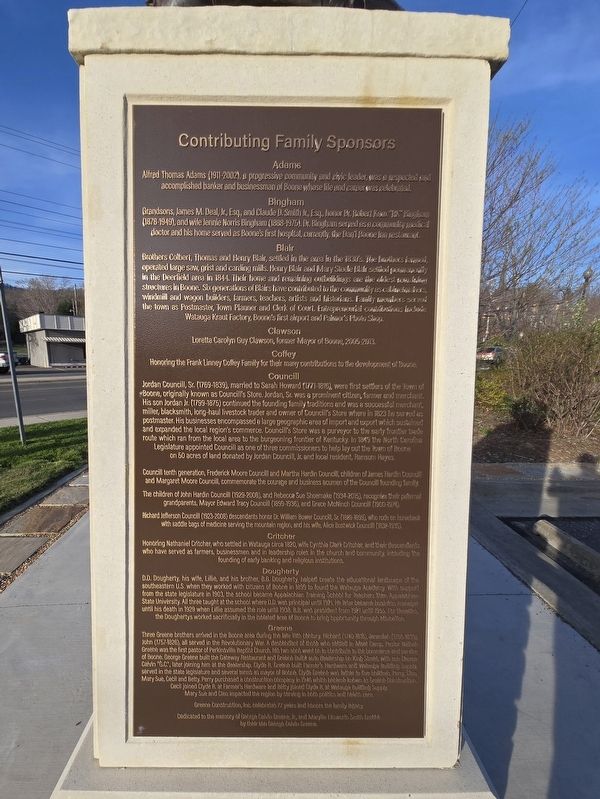
(Southeast side)
"Pioneer Portraits" in Bronze
My vision is to commemorate the brave, courageous and industrious spirit of the pioneers. The representative bronze busts evoke the determined self-reliance of the early American founders . . . — — Map (db m269706) HM
Organized on April 20, 1794, the first Baptist congregation in Johnson County was known as the Roan Creek Church of Christ. Originally located near Shouns, the church sponsored by the congregation of the Three Forks Baptist Church in Watauga County, . . . — — Map (db m104362) HM
Once located 10 yards northeast, Councill's Store was the area's first post office, established in 1823 and operated by Jordan Councill Jr. (1799-1875), a prominent merchant, livestock trader, and slaveholder. In 1849 the North Carolina legislature . . . — — Map (db m228925) HM
In July 1863, Gov. Zebulon B. Vance created the Home Guard to protect communities and capture deserters, Unionists, and bushwhackers. The Guard was made up of men not liable for conscription because of age, health, and other reasons. Capt. Harvey . . . — — Map (db m100748) HM
In 1860 Banner Elk was a small community in the mountains of Watauga County (present-day Avery County). Then called Banner’s Elk, it was named for the local Banner family and the Elk River. During the last years of the Civil War, an organized system . . . — — Map (db m77533) HM
A rich heritage of agriculture and music converged in Historic Downtown Lenoir in the large, open-air market called Hog Waller. In the early 1800s, before the formation of Lenoir and Caldwell County, the Hog Waller market attracted people from all . . . — — Map (db m208197) HM
At one time, the company was the world's largest dealer in herbs and “natural crude medicines” and in providing jobs for mountain people. Located at 107 Pendleton Street in the heart of Marion's historic downtown district, the building is listed on . . . — — Map (db m209808) HM
Thin black lines indicate changes in relevance. Between each pair of lines entries are ordered geographically but all have the same relevance.
* Inflectional forms of words are their plurals, singulars, and possessives as well as gramatical tenses and similar variations.