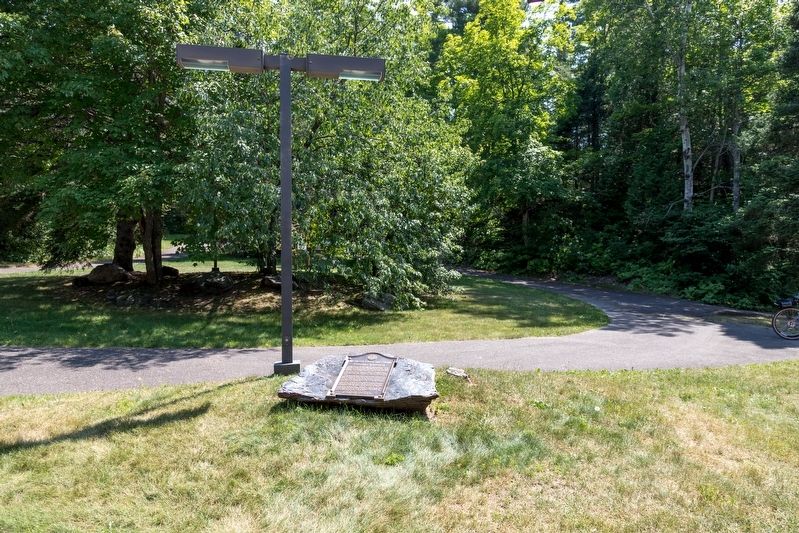
Marji-Gesick a Chippewa chief was hired in 1845 to locate a
valuable iron ore deposit about three miles from here. He was
paid with a Certificate of Interest entitling him to stock in the
company. That action led to a landmark Michigan supreme . . . — — Map (db m253997) HM
The County Road 510 steel truss bridge over the Dead River owes its existence to the passage of a few key Acts by the Michigan Legislature in the early 1900's. The first of these acts was the Trunk Line Act of 1913, which provided for the laying out . . . — — Map (db m198443) HM
Clinton Griffey
Clinton George Griffey (1841-1937) was born in Erie County, Pennsylvania. He published his first newspaper, the Girard Union in Girard, Pennsylvania, at age nineteen. In 1862 he enlisted in the 15th . . . — — Map (db m316197) HM
The Tocsin or Fire Bell has been part of a community since ancient times, warning the inhabitants of danger. The old fire bell was cast in bronze by the Henry McShane Bell Foundry in Baltimore, Maryland in 1882. It was placed in the Spring Street . . . — — Map (db m214545) HM
This Neoclassical Revival structure, designed by Charlton & Gilbert of Marquette, was constructed in 1902-04 at a cost of $210,000. Built of local sandstone, it is the second courthouse to occupy this site. In a case tried here in 1913, President . . . — — Map (db m206155) HM
In March of 1999, the Marquette County Road Commission (MCRC) received word from the State of Michigan that critical bridge funding for replacing the CR 510 Bridge over the Dead River had been approved. It was at this time that the planning process . . . — — Map (db m198444) HM
On September 25th, 1951, a group of artists met in Marquette to plan the idea of forming the Lake Superior Creative Arts Association, later to become Lake Superior Art Association. In 1959, LSAA established Art on the Rocks, the annual art fair . . . — — Map (db m269984) HM
Thin black lines indicate changes in relevance. Between each pair of lines entries are ordered geographically but all have the same relevance.
* Inflectional forms of words are their plurals, singulars, and possessives as well as gramatical tenses and similar variations.