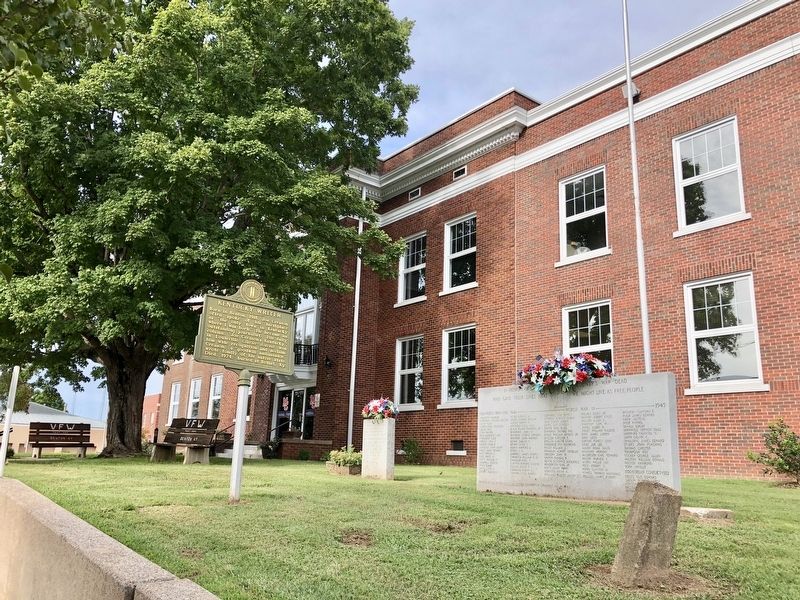
Born in Benton, 1918, Joe Creason often spoke of his birthplace as "the only town in Kentucky where I was born." He became an outstanding journalist. His daily column, "Joe Creason's Kentucky," in Louisville Courier-Journal won him wide . . . — — Map (db m123669) HM
In June 1842, nine justice met at James Clark's home near the spring on west side of old Benton-Paducah Rd. and organized first Marshall Co. Court. They were James Brien, Enos Faughn, Joel Gilbert, John McElrath, Robert Elliott, Wm. Rice, Absalom . . . — — Map (db m170164) HM
For John Marshall, 1755-1835, Chief Justice of the United States, 1801-1835, "principal founder of judicial review and of American system of constitutional law." Area first settled about time of the Jackson Purchase in 1818. First church west of . . . — — Map (db m123672) HM
Birmingham, six miles north, was one of the oldest settlements in Marshall County and a major early boat landing. Settled 1849; named by British settlers for Birmingham, England. Town covered as Kentucky Lake formed; Kentucky Dam built, 1938-44. The . . . — — Map (db m123652) HM
The Farmington engagement took place along this road during Confederate Gen. Joseph Wheeler's October 1-6, 1864, raid through the Sequatchie Valley to cut supply lines to Federal-occupied Chattanooga. Wheeler and his 4,000 cavalrymen captured or . . . — — Map (db m151054) HM
January 15, 1865 was perhaps the darkest day in the history of Guntersville. At noon, forty Federal marines from the gunboat U.S.S. General Grant were sent to burn the town. After the mission was completed, only seven buildings remained standing – . . . — — Map (db m227313) HM
Grant's long and vulnerable railroad supply line to Holly Springs originated in Columbus, Kentucky, and ran outh along the Mobile & Ohio and Mississippi Central railroads. On December 19, 1862, Brigadier General Nathan B. Forrest's Confederate . . . — — Map (db m183931) HM
Thin black lines indicate changes in relevance. Between each pair of lines entries are ordered geographically but all have the same relevance.
* Inflectional forms of words are their plurals, singulars, and possessives as well as gramatical tenses and similar variations.