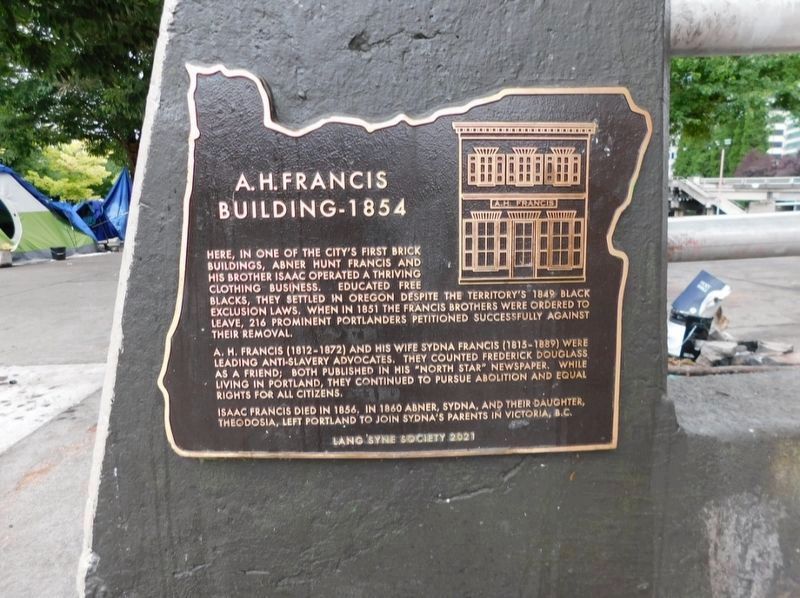
Here, in one of the city's first brick buildings, Abner Hunt Francis and
his brother Isaac operated a thriving clothing business. Educated free
Blacks, they settled in Oregon despite the territory's 1849 Black
exclusion laws. When in 1851 the . . . — — Map (db m286167) HM
Prominent landholder, civic leader and philanthropist, Lownsdale was largely responsible for the early growth of Portland. He arrived here in 1845 from Kentucky and his land claim of 640 acres encompassed most of present day downtown Portland. The . . . — — Map (db m309326) HM
A water front shack in this vicinity housed the hand press brought from San Francisco in 1850 by Thomas Dryer to start a newspaper in the small but ambitious settlement of Portland. This marker commemorates an historic event. — — Map (db m310026) HM
On this block, May 17, 1858, Portland’s first public school was opened: L. L. Terwilliger, principal; Mrs. Mary J. Hensill, primary grades; Owen Connelly, higher section; 280 pupils enrolled. Enlarged in 1873, it became the Central School building. . . . — — Map (db m308964) HM
Simon Benson, born in Norway, arrived in Portland in 1880 at age 29 with little money, a wife and child. By the 1890s he operated a vast timber enterprise, and was an active proponent of new logging techniques, including the donkey steam engine and . . . — — Map (db m256510) HM
First planks for the Canyon Road connecting Portland with the rich Tualatin Valley were laid near this spot in September 1851. As a community effort it brought farm produce to our docks and established Portland as a port and market for the old . . . — — Map (db m309102) HM
A former Iowa territorial legislator and native of Virginia, Chapman arrived in Portland in 1850 and became a partner in the townsite promotion company with Daniel Lownsdale and Stephen Coffin. An attorney with business interests, including shipping . . . — — Map (db m309317) HM