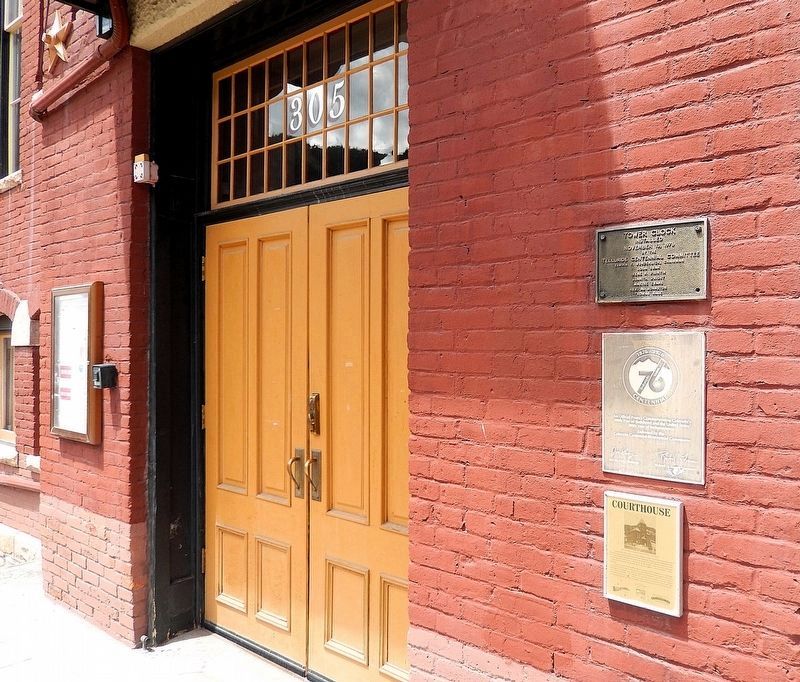
On West Colorado Avenue at Oak Street (now a pedestrian walkway), on the left when traveling east on West Colorado Avenue.
An official project commemorating Colorado's 100th year of Statehood and the United States' 200th Year of Independence. Endorsed by the Colorado Centennial-Bicentennial Commission Joe M. Lacy, Chairman Richard D. Lamm, Governor — — Map (db m283114) HM
On West Colorado Avenue at Oak Street (now a pedestrian walkway), on the left when traveling east on West Colorado Avenue.
In the fall of 1887, work on the San Miguel County Courthouse was completed. This was just nine months after the original courthouse, located on the southeast corner of Fir and Colorado burned to the ground on January 13, 1887. The bricks from the . . . — — Map (db m283094) HM
On West Colorado Avenue at Oak Street (now a pedestrian walkway), on the right when traveling east on West Colorado Avenue.
Prior to Spanish exploration in the Telluride region, Native Americans of the Ute tribe used this area as a seasonal hunting ground. In the 1870's, however, mining ventures and a substantial population growth displaced the Utes further Southwest . . . — — Map (db m282984) HM
On South El Paso Street at East San Antonio Avenue, on the left when traveling north on South El Paso Street.
In the early twentieth century, Felix Martinez was a prominent Hispanic businessman who worked closely with Anglo American leaders to transform El Paso into a major commercial, industrial and agricultural center of the American Southwest. Born in . . . — — Map (db m252424) HM
On Million Dollar Highway (U.S. 550) 2 miles south of County Highway 30, on the right when traveling north.
Panel 1 This region was founded by gold and silver miners in the 1870s. This 17-square mile area has produced 4 million ounces of gold, 21 million ounces of silver, and 12 million tons of lead, zinc and copper. The natural resources from . . . — — Map (db m179088) HM
Thin black lines indicate changes in relevance. Between each pair of lines entries are ordered geographically but all have the same relevance.
* Inflectional forms of words are their plurals, singulars, and possessives as well as gramatical tenses and similar variations.