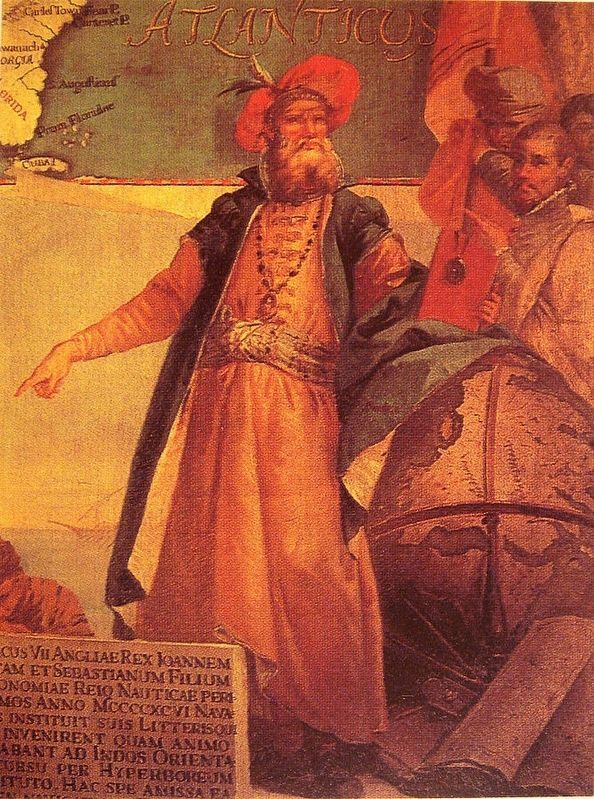
On Cape Shore Road, on the left when traveling north.
Cabot’s Landfall in the New World
In early May, 1497, John Cabot (Giovanni Caboto), a Venetian
citizen bearing letters patent from Henry VII, sailed from
Bristol in the Matthew to seek a western passage to Asia.
On . . . — — Map (db m301879) HM
On Sweetlands Hill, on the right when traveling west.
Built by Ronald Strathie, this hall is thought to be the largest wooden
fraternal hall in Canada. It is home to the Loyal Orange Lodge which,
in the early 20th century, had a local membership of 475. It has also
hosted plays, socials, and . . . — — Map (db m285960) HM
On Sweeneys Lane at Jubilee Lane, on the left when traveling south on Sweeneys Lane.
This is an excellent early example of the Carpenter Gothic style that
proliferated throughout Newfoundland and Labrador in the 19th
century. The style is evoked here by tall, lancet-arched windows,
faux buttresses, and spires of wood. A carved . . . — — Map (db m294796) HM
On Stanley's Crescent at Harwoods Road, on the right when traveling west on Stanley's Crescent.
The current railway station building, which once housed the local
telegraph and customs offices was a later addition to the railway
station established by Newfoundland Railway in 1891. The local
Shrine Club took possession of the building in . . . — — Map (db m285961) HM
On Catalina Road at Main Street, on the right when traveling south on Catalina Road.
This wooden Gothic Revival Style building
was built by Allen and Robert Ryder and is
a very good example of the application of
this style to small churches, much of its
interior detail is original, including the curved
scissor-braced roof frame. — — Map (db m285977) HM