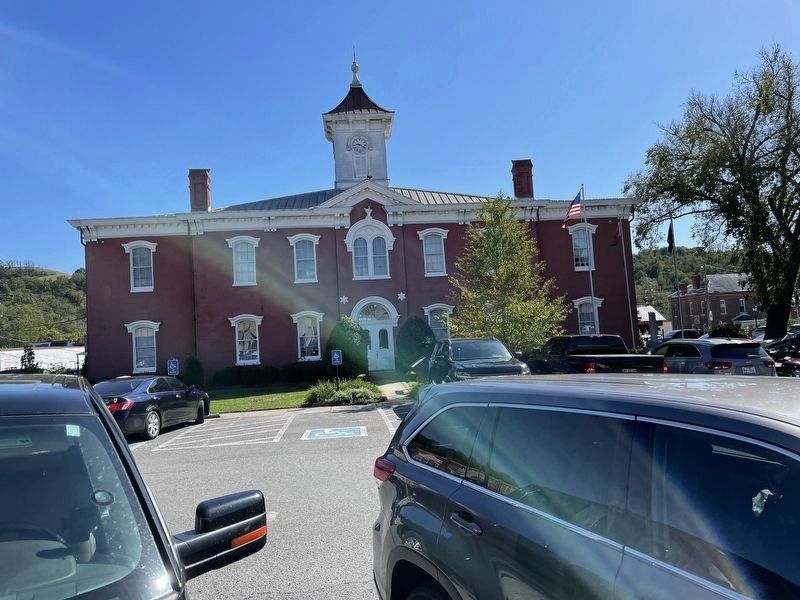
On Short Street west of Mechanic Street South, on the left when traveling west.
Lynchburg was a mere crossroads village in 1861, but the war and the years that followed it transformed this place. By the end of April 1861—six weeks before Tennesseans formally voted to secede—local men had formed Co. E (Lynchburg Rangers), 1st . . . — — Map (db m152104) HM
On Hines Street at Main Street, on the left when traveling south on Hines Street.
Moore County was created by an Act of the Tennessee legislature December 1871, and was named in honor of Gen. William Moore. Born in Kentucky in 1786, he settled on Mulberry Creek circa 1806. Captain in the War of 1812 and the Creek Indian Wars, and . . . — — Map (db m24630) HM
On Charlotte Avenue, on the left when traveling east.
"...Be it resolved by the Senate of the eighty-first General Assembly of the State of Tennessee, the House of Representatives concurring, that the General Assembly of Tennessee, in appreciation of the foresight and untiring efforts of the late Lem . . . — — Map (db m213212) HM
On Short Street east of Hiles Street, on the left when traveling west.
[Monument, front side]
We cannot forget
We must not forget
We dare not forget
Air Force • Army • Coast Guard • Navy • Marine Corps
In honor of those sons and daughters
of Moore County who served their
country . . . — — Map (db m152112) WM
On Shelbyville Hwy (U.S. 41-A) near Carr Creek Rd, on the left when traveling north.
Moore County Established 1871; named in honor of
Major Gen. William Moore
He settled in Tennessee in 1808, coming from Kentucky. Commanded a company in the Creek War; finished the War of 1812 as a Major General. Member of the State House . . . — — Map (db m61915) HM
On Main Avenue S (U.S. 431) at College Street (U.S. 64) when traveling south on Main Avenue S.
In November 1809, thirteen years after
Tennessee became a state, settlers of
lower Bedford County saw the need to
establish a new county which resulted
in an act being passed by the General
Assembly in Knoxville that a county,
to be called . . . — — Map (db m191646) HM
Thin black lines indicate changes in relevance. Between each pair of lines entries are ordered geographically but all have the same relevance.
* Inflectional forms of words are their plurals, singulars, and possessives as well as gramatical tenses and similar variations.