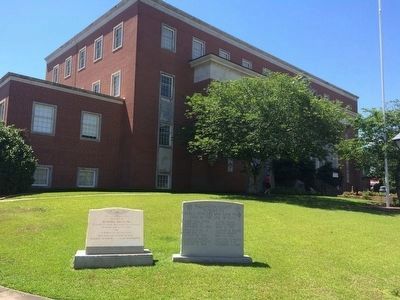
On North Broadnax Street (Alabama Route 49) at Columbus Street, on the right on North Broadnax Street.
In honor of those who served so gallantly
in World War II, 1941 — 1945
and
in memory of the following
who made the supreme sacrifice
Monroe Newman • G.W. Henderson — — Map (db m95134) WM
On North Broadnax Street at West Cusseta Street, on the right when traveling south on North Broadnax Street.
This tablet is placed by
Tallapoosa County
in commemoration of the
one hundredth anniversary
of the
Battle Of Horseshoe Bend,
fought within its limits
on March 27, 1814.
There the Creek Indians, led by
Menawa and other chiefs, . . . — — Map (db m28751) HM
On Stillwaters Highway (Alabama Route 49) 0.3 miles north of Halls Folly Road, on the right when traveling north.
Born and educated in Baden, Germany, and educated as a horticulturist, William Carl Roeck arrived in America in 1854 at the age of eighteen and engaged in extensive travels. He later enlisted in the Confederate Army, serving four years in the Second . . . — — Map (db m223945) HM
On Alabama Route 22 east of Drake Road, on the right when traveling east.
Daviston, Alabama
Daviston, incorporated February 16, 1887, is believed to be the first incorporated rural town in Tallapoosa County. The first mayor was J.D. Dunn. Daviston was a natural evolution of the opening of Indian lands in 1832. Much . . . — — Map (db m92502) HM
On South Broadnax Street at Eufalla Street, on the right when traveling south on South Broadnax Street.
Fletcher Farrington, after graduating from the Alabama Polytechnic Institute (now Auburn University), came to Tallapoosa County as a county agent for the Agricultural Extension Service in 1932. Concluding that soil erosion was the local farmers . . . — — Map (db m95105) HM
On North Broadnax Street (Alabama Route 49) north of West Columbus Street, on the left when traveling north.
In August 1814, following Gen. Andrew Jackson's victory at the
Battle of Horseshoe Bend, the Creek Nation ceded its land in central
and south Alabama to the U.S. Government. On March 24, 1832, the
Creek Nation signed the Treaty of Cusseta, . . . — — Map (db m223956) HM
On Senator Claude Pepper Drive (Alabama Route 50) at Newell Street, on the left when traveling west on Senator Claude Pepper Drive.
(side 1)
Edward Bell High School
On this site Tallapoosa County Training School, later named Edward Bell High School, became the first high school for African Americans in Tallapoosa County, Alabama in 1931, with graduation of its . . . — — Map (db m92505) HM
On North Broadnax Street (Alabama Route 49) at East Cusseta Street, on the right when traveling north on North Broadnax Street.
Strategically located at the juncture of 19th-century roads
from Georgia and Tennessee, Dadeville was first charted in
1837. The next year, it was designated the seat of justice for
Tallapoosa County, one of a number of counties created in
1832 . . . — — Map (db m223964) HM
On North Broadnax Street (Alabama Route 49) at West Cusseta Street, on the right when traveling south on North Broadnax Street.
To the memory of
the men
of Tallapoosa County Alabama
who gave their lives in the
World War
Sanford E. Adams
Henry Lorenza Dabbs
Paul H. Harris
Amos D. Howle
Handley Mask
Clarence E. Newell
Allen Plant
Harmie E. Stevens . . . — — Map (db m68068) WM
On South 9th Street south of Avenue A, on the right when traveling south.
Lee County Courthouse
Lee County was created from portions of Russell,
Macon, Chambers and Tallapoosa Counties by act of
the Alabama Legislature approved December 5, 1866.
Lee County's first election was held January 21, 1867.
An . . . — — Map (db m297059) HM
On East Lafayette Street east of North Spring Street, on the left when traveling east.
A 1907 act of the Alabama Legislature called for the
construction of a new public high school in each
county. Officials selected Dadeville as the location of
Tallapoosa County High School. Residents sought
private funds and used a bond issue to . . . — — Map (db m223975) HM
Thin black lines indicate changes in relevance. Between each pair of lines entries are ordered geographically but all have the same relevance.
* Inflectional forms of words are their plurals, singulars, and possessives as well as gramatical tenses and similar variations.