On West Main Street (State Highway 89) at North Poplar Street, on the left when traveling east on West Main Street.
(front/south side)
In honor of the Confederate Soldiers of Weakley County,
Tennessee 1861-1865
(west side)
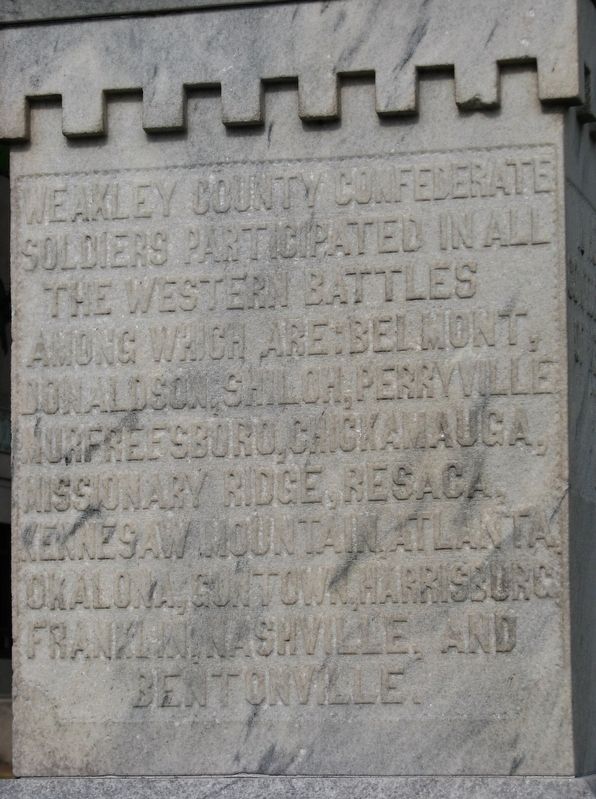
Weakley County Confederate soldiers participated in all the western battles among which are: Belmont, Donaldson, Shiloh, . . . — — Map (db m127898) WM
On West Main Street (Tennessee Route 89/54) at North Poplar Street, on the right when traveling west on West Main Street.
Weakley County was established Oct. 21, 1823, and named for Robert Weakley, then Speaker of the State Senate. In 1825, John Terrell gave 39 acres for the county seat. Martin Lawler, Richard Ridgeway, John R. Shultz, Perry Vincent, and Mears Warner, . . . — — Map (db m83162) HM
On West Main Street (Tennessee Route 54) west of North Wilson Street, on the right when traveling west.
Weakley County's residents voted to stay with the Union in June 1861 while most of West Tennessee supported the Confederacy. Local farmer and slave owner John Drewry spoke passionately against secession here at the courthouse. On June 8, he . . . — — Map (db m274280) HM
On University Street (State Highway 431) 0.1 miles west of Lovelace Avenue, on the right when traveling east.
Founded in 1900 by local Baptists as Hall-Moody Institute, later Hall-Moody Junior College. Following acquisition by Martin and Weakley County, State Legislature placed the College under The University of Tennessee in 1927; made it degree-granting . . . — — Map (db m155916) HM
On North Main Street at Cedar Street, on the left when traveling north on North Main Street.
Shortly after the Battle of Shiloh on April 6-7, 1862, information reached the Confederate army near Corinth in northern Mississippi that a large store of Union supplies worth $3,000,000 was located at Paducah, Kentucky. On April 29, Confederate . . . — — Map (db m271959) HM
Wiley Fore and his family came to this area from Alabama in 1883. The Baker community had been started two years earlier by Fore's nephew, Robert Baker, and his family. Soon after his arrival Fore organized the Bethel Cumberland Presbyterian . . . — — Map (db m3562) HM
Early Tennessee settlers did not have access to year-round fresh produce like we do today.
General stores were often miles away and sold dried goods and seeds for growing your own
food in kitchen gardens like this. Common plants were onions, . . . — — Map (db m205314) HM
Thin black lines indicate changes in relevance. Between each pair of lines entries are ordered geographically but all have the same relevance.
* Inflectional forms of words are their plurals, singulars, and possessives as well as gramatical tenses and similar variations.