On South Front Street close to Main Street, on the right when traveling north.
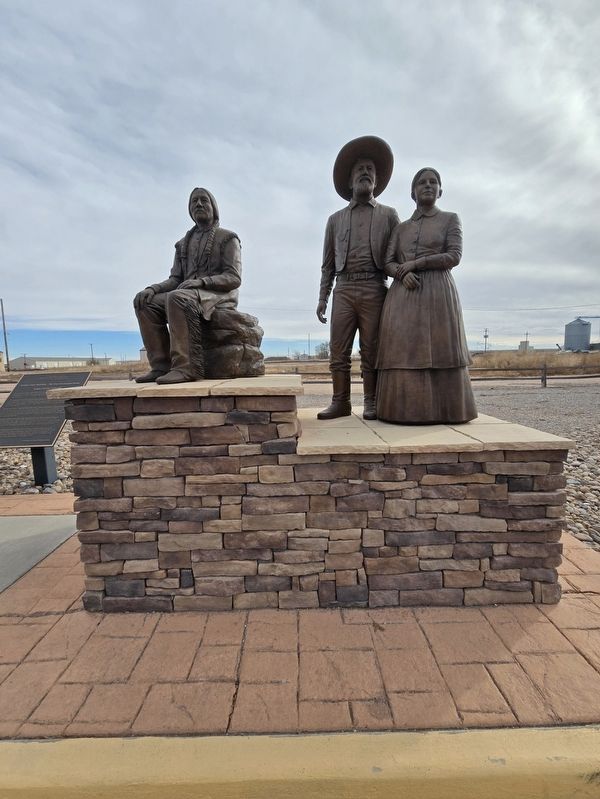
In the late 1800's the South Platte River Valley was a treeless wilderness covered in sagebrush, prairie grass and scrub willows. Great herds of antelope and buffalo roamed the windswept plains. Those continuing further west referred to this . . . — — Map (db m288864)
On South 4th Street at Main Street, on the right when traveling north on South 4th Street.
In Loving Memory of Orville S. Johnson (1911-1987) and H. Catherine Johnson (1914–2003) Orville and Catherine Johnson were lifetime residents of Northeast Colorado. Orville graduated from Sterling High School in 1930) and Catherine from Padroni . . . — — Map (db m289034) HM
On N 4th Street at Main Street, on the right when traveling north on N 4th Street.
"This river, this valley, this giant furrow was the route of moving Indian tribes, of John C. Fremont on two occasions, of trappers, traders and gold seekers. It dictated the course of the Union Pacific tracks from Julesburg to Denver and the . . . — — Map (db m288862) HM
On U.S. 83 at 2nd Street, on the left when traveling north on U.S. 83.
Legends are sometimes too good to be true, but Buffalo Bill was the real thing. He was born William Frederick Cody in a log cabin in Iowa in 1846, grew up on the plains of Kansas, and fought for the Union during the Civil War as a trooper . . . — — Map (db m116885) HM
Near County Highway 63.2 at County Highway 36, on the right when traveling north.
The Northeastern most county in Colorado was first Weld County, later Logan County and established in its own right April 9, 1889.
It consists of 554 square miles, incorporating 3 towns: The County Seat, Julesburg, Ovid and Sedgwick.
. . . — — Map (db m119437) HM
On U.S. 83 at 2nd Street, on the left when traveling north on U.S. 83.
At the end of the Ice Age, about 9000 years ago, people hunted wooly mammoths and ancient bison on the plains of what is now Kansas. They used spears and atlatls, or throwing sticks, and they made beautiful stone points from native flint. They . . . — — Map (db m66121) HM
On Main Street (U.S. 68) at Court Avenue, on the left when traveling south on Main Street.
America's first concrete streets were those which surrounded this court house. Concrete was first used in 1891 to provide an 8-foot strip along Main Street where horses were hitched. Two years later Court Avenue was paved with concrete made from . . . — — Map (db m156664) HM