
Bellefontaine in Logan County, Ohio — The American Midwest (Great Lakes)
Oldest Concrete Street in America
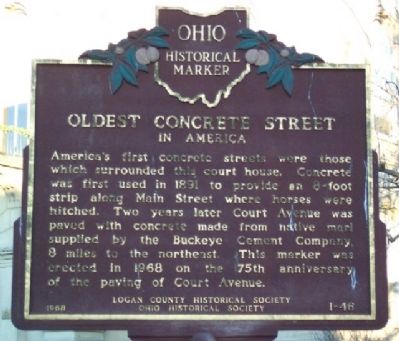
Photographed by William Fischer, Jr., December 29, 2008
1. Oldest Concrete Street in America Marker
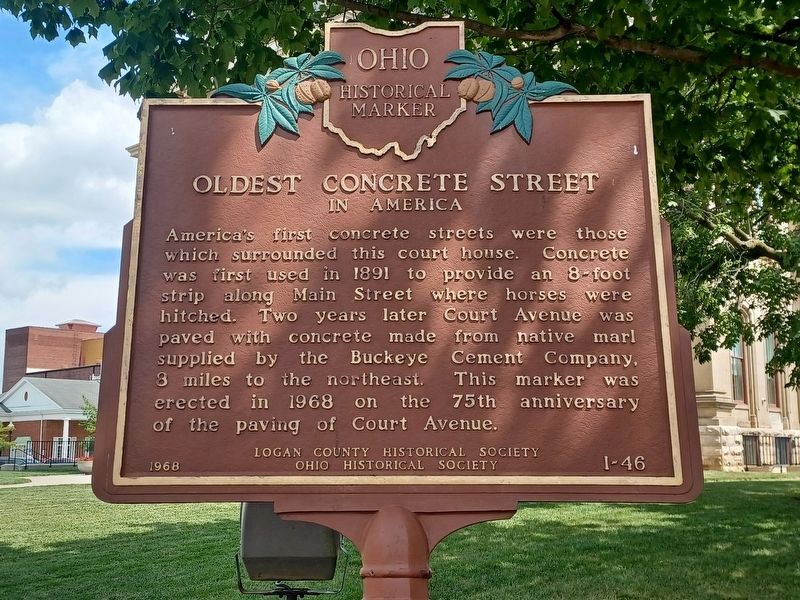
America's first concrete streets were those which surrounded this court house. Concrete was first used in 1891 to provide an 8-foot strip along Main Street where horses were hitched. Two years later Court Avenue was paved with concrete made from native marl supplied by the Buckeye Cement Company, 8 miles to the northeast. This marker was erected in 1968 on the 75th anniversary of the paving of Court Avenue.
Erected 1968 by Logan County Historical Society and The Ohio Historical Society. (Marker Number 1-46.)
Topics and series. This historical marker is listed in these topic lists: Industry & Commerce • Man-Made Features • Notable Places • Roads & Vehicles. In addition, it is included in the Ohio Historical Society / The Ohio History Connection series list. A significant historical year for this entry is 1891.
Location. 40° 21.633′ N, 83° 45.576′ W. Marker is in Bellefontaine, Ohio, in Logan County. It is at the intersection of Main Street (U.S. 68) and Court Avenue, on the left when traveling south on Main Street. Marker is at the SW corner of the county courthouse grounds. Touch for map. Marker is in
this page online

Regionally, this marker is in Ohio’s Till Plains. It is also in the American Midwest and in the Corn Belt. Globally, it is in North America, the Western Hemisphere, the Western World, and the Anglosphere. Historically, it finds itself in what was once the Viceroyalty of New France, the Haudenosaunee (Iroquois) Confederacy, the territory of the Mississippian Culture, and the Northwest Territory.
Other nearby markers. At least 8 other markers are within walking distance of this marker: Grid Indentation Pattern (here, next to this marker); The pavement of Court Avenue (a few steps from this marker); First Concrete Pavement (a few steps from this marker); Bartholomew's Concrete (a few steps from this marker); International Exposition of 1893 (a few steps from this marker); George W. Bartholomew (a few steps from this marker); The Bottom Course (a few steps from this marker); Bartholomew convinced the City of Bellefontaine (a few steps from this marker). Touch for a list and map of all markers in Bellefontaine.
Also see . . . First Concrete Street in the United States.
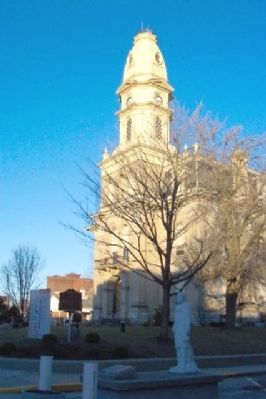
Photographed by William Fischer, Jr., December 29, 2008
2. Oldest Concrete Street in America Marker
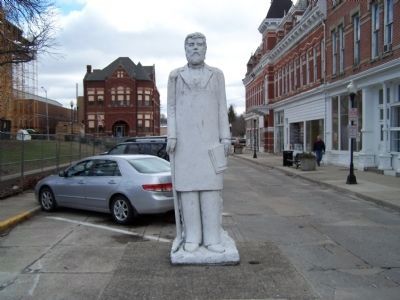
At left. George Bartholomew statue and marker in foreground. County courthouse in background.
In the late 1880's George W. Bartholomew perfected and patented the "wet method" of making concrete. While on a sales trip to Philadelphia in 1890, Bartholomew examined an asphalt street noting that horses' hoofs left imprints in the surface. Believing that his concrete would make a much better surface he returned to Bellefontaine and set about convincing the City Council to join in an experiment to test the feasibility of his idea. In 1891 an eight foot wide layer of concrete was laid along Main Street in front of the Logan County Courthouse where horses were tied. After almost two years of use during which the pavement had stood up to the wear, the City Council contracted with Bartholomew's Buckeye Portland Cement Company to surface the four streets (Main Street, Opera Street, Columbus Street and East Court Avenue) that were adjacent to the courthouse square. Bartholomew provided the concrete at no cost and the city appropriated $9000 to cover the cost of other materials and labor. In addition, Bartholomew(Submitted on September 15, 2025, by Joel Seewald of Madison Heights, Michigan.)was required to post a $5000 bond to be forfeited if the surface did not last five years.Photographed by William Fischer, Jr., December 29, 20083. Oldest Concrete Street in America (Court Street)Opera House in background.
The concrete was poured in the summer of 1893 and the four streets mentioned above became the first public thoroughfares in the United States to be surfaced with concrete. The experiment proved Bartholomew's contention that concrete could serve as a paving material. The streets Bartholomew paved remained in service for 65 years without major maintenance. In 1956 the first major maintenance project was undertaken to repair chipping and breakage which had occurred at the comers and along the edges of the sections.
Bartholomew remained in Bellefontaine until 1909 when dwindling supplies of limestone forced him to close his Buckeye Portland Cement Company. He then moved to Denver, Colorado and became the manager of a cement plant there.
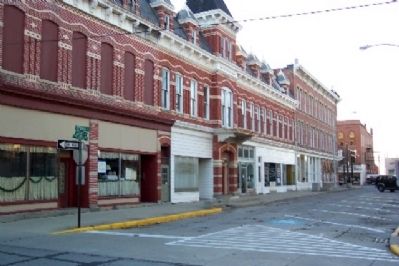
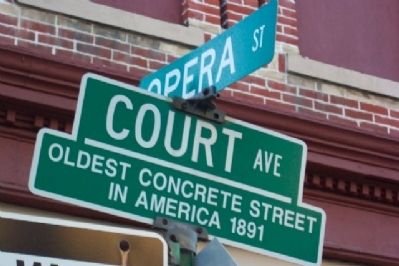
Photographed by William Fischer, Jr., December 29, 2008
4. Oldest Concrete Street in America Street Sign
Photographed by Rev. Ronald Irick, March 7201
5. Oldest Concrete Street in America Marker
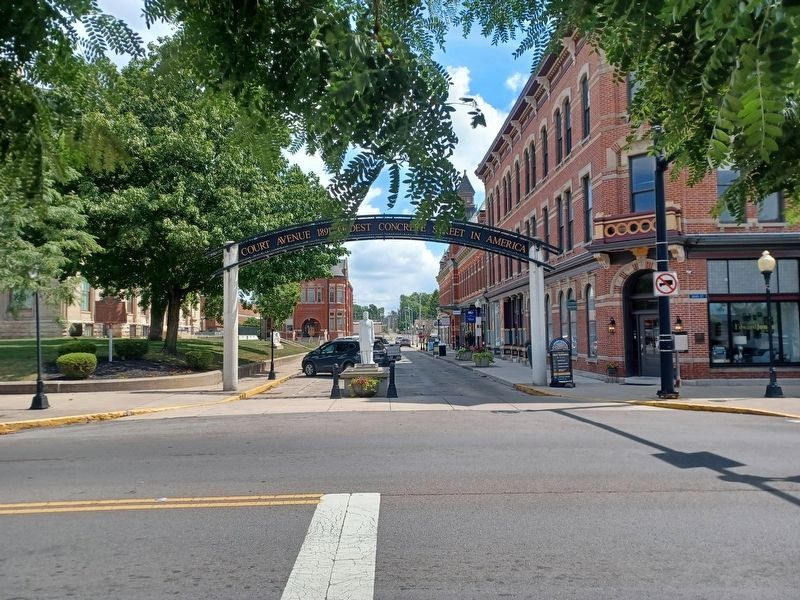
full view of George Bartholomew statue
Photographed by Joel Seewald, August 23, 2025
6. Oldest Concrete Street in America Marker
Photographed by Joel Seewald, August 23, 2025
7. Oldest Concrete Street in America Marker
Credits. This page was last revised on September 20, 2025. It was originally submitted on August 30, 2009, by William Fischer, Jr. of Reynoldsburg, Ohio. This page has been viewed 2,105 times since then and 118 times this year. Last updated on September 23, 2020, by Robert Baughman of Bellefontaine, Ohio. Photos: 1, 2. submitted on August 30, 2009, by William Fischer, Jr. of Reynoldsburg, Ohio. 3, 4. submitted on August 31, 2009, by William Fischer, Jr. of Reynoldsburg, Ohio. 5. submitted on April 8, 2015, by Rev. Ronald Irick of West Liberty, Ohio. 6, 7. submitted on September 15, 2025, by Joel Seewald of Madison Heights, Michigan. • Devry Becker Jones was the editor who published this page.
