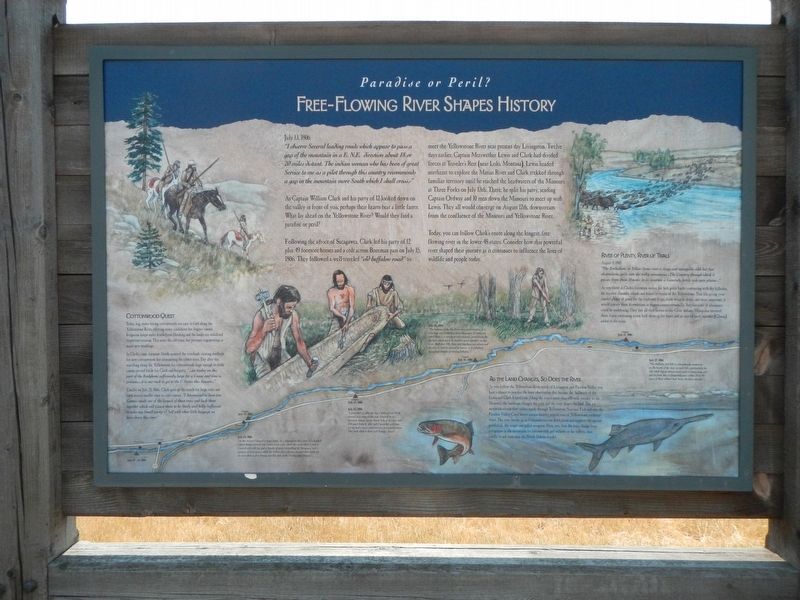
On Interstate 90 at milepost 325, on the right when traveling east.
(Three panels make up this marker:) Yellowstone River:
Haven for Great Hers of Wildlife
July 24, 1806
"Saw emenc number of Deer Elk and buffalow on the banks. Some beaver...for me to mention or give an . . . — — Map (db m191921) HM
A few years after Livingston Memorial Hospital opened in February 1955, the Livingston Enterprise reported, “This neat, modern building will hold a prominent position in the lives of Livingston residents for years to come. For some it will be their . . . — — Map (db m191797) HM
On Interstate 90 at milepost 325, on the right when traveling east.
(Left panel:)
Early Exploration and Settlement:
John Colter, member of the 1804-1805 (sic) Lewis and Clark Corps of Discovery, in 1807 was the first known white man to have traversed through the area known as Yellowstone . . . — — Map (db m191799) HM
Near Zerex Street (U.S. 40) at Clayton Avenue, on the right when traveling north.
Jeremiah Johnson was a Mountain Man. Indians gave him the name “Dapiek Absaroka”, meaning Crow Killer. He carried on a one-man war with the Crow Indian Nation in retaliation for the death and scalping of his Flathead Indian wife, The Swan, and . . . — — Map (db m288398) HM
On West Callender Street near South Yellowstone Street, on the left when traveling west.
W. H. Campbell, a physician, president of the Montana State Board of Medical Examiners, and two-term state senator from Park County, built this Queen Anne style home in 1890. The one-and-one-half-story residence has a central hipped roof with two . . . — — Map (db m191641) HM
On U.S. 89 0.8 miles south of Yankee Jim Campground, on the right when traveling south.
Visit the interpretive trail across the river and take a pleasant walk on an improve trail or enjoy a picnic. A series of interpretive signs will take you on a journey through time to some fascinating eras of history.Past, present and future The . . . — — Map (db m46260) HM
On W Yellowstone Avenue (U.S. 20) west of Demaris Drive, on the right when traveling west.
Colter’s Hell is a large, mostly extinct, geyser basin. Today, there are a few hot springs, and vents which release sulphurous gasses along the Shoshone River. This site includes some of the world’s largest extinct geyser cones and thermal pools. . . . — — Map (db m86147) HM
On Spring Street, on the left when traveling east.
When the Northern Pacific Railroad announced plans to build a branch line to Yellowstone National Park in the early 1880s, the small town of Gardiner quickly emerged as a "wild west" town. Early accounts labeled it "a veritable Shantyville . . . an . . . — — Map (db m227576) HM
Thin black lines indicate changes in relevance. Between each pair of lines entries are ordered geographically but all have the same relevance.
* Inflectional forms of words are their plurals, singulars, and possessives as well as gramatical tenses and similar variations.