Spanish Fort in Baldwin County, Alabama — The American South (East South Central)
Stop 8 The Eighth Iowa Line:
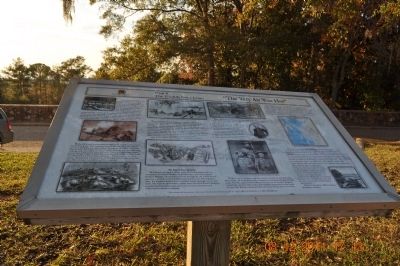
“The Very Air Was Hot”
Photographed by Sandra Hughes, December 8, 2011
1. Stop 8 The Eighth Iowa Line: Marker
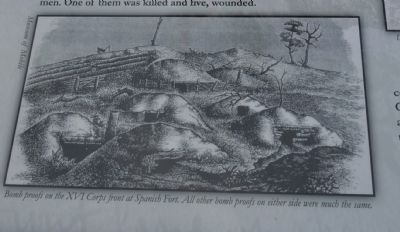
By the 8th, Canby had mounted 53 siege guns, including 16 mortars, and 37 field guns. That evening Gibson’s batteries and skirmishers opened a brisk fire intended to draw the enemy out. They succeeded only too well. The return fire from Canby’s batteries was overwhelming, and Gibson’s guns were soon silenced. Even the Confederate bomb proofs, through made of three layers of logs and six feet of dirt, could not withstand the fury of this cannonade. For example, a ten-inch mortar
this page online
“The very air was hot. The din was so great in distracted our senses, we could hardly hear each other speak and could hardly tell what we were doing. The cracking of musketry, the unbroken roaring of artillery; the yelling and shrieking of the shells, the bellowing boom of mortars, the dense shroud of sulphurous smoke thickening around us – it was thought the mouth of the pit had yawned and the uproar of the damned was about us, and is was not taking away form this infernal picture to see men, as I did, hopping about, ‘raving, distracted mad,’ the blood bursting form eyes and ears and mouth, driven stark crazy by concussions or some other cause.” Phillip D. Stevenson, Fifth Company, Washington Artillery.
The Eighth Iowa Advances At 6:10 p.m. on April 8, under cover of this bombardment, two companies of Colonel William Bell’s 8th Iowa, of Colonel James Geddes’ Brigade, advanced around the far right of the Union works and into a swamp on the Confederate’s extreme left. Skirting fallen trees, the Yankees
Photographed by Sandra Hughes, December 8, 2011
2. Stop 8 The Eighth Iowa Line: Marker
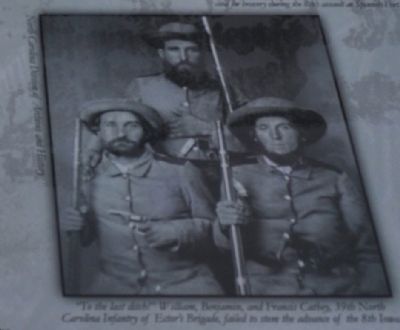
"To the last ditch!" William Benjamin, and Francis Cathey, 39th North Carolina Infantry of Ector's Brigade, failed to stem the advance of the 8th Iowa.
Bell’s skirmishers then forced the defenders back and occupied the hill. Bell rushed the rest of the 8th to their support. By now night had fallen and, finding the hill too exposed in the bright moonshine, Bell led his men forward. The 8th followed enthusiastically, exploiting a weakness in the enemy’s lines. The Yankees then faced an appalling resistance among Ector’s Texans and North Carolinians, quite a number of whom refused to yield and were shot, dying in the last ditch rather than surrender.
Under cover of darkness and clamor of battle all along the line, Bell overran the Confederate left, composed of isolated rifle pits, for 300 yards. The 8th, supported by 8:00 p.m. by the rest of Geddes’ Brigade, entered the enemy’s main works. The Yankees entrenched a line inside of the fort. The Rebels counterattacked, but the Federals beat them back.
When Gibson learned a force in strength had turned his position, he spiked his
Photographed by Sandra Hughes, December 8, 2011
3. Stop 8 The Eighth Iowa Line: Marker
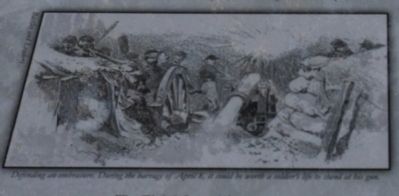
Defending an embrasure, during the barrage of April 8, it could be worth a soldier's life to stand at his gun.
“The face of the bluff was precipitous, and creased with great---ravines opening out on the water. Down we …[went], pell-mell, right down the almost perpendicular sides of the gorge, clinging to vines, saplings, the sides of rocks; any way to keep our hold, until we reached the bottom, fifty feet or so below, and there to our amazement, we found the beginning of a treadway, one or two planks wide. At the word, all shoes and boots were off and we stood in our stocking or naked feet in a single line… After order not to whisper a word…, we went forth…We passed so close to the enemy’s pickets stationed in the marsh that we could hear them talking, and right under the noses of their battery.
Finally,
Photographed by Sandra Hughes, December 8, 2011
4. Stop 8 The Eighth Iowa Line: Marker
Bomb proofs on the XVI Corps front at Spanish Fort. All other bomb proofs on either side were much the same.
Topics. This historical marker is listed in this topic list: War, US Civil. A significant historical month for this entry is April 1904.
Location. 30° 39.525′ N, 87° 54.706′ W. Marker is in Spanish Fort, Alabama, in Baldwin County. It is on Larry Dee Cawyer Drive. Touch for map. Marker is at or near this postal address: 29750 Larry Dee Cawyer Drive, Daphne AL 36527, United States of America. Touch for directions.

Regionally, this marker is on the Gulf Coast and in the Mobile Bay area. It is also in the American South, specifically in the Deep South, and on the Gulf Coast. Globally, it is in North America, a Gulf of Mexico state, the Western Hemisphere, the Western World, and the Anglosphere. Historically, it finds itself in what was once New Spain, the Viceroyalty of New France, the territory of the Mississippian Culture,
Photographed by Sandra Hughes, December 8, 2011
5. Stop 8 The Eighth Iowa Line: Marker
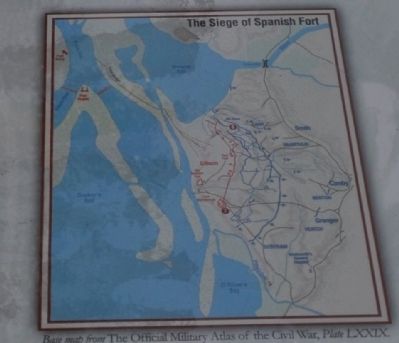
The Siege of Spanish Fort
Base map from the Official Military Atlas of the Civil War,
Plate LXXIX
Other nearby markers. At least 8 other markers are within walking distance of this marker: “Damn The Torpedoes!” (here, next to this marker); Stop 7 Fort McDermott: (here, next to this marker); Revolutionary War Battlefield and Burial Ground at Spanish Fort (1780-1781) (within shouting distance of this marker); Fuller Memorial Park (approx. 0.3 miles away); Union Siege Battery No. 1 (approx. half a mile away); The Eastern Shore Trail (approx. half a mile away); Spanish Fort (approx. 0.6 miles away); Albert Carey Danner (approx. 0.7 miles away). Touch for a list and map of all markers in Spanish Fort.
Photographed by Mark Hilton, January 14, 2017
6. Stop 8 The Eighth Iowa Line: Marker
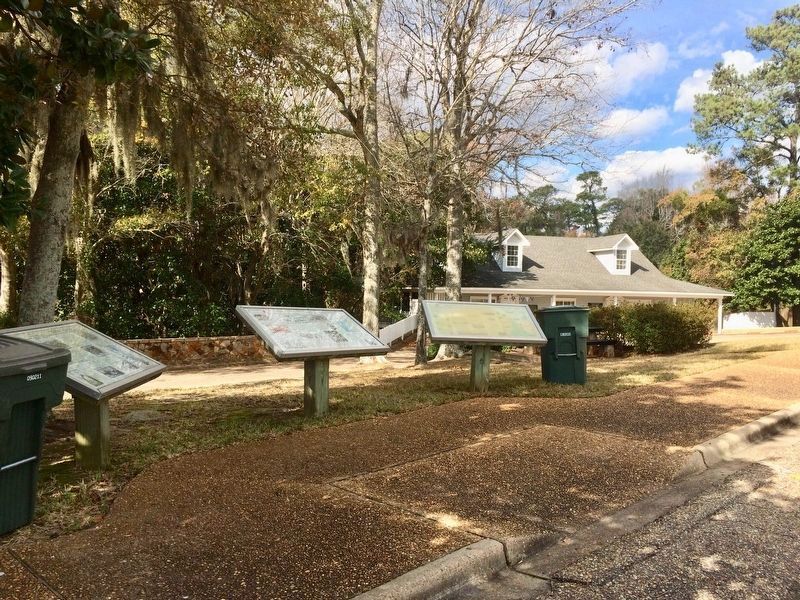
Marker is the one in the middle of the three and is located at the Eastern Shore Chamber of Commerce and the Larry Dee Cawyer Scenic Overlook.
Photographed by Mark Hilton, January 14, 2017
7. Stop 8 The Eighth Iowa Line: Marker
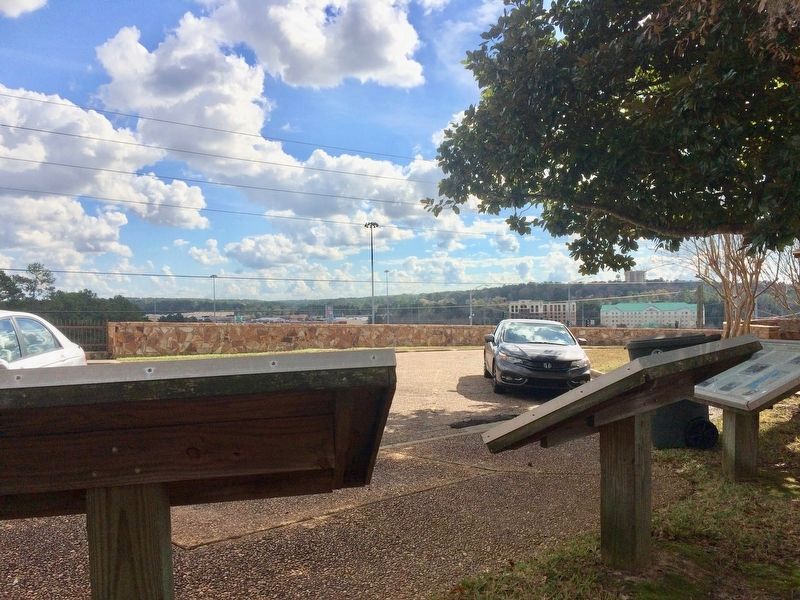
This marker is the middle one of the three.
Credits. This page was last revised on January 16, 2017. It was originally submitted on December 17, 2011, by Sandra Hughes Tidwell of Killen, Alabama, USA. This page has been viewed 2,321 times since then and 60 times this year. Last updated on September 25, 2015, by Eric Polk of Lakewood, California. Photos: 1, 2, 3, 4, 5. submitted on December 17, 2011, by Sandra Hughes Tidwell of Killen, Alabama, USA. 6, 7. submitted on January 14, 2017, by Mark Hilton of Montgomery, Alabama. • Bernard Fisher was the editor who published this page.
