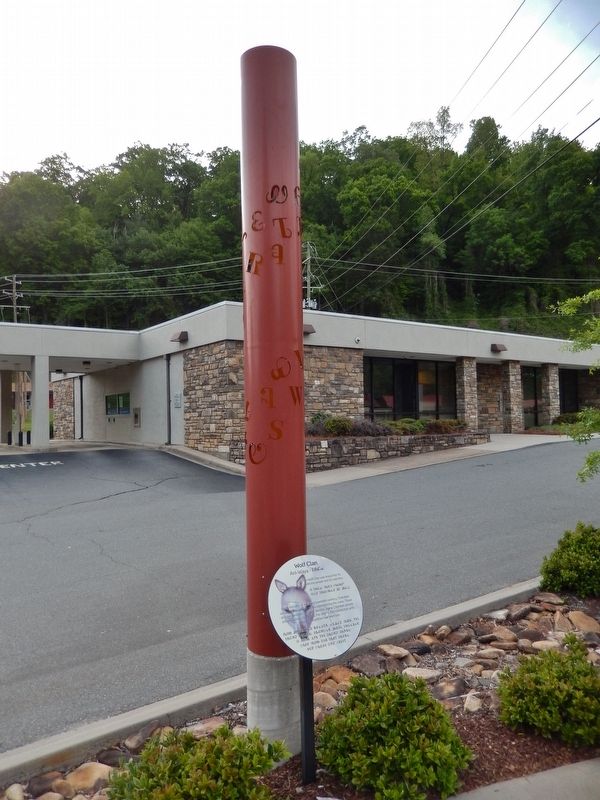
On Tsali Boulevard (U.S. 441) 0.1 miles north of Drama Road (County Highway 1361), on the left when traveling north.
The Wolf Clan was known for its medicine people and its warriors.
(Cherokee language translation)
Clan Masks:
In the early twentieth century, Cherokee artists began carving masks representing the clans. These also symbolized . . . — — Map (db m134820) HM
On Tsali Boulevard (U.S. 441) 0.1 miles north of Drama Road (County Highway 1361), on the right when traveling north.
The wild potato refers to a native plant whose root is a good food source, also known as the Jerusalem artichoke. Some oral traditions say there were originally fourteen clans, including the Savannah and Wild Holly, whose members all became part of . . . — — Map (db m134821) HM
On Tsali Boulevard (U.S. 441) 0.1 miles south of Drama Road (County Highway 1361), on the right when traveling north. Reported unreadable.
According to oral tradition, the Blue Clan knew about a plant with a blue flower that was used to heal children’s diseases.
(Cherokee language translation)
Clan Facts:
Your clan came from your mother. People of the same clan . . . — — Map (db m305013) HM
On Tsali Boulevard (U.S. 441) at Drama Road, on the right when traveling south on Tsali Boulevard. Reported unreadable.
Wodi refers to the paint made from red ochre. In the legend of monster Stoneman, a lump of this paint remained when the monster burned up. When the medicine man painted people with it, their wishes came true: to be a great hunter, or . . . — — Map (db m305012) HM
Near Tsali Boulevard (U.S. 441) 0.1 miles south of Drama Road, on the right when traveling south.
Ani-Gilohi—(Cherokee language translation)
People in this clan wore their hair long. They walked with confidence and were often leaders.
(Cherokee language translation)
CLAN FACTS: Throughout the large . . . — — Map (db m73920) HM