McClellan Park in Sacramento County, California — The American West (Pacific Coastal)
McClellan Air Force Base
Photographed by Joseph Alvarado, May 7, 2023
1. McClellan Air Force Base Marker - Panel 1a - The 1930's
[Panel 1a:]
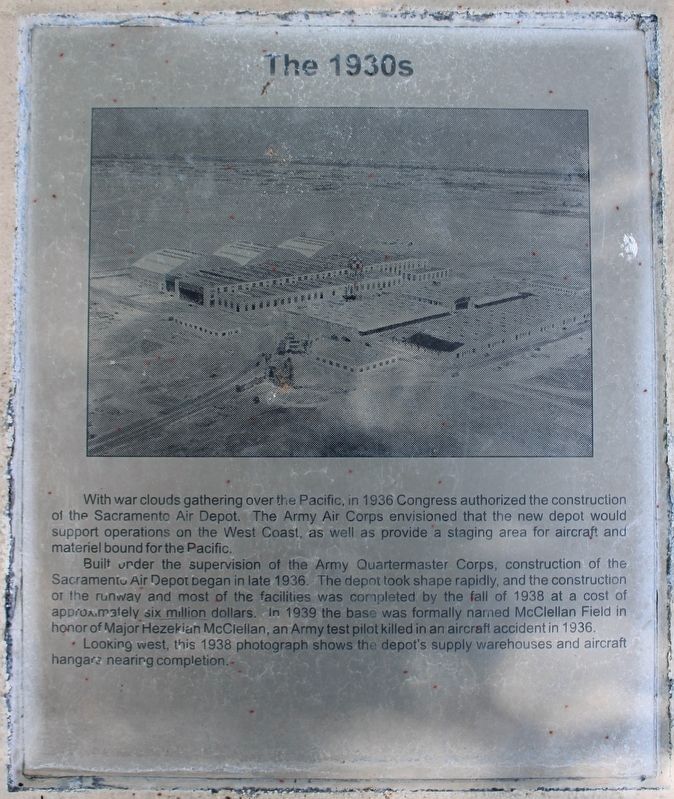
Built under the supervision of the Army Quartermaster Corps, construction of the Sacramento Air Depot began in late 1936. The depot took shape rapidly, and the construction of the runway and most of the facilities was completed by the fall of 1938 at a cost of approximately six million dollars. In 1939 the base was formally named McClellan Field in honor of Major Hezekiah McClellan, an Army test pilot killed in an aircraft accident in 1936.
Looking west, this 1938 photograph shows the depot's supply warehouses and aircraft hangers nearing completion.
[Panel 1b:]
this page online
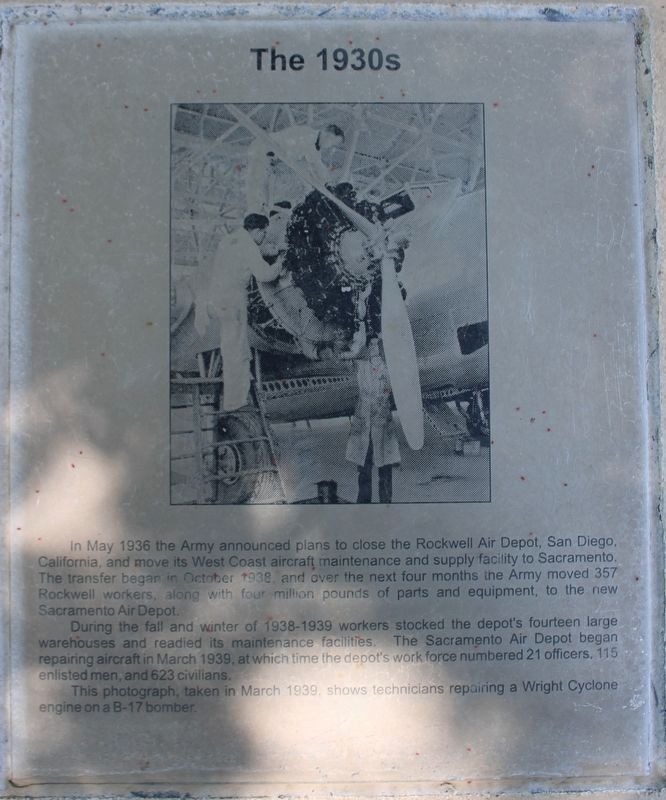
During the fall and winter of 1938-1939 workers stocked the depot's fourteen large warehouses and readied its maintenance facilities. The Sacramento Air Depot began repairing aircraft in March 1939, at which time the depot's work force numbered 21 officers, 115 enlisted men, and 623 civilians.
This photograph, taken in March 1939, shows technicians repairing a Wright Cyclone engine on a B-17 bomber.
[Panel 2a:]
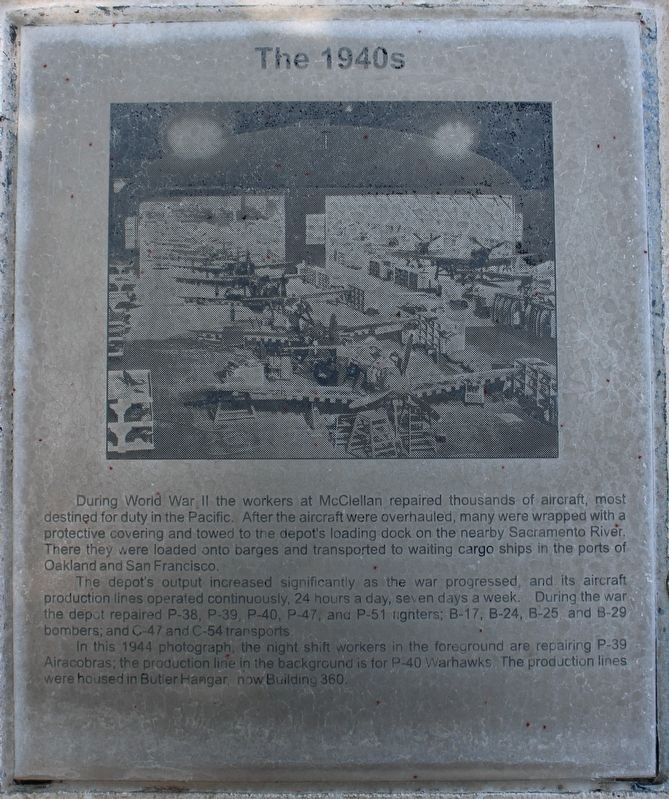
The depot's output increased significantly as the war progressed, and its aircraft production lines operated continuously, 24 hours a day, seven days a week. During the war the depot repaired P-38, P-39, P-40, P-47, and P-51 fighters, B-17, B-24, B-25, and B-29 bombers; and C-47 and C-54 transports.
In this 1944 photograph, the night shift workers in the foreground are repairing P-39 Airacobras;
Photographed by Joseph Alvarado, May 7, 2023
2. McClellan Air Force Base Marker - Panel 1b - The 1930's
[Panel 2b:]
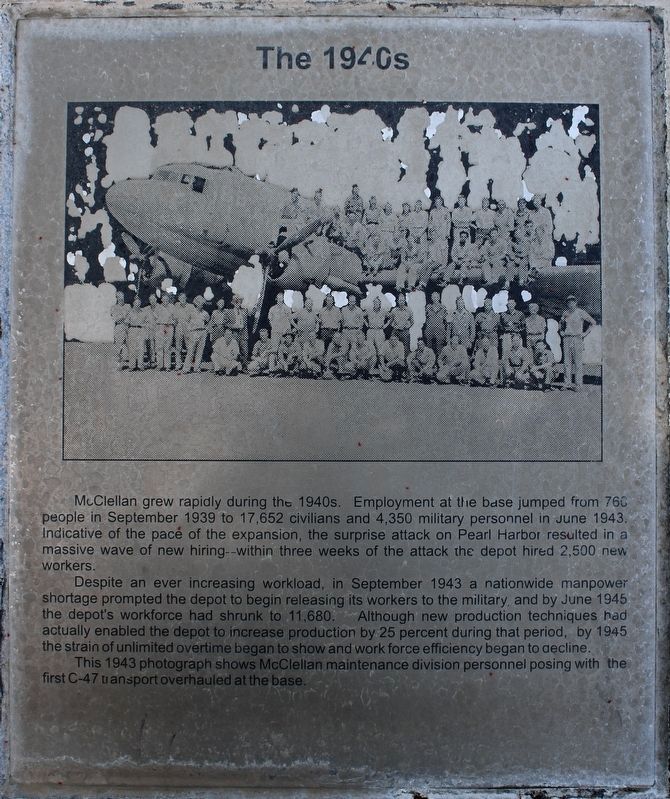
Despite an ever increasing workload, in September 1943 a nationwide manpower shortage prompted the depot to begin releasing its workers to the military and by June 1945 the depot's workforce had shrunk to 11,680. Although new production techniques had actually enabled the depot to increase production by 25 percent during that period, by 1945 the strain of unlimited overtime began to show and workforce efficiently began to decline.
This 1943 photograph shows McClellan maintenance division personnel posing with the first C-47 transport overhauled at the base.
[Panel 3a:]
Photographed by Joseph Alvarado, May 7, 2023
3. McClellan Air Force Base Marker - Panel 2a - The 1940's
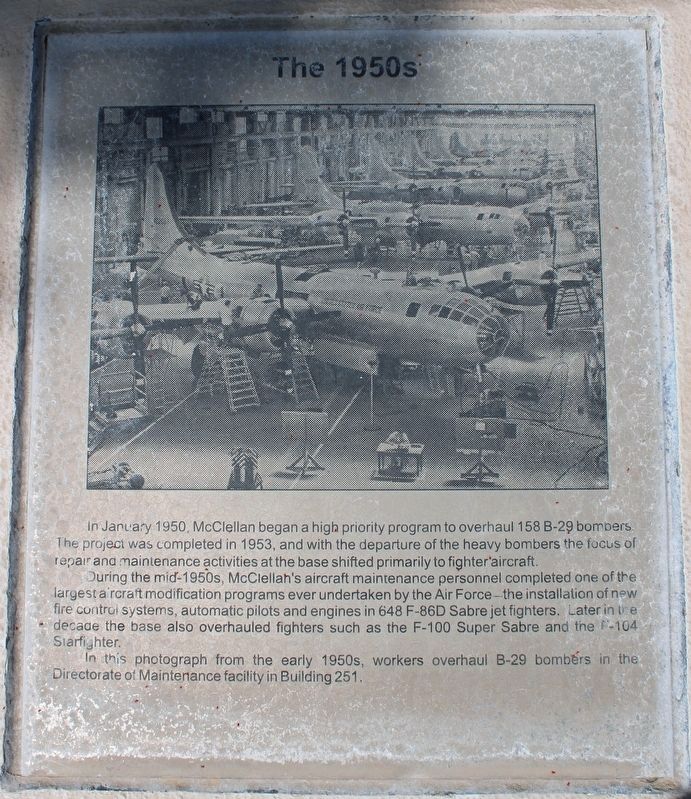
During the mid-1950s, McClellan's aircraft maintenance personnel completed one of the largest aircraft modification programs ever undertaken by the Air Force - the installation of new fire-control systems, automatic pilots and engines in 648 F-86D Sabre jet fighters. Later in the decade the base also overhauled fighters such as the F-100 Super Sabre and the F-104 Starfighter.
In this photograph from the early 1950s, workers overhaul B-29 bombers in the Directorate of Maintenance facility in Building 251.
[Panel 3b:]
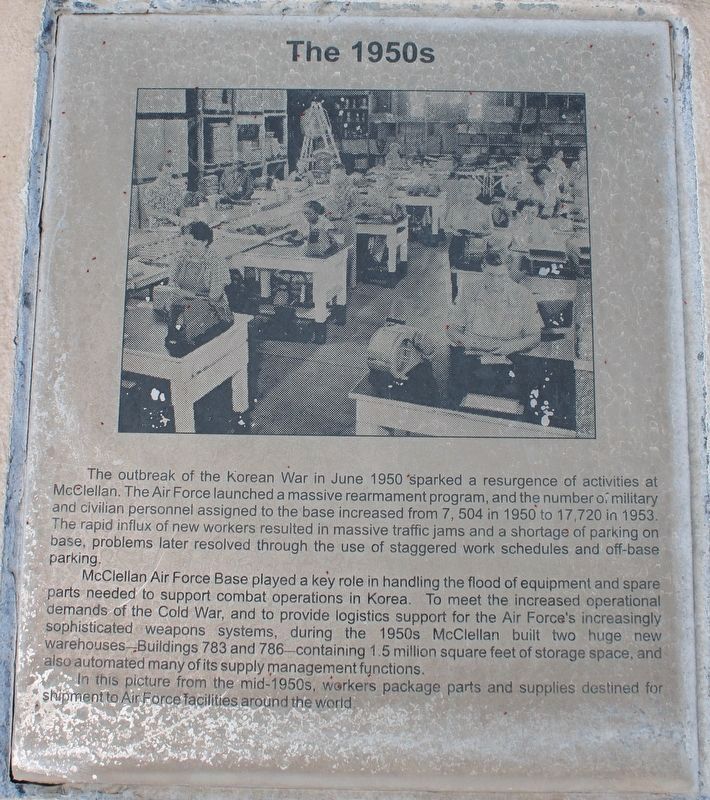
McClellan Air Force Base played a key role in handling the flood of equipment and spare parts needed to support combat operations in Korea.
Photographed by Joseph Alvarado, May 7, 2023
4. McClellan Air Force Base Marker - Panel 2b - The 1940's
In this picture from the mid-1950s, workers package parts and supplies destined for shipments to Air Force facilities around the world.
Panel 4a:]
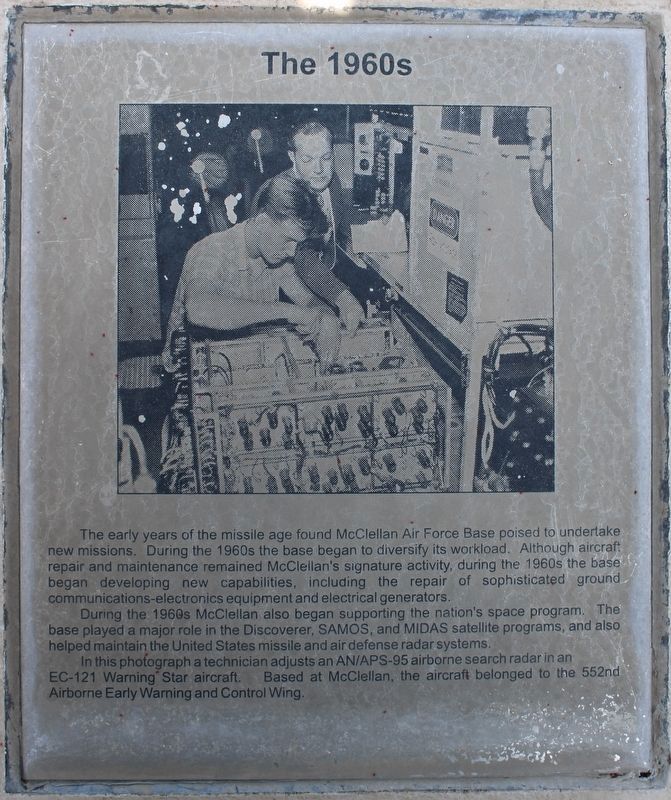
During the 1960s McClellan also began supporting the nation's space programs, and also helped maintain the United States missile and air defense radar systems.
In this photograph a technician adjusts an AN/APS-95 airborne search radar in an EC-121 Warning Star aircraft. Based at McClellan, the aircraft belonged to the 552nd
Photographed by Joseph Alvarado, May 7, 2023
5. McClellan Air Force Base Marker - Panel 3a - 1950's
[Panel 4b:]
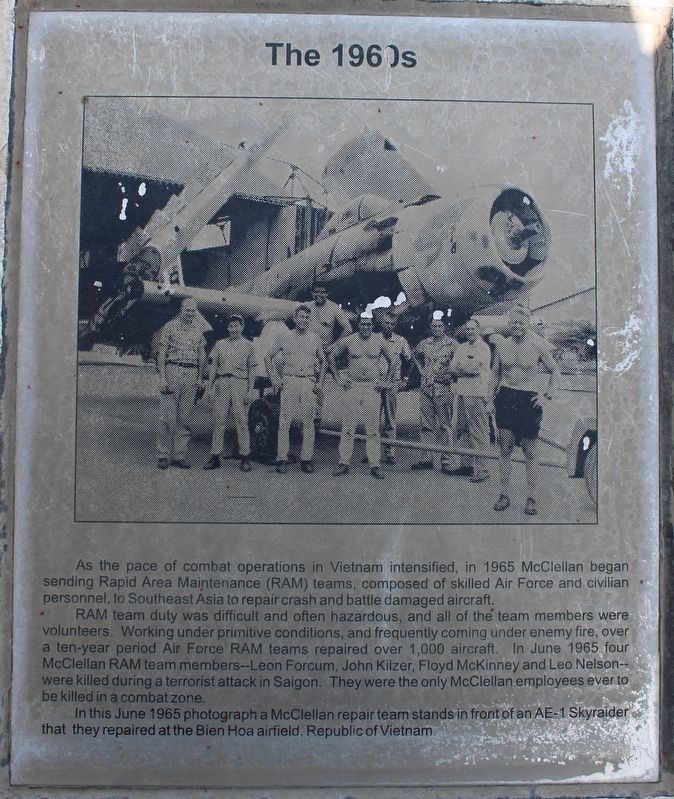
RAM team duty was difficult often hazardous, and all of the team members were volunteers. Working under primitive conditions, and frequently coming under enemy fire, over a ten-year period Air Force RAM teams repaired over 1,000 aircraft. In June 1965 four McClellan RAM team members--Leon Forcum, John Kilzer, Floyd McKinney and Leo Nelson--were killed during a terrorist attack in Saigon. They were the only McClellan employees ever to be killed in a combat zone.
In this June 1965 photograph a McClellan repair team stands in front of an AE-1 Skyraider that they repaired at the Bien Hoa airfield, Republic of Vietnam.
Panel 5a:]
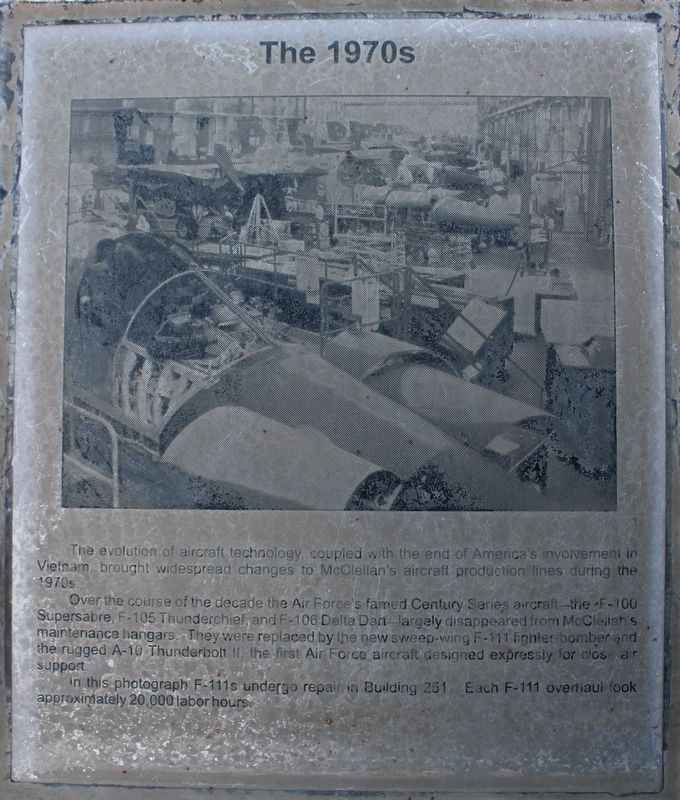
Over the course of the decade the Air Force's famed Century Series aircraft-the F-100 Super Sabre, F-105 Thunderchief,
Photographed by Joseph Alvarado, May 7, 2023
6. McClellan Air Force Base Marker - Panel 3b - 1950's
In this photograph F-111s undergo repair in Building 251. Each F-111 overhaul took approximately 20,000 labor hours.
[Panel 5b:]
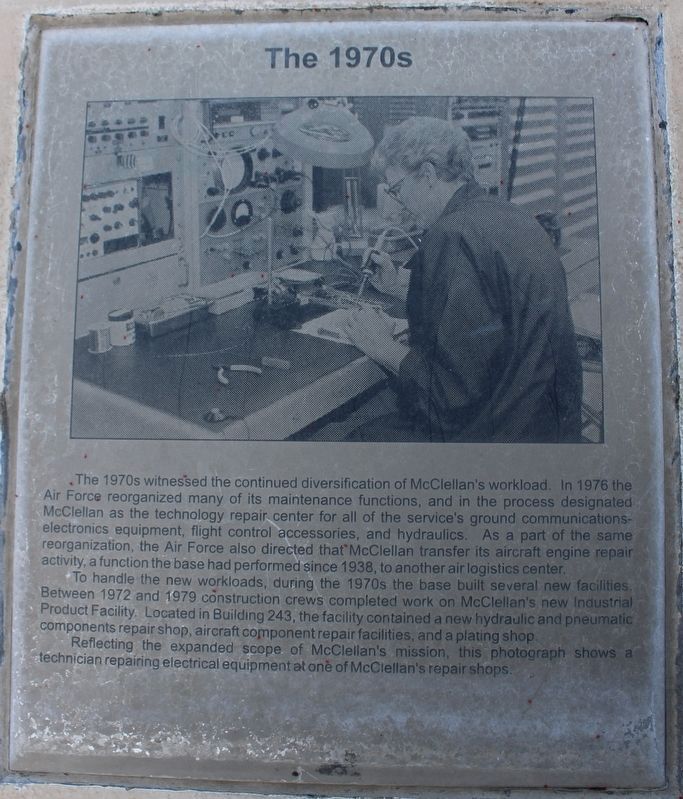
To handle the new workloads, during the 1970s the base built several new facilities. Between 1972 and 1979 construction crews completed work on McClellan's industrial Product Facility. Located in Building 243, the facility contained a new hydraulic and pneumatic components repair shop, aircraft component repair facilities, and
Photographed by Joseph Alvarado, May 7, 2023
7. McClellan Air Force Base Marker - Panel 4a - The 1960's
Reflecting the expanded scope of McClellan's mission, this photograph shows a technician repairing electrical equipment at one of McClellan's repair shops.
[Panel 6a:]
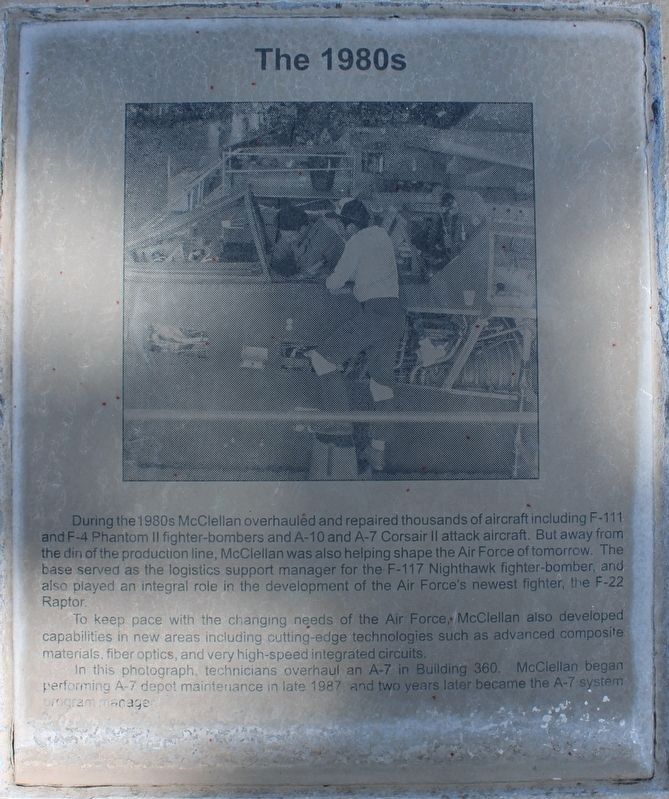
To keep pace with the changing needs of the Air Force, McClellan also developed capabilities in new areas including cutting-edge technologies such as advanced composite materials, fiber optics, and very high-speed integrated circuits.
In this photograph, technicians overhaul an A-7 in Building 360. McClellan began performing A-7 depot maintenance in late 1987, and two years later became the A-7 system program manager.
[Panel 6b:]
Photographed by Joseph Alvarado, May 7, 2023
8. McClellan Air Force Base Marker - Panel 4b - The 1960's
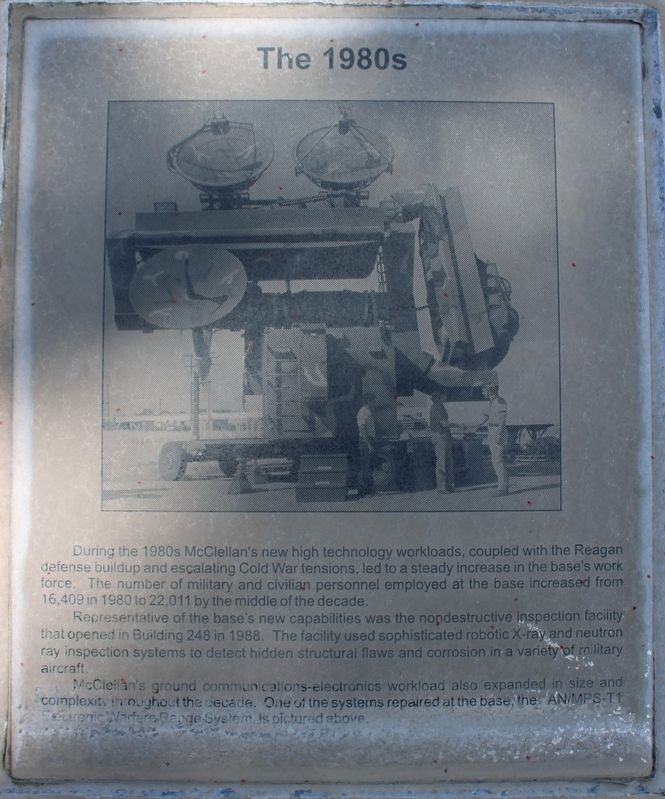
Representative of the base's new capabilities was the nondestructive inspection facility that opened in Building 248 in 1988. The facility used sophisticated robotic X-ray and neutron ray inspection systems to detect hidden structural flaws and corrosion in a variety of military aircraft.
McClellan's ground communications-electronics workload also expanded in size and complexity throughout the decade. One of the systems repaired at the base, the AN/MPS-T1 Electronic Warfare Range System. is pictured above.
[Panel 7a:]
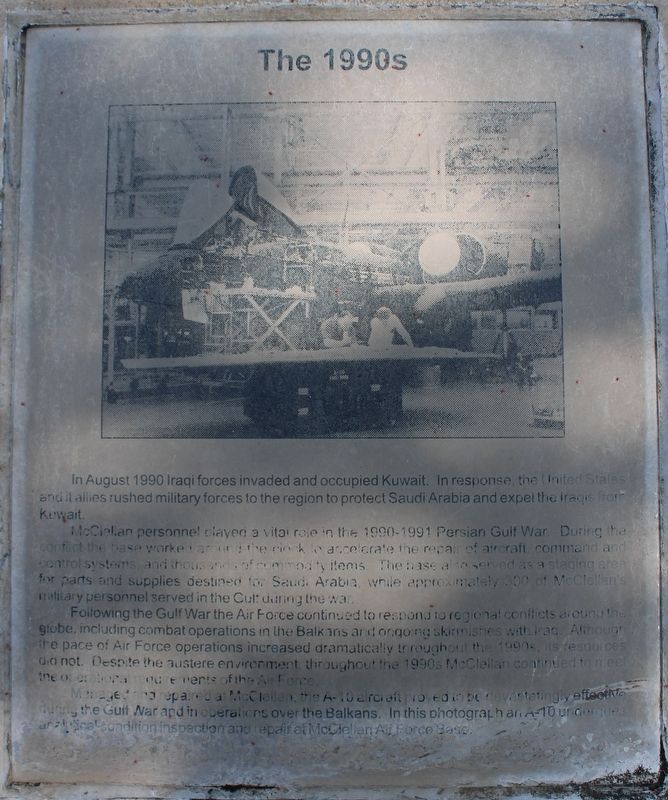
McClellan's personnel played a vital role in the 1990-1991 Persian Gulf War. During the conflict the base worked around-the-clock to accelerate the repair of aircraft, command and control systems, and thousands of commodity items. The base also served as a staging area for parts and supplies destined for Saudi Arabia, while
Photographed by Joseph Alvarado, May 7, 2023
9. McClellan Air Force Base Marker - Panel 5a - The 1970's
Following the Gulf War the Air Force continued to respond to regional conflicts around the globe, including combat operations in the Balkans, and ongoing skirmishes with Irag. Although the pace of Air Force operations increased dramatically throughout the 1990s, its resources did not. Despite the austere environment, throughout the 1990s McClellan continued to meet the operational requirements of the Air Force.
Managed and repaired at McClellan, the A-10 aircraft proved to be devastatingly effective during the Gulf War and in operations over the Balkans. In this photograph an A-10 undergoes analytical condition inspection and repair at McClellan Air Force Base.
[Panel 7b:]
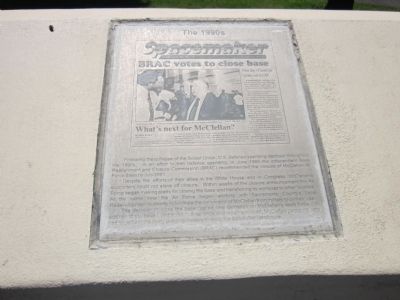
Despite the efforts of their allies in the White House and in Congress, McClellan's supporters could not stave off closure. Within weeks of the closure announcement the Air Force began
Photographed by Joseph Alvarado, May 7, 2023
10. McClellan Air Force Base Marker - Panel 5b - The 1970's
The decision to close the base placed new demands on McClellan's work force. In addition to the base's traditional maintenance and repair workload, McClellan's personnel now had to perform the manual tasks necessary to ready the installation for closure.
[Panel 8a:]
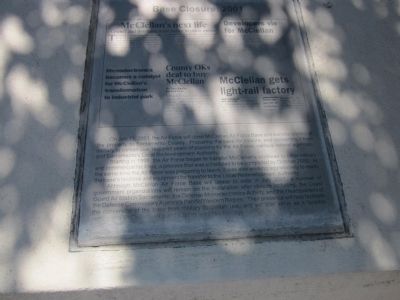
Starting in 1998, the Air Force began to transfer McClellan's workload to other military and commercial facilities, a process that was scheduled to be completed by October 2000. At the same time the Air Force was preparing to leave, it was also working aggressively to ready the base's facilities and equipment for transfer to the Local Redevelopment Authority.
Although
Photographed by Joseph Alvarado, May 7, 2023
11. McClellan Air Force Base Marker - Panel 6a - The 1980's
[Panel 8b:]
1936 - 2001
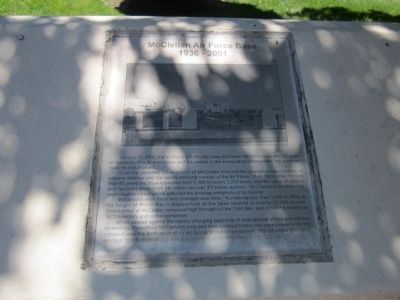
Over the decades, the evolution of McClellan mirrored the changing requirements of national defense and the rabidly evolving mission of the Air Force. Over the course of more than 60 years the base expanded from 1,100 to nearly 3,000 acres, and the value of its land and facilities grew from $6 million to over $3 billion dollars. McClellan's increasingly sophisticated infrastructure reflected the
McClellan's work force also changed over time. Numbering less than 1,000 in 1939,
Photographed by Joseph Alvarado, May 7, 2023
12. McClellan Air Force Base Marker - Panel 6b - The 1980's
When viewed against the rapidly changing backdrop of international affairs and military technology, throughout McClellan's long and distinguished history the base's most enduring constant was the dedication of its military and civilian personnel. For 65 years their skill, courage, and dedication was a vital component in the defense of the United States.
Topics and series. This memorial is listed in these topic lists: Air & Space • War, 1st Iraq & Desert Storm • War, Cold • War, Korean • War, Vietnam • War, World II. In addition, it is included in the Former U.S. Presidents: #40 Ronald Reagan series list.
Location. 38° 39.773′ N, 121° 23.095′ W. Memorial is in McClellan Park, California, in Sacramento County. It is on Arnold Avenue, on the right when traveling north. Marker is located in a small park area bordered on the north by McClellan Mall and on the south by Mitchell Street. Touch for map. Memorial is at or near this postal address: 3404
Photographed by Joseph Alvarado, May 7, 2023
13. McClellan Air Force Base Marker - Panel 7a - The 1990's

Regionally, this memorial is in Sacramento Metro, in the Sacramento Valley, and specifically in the Central Valley. It is also on the American Pacific Coast. Globally, it is in North America, on the Ring of Fire, on the Pacific Rim, in the Western Hemisphere, in the Western World, and in the Anglosphere. Historically, it finds itself in what was once New Spain and also Mexico’s Alta California.
Other nearby markers. At least 8 other markers are within 2 miles of this marker, measured as the crow flies: A different marker also named McClellan Air Force Base (here, next to this marker); Base Headquarters (within shouting distance of this marker); Base Hospital (about 300 feet away, measured in a direct line); Bachelors' Barracks and Post Exchange (about 400 feet away); Firehouse (about 700 feet away); Rapid Area Maintenance Team (about 800 feet away); POW/MIA (approx. 0.9 miles away); Walerga Assembly Center (approx. 1.9 miles away). Touch for a list and map of all markers in McClellan Park.
Also see . . . History of McClellan Air Force Base. The California State Military Museum gives a detailed history. (Submitted on July 7, 2012.)
Photographed by Syd Whittle, July 6, 2012
14. McClellan Air Force Base Marker - Panel 7b - The 1990's
Click to view photo.
Photographed by Syd Whittle, July 6, 2012
15. McClellan Air Force Base Marker - Panel 8a - Base Closure 2001
Click to view photo.
Photographed by Syd Whittle, July 6, 2012
16. Panel 8b - McClellan Air Force Base 1936 - 2001
Click to view photo.
Photographed by Joseph Alvarado, May 7, 2023
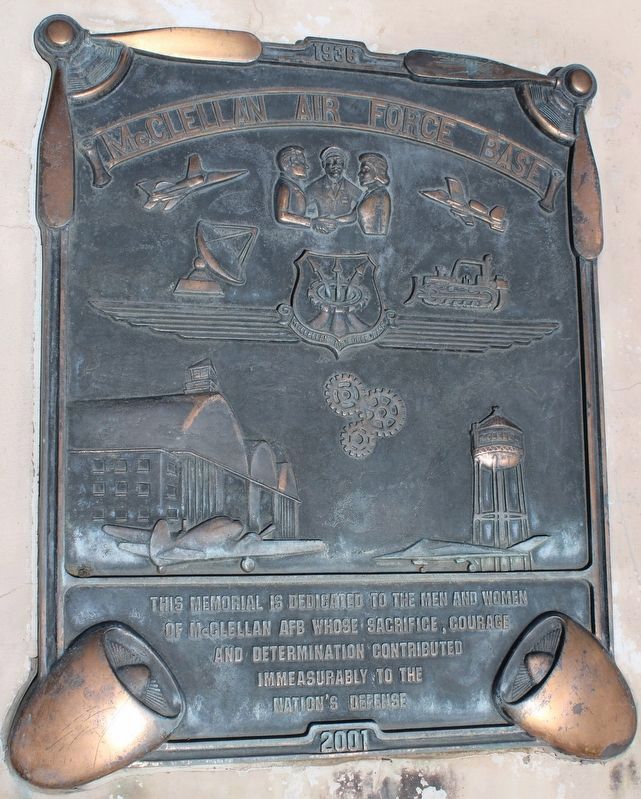
17. McClellan Air Force Base
This memorial is dedicated to the men and women of McClellan AFB whose sacrifice, courage and determination contributed immeasurably to the Nation’s defense
2001
Photographed by Syd Whittle, July 6, 2012
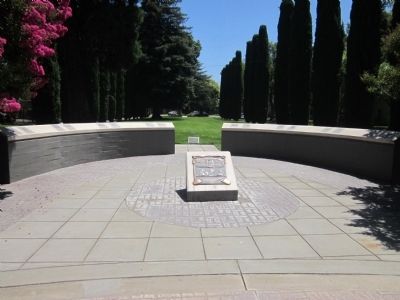
18. McClellan Air Force Base Markers
Panels 1a - 4b are on the left. Panels 5a - 8b are on the right.
Photographed by Joseph Alvarado, May 7, 2023
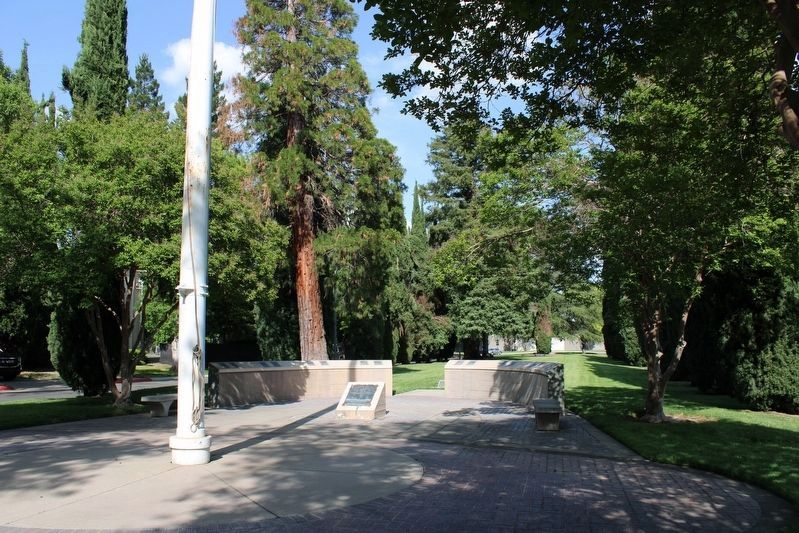
19. McClellan Air Force Base Markers
Photographed by Joseph Alvarado, May 7, 2023
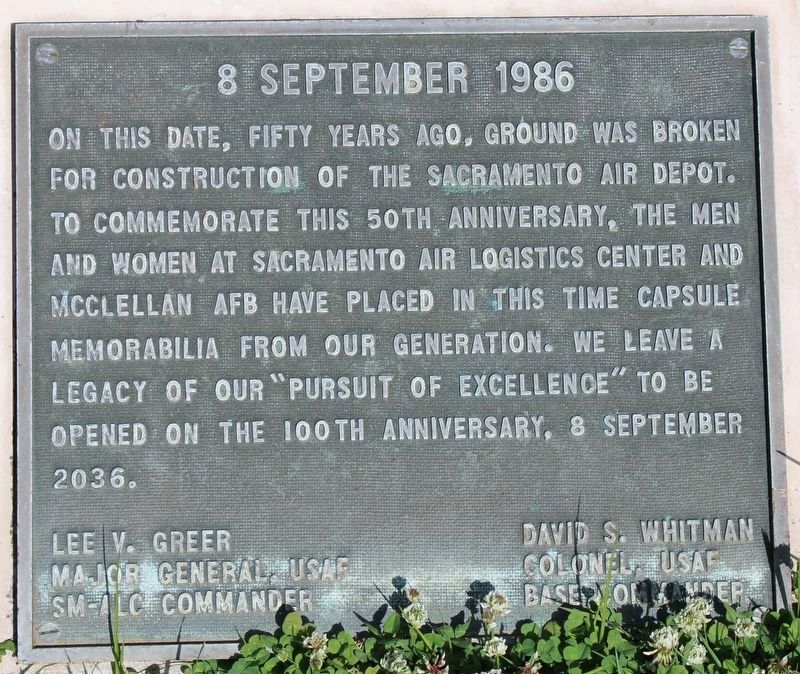
20. Time Capsule Behind The Marker
On this date, fifty years ago, ground was broken for construction of the Sacramento Air Depot. To commemorate this 50th anniversary, the men and women at Sacramento Air Logistics Center and McClellan AFB have placed in this time capsule memorabilia from out generation. We leave a legacy of our “Pursuit of Excellence” to be opened on the 100th Anniversary, 8 September 2036.
Lee V. Greer, Major General, USAF
SM-ALC Commander
David S. Whitman, Colonel, USAF
Base Commander
Photographed by Joseph Alvarado, May 7, 2023
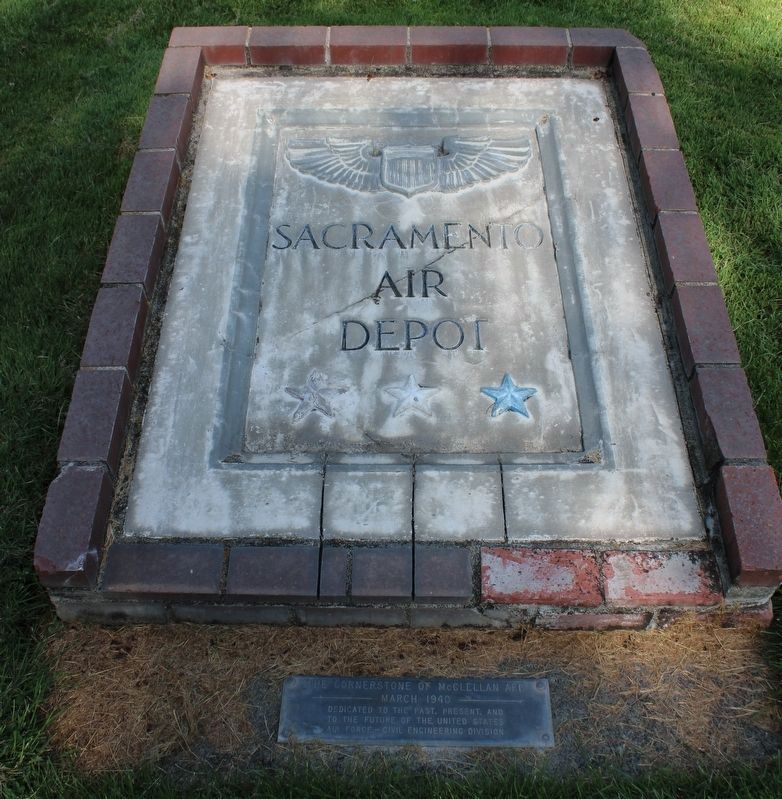
21. The Cornerstone of the McClellan AFB
Dedicated to the past, present, and to the future of the United States Air Force. – Civil Engineering Division
Photographed by Joseph Alvarado, May 7, 2023
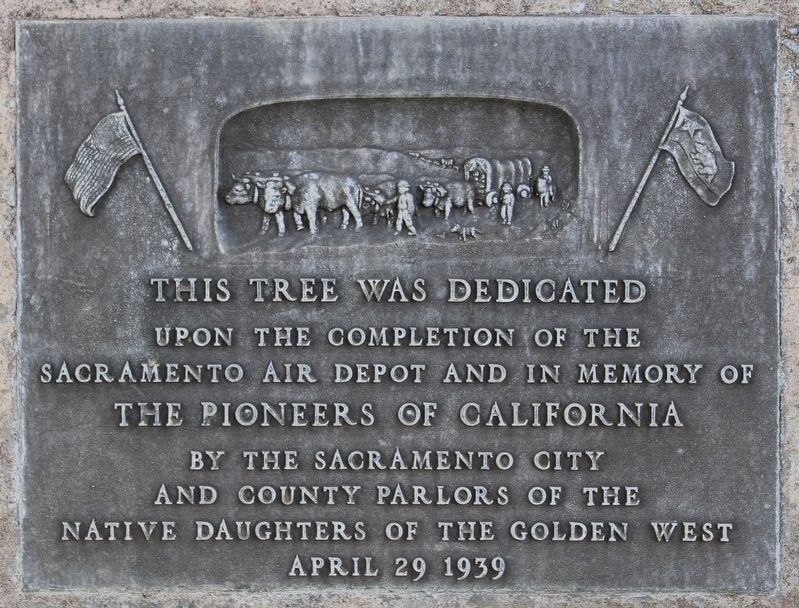
22. Dedicated Tree
By the Sacramento city and county Parlors of the Native Daughters of the Golden West
April 29, 1939
Photographed by Joseph Alvarado, May 7, 2023
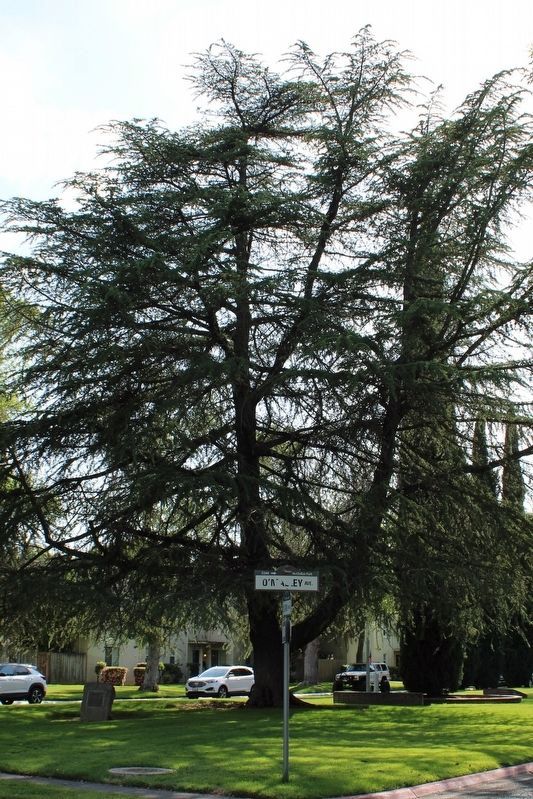
23. Dedicated Tree
The plaque is on the boulder to the left of the tree.
Credits. This page was last revised on July 5, 2023. It was originally submitted on July 6, 2012, by Syd Whittle of Mesa, Arizona. This page has been viewed 3,369 times since then and 249 times this year. Photos: 1, 2, 3, 4, 5, 6, 7, 8, 9, 10, 11, 12, 13. submitted on July 3, 2023, by Joseph Alvarado of Livermore, California. 14, 15, 16. submitted on July 7, 2012, by Syd Whittle of Mesa, Arizona. 17. submitted on July 3, 2023, by Joseph Alvarado of Livermore, California. 18. submitted on July 7, 2012, by Syd Whittle of Mesa, Arizona. 19. submitted on July 3, 2023, by Joseph Alvarado of Livermore, California. 20, 21, 22, 23. submitted on July 5, 2023, by Joseph Alvarado of Livermore, California.
