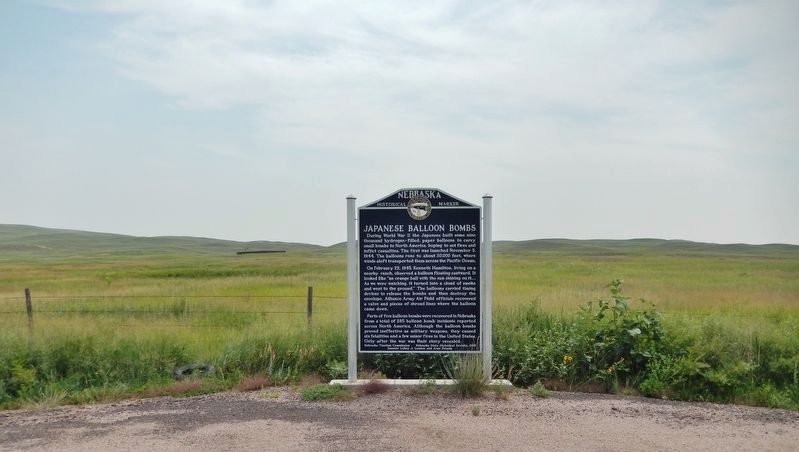
During World War II the Japanese built some nine thousand hydrogen-filled, paper balloons to carry small bombs to North America, hoping to set fires and inflict casualties. The first was launched November 3, 1944. The balloons rose to about 30,000 . . . — — Map (db m180929) HM
In the sky over 50th and Underwood, a Japanese balloon bomb exploded on April 18, 1945. The incendiary device flared brightly in the night, but caused no damage.
The Japanese military hoped the device would create an incident, which if . . . — — Map (db m265977) HM
Very near here, on a warm spring day in 1945, six people-a woman and five children-were killed by a Japanese "balloon bomb," or Fugo. The party had arrived for a picnic when they discovered the deflated balloon. While they gathered around the . . . — — Map (db m112533) HM
When a Japanese balloon bomb exploded at
this site, Elsie Mitchell and her Sunday school
class of five children, out on an early spring
fishing outing, were killed. They were the only
World War II casualties to occur on the North
American . . . — — Map (db m112595) HM