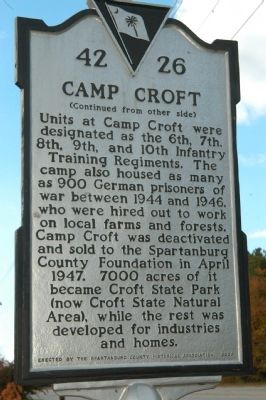
[Marker Front]:
Camp Croft, constructed in 1940-41, was named for Greenville native Maj. Gen. Edward Croft (1875-1938). The pillars from the main gate stand nearby. Camp Croft was one of nine U.S. Army Infantry Replacement Training . . . — — Map (db m13325) HM
German prisoners of war were held in a camp on this site from September 1943 to the spring of 1946. This camp, one of 21 in S.C., was a sub-camp of Fort Jackson, in Columbia. 250 prisoners captured in North Africa were the first held here; later . . . — — Map (db m36557) HM
The U.S. Army began building POW camps in the United States in early 1942 for captured Axis prisoners. During World War II, the Army shipped almost 425,000 military prisoners to 511 camps in the U.S. Approximately 50,000 of those POWs, primarily . . . — — Map (db m29450) HM
This site was once a twenty-four acre camp for Prisoners of War established on the grounds of the Marion Engineer Depot. The Depot was a major supply and logistics site of the U.S. Army Engineers during World War II. The first contingent of POWs . . . — — Map (db m29115) HM
During World War II over 400,000 German and Italian POWs were quartered in camps across the United States. In many cases the prisoners were used to fill vast labor shortages in production and agriculture. Their prisoner camps were small communities . . . — — Map (db m22627) HM
As MacDill Field's first runways were being completed in 1941, only 8,500 men were enlisted in the Army Air Corps. But by the end of World War II in 1945, over 2.5 million Americans had joined the newly renamed Army Air Forces. The demands of war . . . — — Map (db m34125) HM