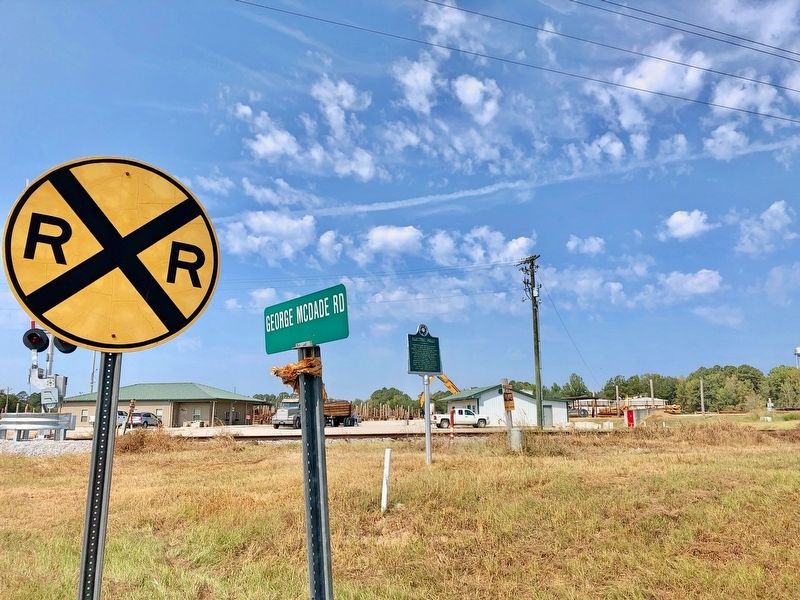
On U.S. 45 at George McDade Road, on the right when traveling south on U.S. 45.
Established in 1913, the town of Electric Mills was built by the Sumter Lumber Company, which relocated to Kemper County from Alabama. Powered by electricity generated by the mill, the town was among the first in Mississippi with electric lights and . . . — — Map (db m140642) HM
On Fire Tower Road at Chapel Hill Road, on the right when traveling west on Fire Tower Road.
Est.1874 as a community church called Narkeeta Chapel. Land and nearby spring donated by J. L. Parmer. Reorganized 1890 as Chapel Hill Methodist Church. Present building constructed 1891, remodeled 1976. — — Map (db m140641) HM
On Mississippi Route 16 at Giles Road, on the left when traveling east on Mississippi Route 16.
This cemetery is a part of the plantation established by Jacob Giles (1799-1860) a settler from N. Carolina. Adjacent to the cemetery stood Grace Chapel (Epis.). Giles' house, built ca. 1825, stands .3 miles west. — — Map (db m140649) HM
On State Highway 16 at Thompson Road, on the right when traveling east on State Highway 16.
This cemetery was part of the William Cannon plantation dedicated prior to 1839. William Cannon 1779 - 1843 great-great-grandfather of Margaret Cannon Boyce Brown. — — Map (db m92650) HM
On Main Avenue (Mississippi Route 39) south of Veterans Street, on the right when traveling south.
Born in 1771 in Virginia, Reuben Kemper moved to Spanish West Florida in 1800 and was active in the affairs of the Mississippi Territory. After several attempts to overthrow Spanish rule by force, Kemper's vision became reality in 1810 when the . . . — — Map (db m140652) HM
Near West Beacon Street (Mississippi Route 21) west of Front Ave, on the left when traveling west.
The blues form reached both artistic and emotional peaks in the works of Otis Rush, who was born south of Philadelphia in Neshoba County in 1935. His music, shaped by the hardships and troubles of his early life in Mississippi, came to fruition in . . . — — Map (db m140850) HM
Thin black lines indicate changes in relevance. Between each pair of lines entries are ordered geographically but all have the same relevance.
* Inflectional forms of words are their plurals, singulars, and possessives as well as gramatical tenses and similar variations.