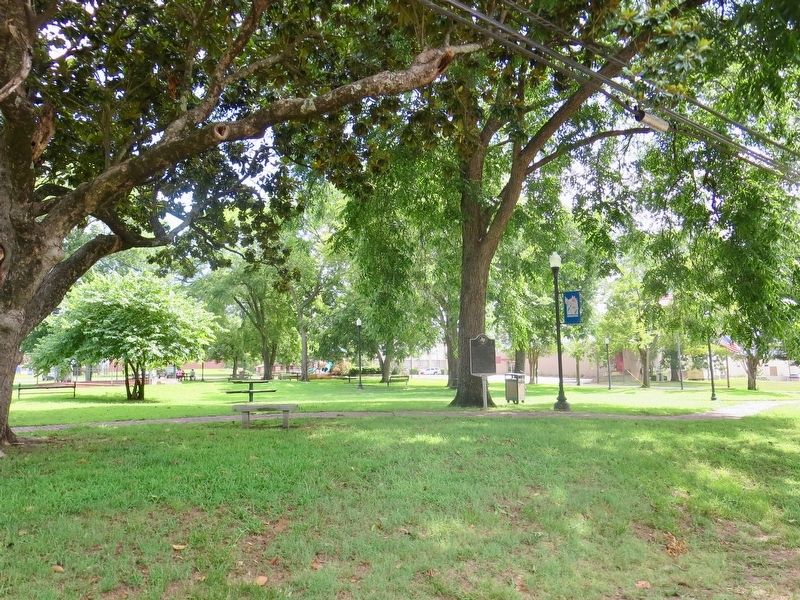
Created and organized in 1875, with Daingerfield as county seat. Named for William W. Morris (1805-1883), who came to Texas in 1849. When the Civil War began in 1861, was in 8th Legislature that armed the state, enacted soldiers' families' relief . . . — — Map (db m192225) HM
Ancestors of James Thompson lived in Virginia in the 17th century. Thompson served in Capt. Bynum's Company of North Carolina Militia in 1781, helping win victory in the American Revolution. In pioneer spirit, he and his family later moved to . . . — — Map (db m119477) HM
Governor Oscar Colquitt was born in Georgia in 1861 to Thomas Jefferson Colquitt and Ann Elizabeth (Burkhalter) Colquitt. His family had a long tradition of political service. Two of his uncles served as U.S. Senators, with one of them, Alfred H. . . . — — Map (db m305756) HM
Born in Halifax County, North Carolina, William Wright Morris moved with his family to Coosa County, Alabama, in 1840. He taught school, studied law, and was elected judge. In 1847 he brought his mother, widowed sister Martha (Morris) Spivey, her . . . — — Map (db m266766) HM
Built on the Missouri-Kansas-Texas Railroad right-of-way by T.W. Whiting for the convenience of his wife Allie and visitors to the Sylvan Park Ranch in northwest Morris County. This is the last known privately owned railway station and was loaned . . . — — Map (db m44993) HM
The earliest recorded burial on this site was that of Elizabeth A. Baker, who died on April 26, 1883. Pattie D. Baker, who died in October of that year, is one of several people reported to have been reinterred here from the local school grounds. In . . . — — Map (db m221416) HM
When Morris County was divided into school districts in 1893, this part of the county was included in the Valley View District. B. and R. E. Fomby donated 3.5 acres of land at this site for a schoolhouse, and a one-room school building was moved to . . . — — Map (db m223359) HM
Thin black lines indicate changes in relevance. Between each pair of lines entries are ordered geographically but all have the same relevance.
* Inflectional forms of words are their plurals, singulars, and possessives as well as gramatical tenses and similar variations.