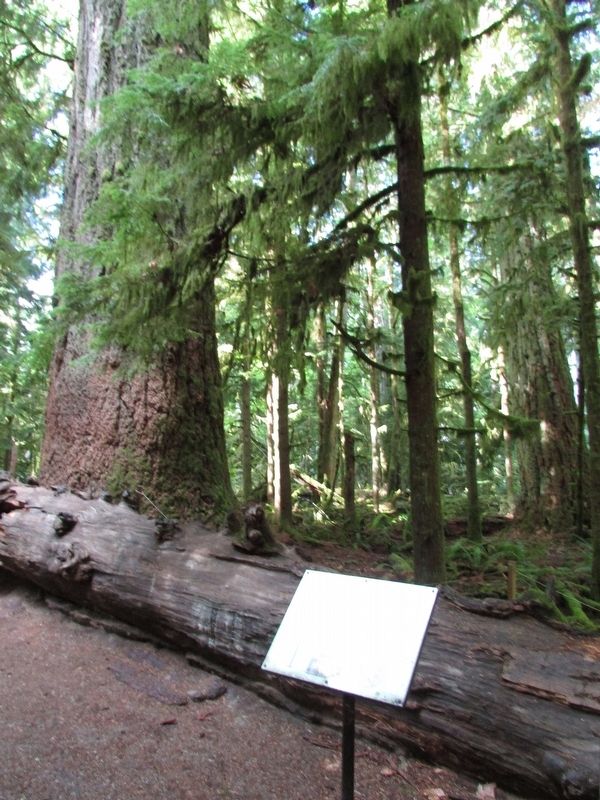
The largest tree in the park is this giant Douglas-fir. It is over 800 years old, 76 m tall and 9 m round. It was over 300 years old when Christopher Columbus came to North America in 1492. Douglas-fir is one of Canada’s oldest living tree species . . . — — Map (db m311179) HM
See Cathedral Grove on a short loop walk that takes you through a forest of giant trees. The largest are 800 years old, but most sprouted when a fire opened the forest about 300 years ago. — — Map (db m310672) HM
Scottish-born botanist David Douglas identified over 200 new plant species in North America, including the famous Douglas fir. Primarily a collector rather than a published scientist, he sent more plants to Europe than any other . . . — — Map (db m284470) HM
Saint Anne's Anglican Church, the Island's oldest surviving log church, was founded in July 1894. Gravestones honour many new settlers who helped in its construction. In October 1896, the first wedding was celebrated by the Rev. Charles Cooper, the . . . — — Map (db m187911) HM
This ancient forest is not just a grove of spectacular giant trees, but a rich ecosystem of hundred of different kinds of interdependent animals, plants, fungi, and microscopic organisms. It forms a self-sustaining system in which nutrients are . . . — — Map (db m311186) HM
On November 12, 1892, the first Snuneymuxw vs. European soccer match was played here. One of the star players "Xul-si-malt" Harry Manson, went on to win British Columbia and Nanaimo championships. His legacy of overcoming prejudice in sport is . . . — — Map (db m187894) HM
Traditional territory of the Hupacasath First Nation: Cathedral Grove A place of spiritual significance to the Hupacasath First Nation, this grove of towering old-growth Douglas-fir trees has been inspiring people to look skyward for thousands . . . — — Map (db m311176) HM
Nanaimo was founded as a coal-mining settlement in 1852. Its most productive mine, No. 1, opened in 1881. From the bottom of the main shaft, one-half mile south of here, a labyrinth of workings extended for miles under the sea. These operations were . . . — — Map (db m187983) HM
British Columbia has some of the finest old-growth temperate rain forest in the world. Known for the size and longevity of their trees, they can be considered one of the richest expressions of life on this planet. There are many reasons to . . . — — Map (db m311248) HM
In 1869 Robert Dunsmuir discovered coal in this area. The settlement of Wellington developed after 1871 when coal was transported first by wagon and later by rail to wharves at Departure Bay. When the mines closed in 1900, many of Wellington's . . . — — Map (db m187948) HM