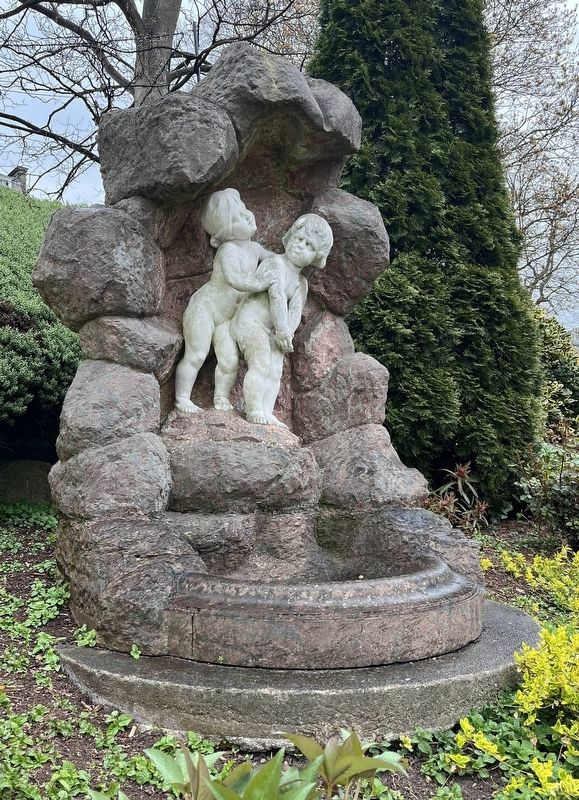
This statue has been donated to Harrogate by Mrs Frainy Ardeshir in loving memory of her husband's sister Mrs Mehroo Jehangir.
Sculpted in France by the notable artist Charles Raphael Peyre, the statue was exhibited at the Paris Salon in 1913 . . . — — Map (db m277634) HM
Pickersgill Palliser commissioned architect Richard Dyson in 1855 to build nos. 8 & 9 Royal Parade, with ground floor shops & model apartments above, where he lived and worked for several years. Palliser established Harrogate's first printing press . . . — — Map (db m277640) HM
Prospect Square was developed between 1859 and 1860 on land once owned by the Carter family. Cambridge Crescent (N) 1867-8 and Prospect Crescent (E) of 1873-80 were built by George Dawson and designed by J.H. Hirst, who also designed St Peter's . . . — — Map (db m277639) HM
Dr. Edmund Deane first drew the attention of the world to the strongest sulphur spring in Great Britain when he published his 'Spadacrene Anglica' in 1626. This Royal Pump Room was built in 1841-2 as the first act of the Harrogate improvement . . . — — Map (db m277636) HM
When the great forest of Knaresborough was enclosed by the act of 1770, an award dating from 19th august 1778 set aside as common land 200 acres between the ancient villages of High and Low Harrogate to protect the public right of access to the . . . — — Map (db m277638) HM
Victoria Gardens occupies the site of Harrogate's first covered public market, built in 1874 to the design of Arthur Hiscoe. On 31 January 1937, this building was destroyed by fire and was replaced in 1939 by a new market hall designed by Leonard . . . — — Map (db m277641) HM
In 1815, Nicholas Carter senior built the first house on Prospect Hill as a home and premises for the sale of wine and spirits and the accommodation of guests. Known as "Carter's" and then as the "Prospect", the building was often enlarged as the . . . — — Map (db m277633) HM