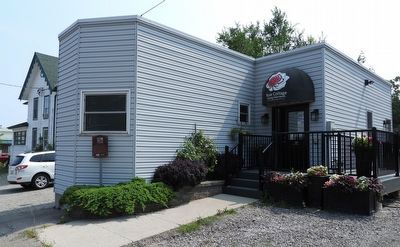
This uniquely shaped building served as the original office of the Beamsville
Basket and Veneer Company. Founded in 1909 by Aquila W. Reid
and Samuel Piott, and later overseen by Reid's sons, W.O. Reid and B.H. Reid,
the factory produced baskets . . . — — Map (db m281123) HM
In 1857 this was the site of a foundry built by Alanson Harris. Here he invented and manufactured plows, hay rakes, and other labour-saving implements used by early farmers which contributed greatly to this community's successful agricultural . . . — — Map (db m291437) HM
On this site in 1856, Andrew Dean built the largest grist mill in Lincoln County.
Grist mills, where grain was ground into flour, were an important part of early settlement. Because settlers had little cash, the miller took every tenth bushel of . . . — — Map (db m299252) HM
The Ball Family home, built by local architect Newton Perry, is a fine
example of a Georgian-style house. It was constructed for George
P.M. Ball and his family in 1846. The front of the house along Sixth
Avenue was used as a general store for . . . — — Map (db m278441) HM
By 1809 John and George Ball had constructed a four-storey grist-mill here on Twenty Mile Creek. Equipped with two run of stones, the mill provided flour for British Troops during the War of 1812. It was expanded during the 1840's and by the end of . . . — — Map (db m282946) HM
In 1912, Norman M. Bartlett began manufacturing lime sulphur in a 40 inch cast iron kettle, establishing Bartlett Spray Works. He gained notoriety quickly with his high quality product and it wasn't long before other products were added to his . . . — — Map (db m291457) HM
Beamsville High School has been part of our community and a landmark in our area since 1917. It was designed by Canadian architect, Walter William LaChance in the Beaux-Arts style.
It features a monumental staircase, four smooth columns with lonic . . . — — Map (db m278515) HM
Beamsville High School 1917
Walter LaChance, Architect . L.E. Huntsman, Builder
Beamsville High & Vocational School 1924
Nicholson and MacBeth, Architect . Newman Construction, Builder
Heritage Lincoln . Designated under the Ontario . . . — — Map (db m278516) HM
In 1906, a canning factory was established on this site.
As farms grew and fruit and vegetable production became more prevalent, there was a need for more than limited seasonal marketing of fresh product.
The Town gave the Beamsville Preserving . . . — — Map (db m299323) HM
Backsmithing was one of the most important professions in an early
settler village. The blacksmith would make tools, horse shoes, and
other metal materials as needed.
The first recorded blacksmith in the village of Glen Elgin was Ira C. . . . — — Map (db m278448) HM
By 1876, Campden, which was originally known as Moyer's Corners, was a small nearly self-sufficient community of about 150 inhabitants. It had its own
doctor, two general stores, a shoe shop, several blacksmiths, a cabinet maker, a cigar factory, a . . . — — Map (db m278496) HM
In the mid-to-late 1800's, this site looked very different. James Henry, a prominent
merchant in the village, had built a very spacious and opulent home for his wife.
It had large rooms on two levels, at least three fireplaces, fine decorative . . . — — Map (db m278513) HM
Built by the Fairchild family between 1797 and
1810 in Jordan Station, this cabin represents what
early settlers like the Ball family would have lived in
when they first came to Ontario.
The Furry Cabin, located east of the . . . — — Map (db m278436) HM
This Regency-style cottage was built circa 1840. The original building was almost square in plan, and the interior wooden flooring suggests that it had a small front living room, two bedrooms and a kitchen/work area. The exterior featured a hipped . . . — — Map (db m245557) HM
Following the American Revolution, Mennonites living in Pennsylvania began to come to the Niagara Peninsula in search of good farm land. A small group settled on land west of Twenty Mile Creek in 1786. Then, in 1799, Jacob Moyer, Abraham . . . — — Map (db m284022) HM
In 1923, Aubrey Fleming began incubating chicks in a small carriage shed on his fruit farm, located at this site, and established one of the first chick hatcheries in Ontario. In the early years, most of the chicks raised in this area had been . . . — — Map (db m299341) HM
This was once the site of a thriving Model T Ford sub-dealership specializing in "Auto Tracs ", TT Model Ford trucks and Fordson tractors. During the great depression era, when agriculture's success was dependent on
self reliance and innovation, . . . — — Map (db m291438) HM
Born at Beamsville and educated at Victoria College and the University of Toronto, Locke taught at Toronto, Chicago and Harvard Universities and was Dean of Education at Chicago and at MacDonald College before becoming Chief Librarian of . . . — — Map (db m284017) HM
On October 13, 1807, John (1760-1822) and George (1765-1854) Ball purchased 1,200 acres of land from the children of
Lieutenant-Colonel John Butler (1728-1796). The two brothers purchased the property knowing that the waterfalls on the
property . . . — — Map (db m278445) HM
In the fall of 1809, the grist mill had been constructed and
began operation grinding wheat, corn, oats, rye, and barley
for the surrounding community. It was built by two brothers,
George and John Ball, and was the first of three mills they . . . — — Map (db m278479) HM
The HG & B was the first electric railway in Canada
designed exclusively for inter-urban transport. This
plaque commemorates its first trip to Beamsville in
October 1896. Passengers could travel the 37 km
from downtown Hamilton to Beamsville in . . . — — Map (db m278512) HM
In 1906, Moses F. Rittenhouse purchased 90 acres at this site and donated it for use as a horticultural experimental farm operated by the Provincial Ministry of Agriculture. Research was undertaken related to fruit, vegetable, and ornamental . . . — — Map (db m299321) HM
Jacob Beam (1728 - 1812) was a British Loyalist from Sussex County, New Jersey. During the American Revolution, he was jailed, fined and stripped of his land as punishment for assisting the British army.
The Beam family, including Jacob's . . . — — Map (db m284019) HM
By the 1870s, farms were switching from grain/cattle production to the more lucrative fruit cultivation. Clark Snure, a local businessman, saw this trend and established "Jordan Apple Works" on this site. The products, barrels of dried fruits, jams, . . . — — Map (db m284023) HM
For 175 years, the Jordan House has been the longest serving and licensed hotel in the Town of Lincoln.
First established in 1842, by John Spence, this inn was designed to provide the basics of food, water and
shelter as travelers passed through . . . — — Map (db m281134) HM
This building serviced Jordan Station and surrounding area from 1913 until the last train stopped at this station on August 15, 1975. The station, outhouse building, and signals were purchased from the Canadian National Railway (CNR) and moved to . . . — — Map (db m291447) HM
This monument was erected on the site of the first Mennonite meetinghouse in Canada to commemorate 200 years of Mennonite settlement in this country.
The monument was designed to unite a number of symbolic elements. Interlocked wheels . . . — — Map (db m284025) HM
During the War of 1812 the Mennonite congregation meeting on this site included members who followed their conscience and refused to serve in the military. Other Mennonite settlements in Niagara, Rainham, Markham and Waterloo faced the same issue . . . — — Map (db m284024) HM
A Legacy of Innovation and Philanthropy
Moses Franklin Rittenhouse (1846-1915) was a Canadian-American business man and philanthropist born in Vineland, Ontario who amassed his fortune in the lumber industry after moving to Chicago. . . . — — Map (db m299320) HM
This site was the location of the Mountain Meeting House that was built in about 1843.
David Moyer sold a half-acre of his farm for five shillings ($1.00) to Abraham Kratz, a
Mennonite elder, for a place to worship. The Meeting House measured 36 . . . — — Map (db m278494) HM
Jacob Honsberger Moyer bought this farm property in 1860, and built this house in 1867. By 1871 local farmers had advanced from clearing land and growing grain for their own use to a situation of surplus production.
Recognizing an excellent . . . — — Map (db m291459) HM
Indigenous peoples have been present in the Niagara Peninsula
for some 13,000 years. They arrived at the end of the last ice age,
hunting game and harvesting fish. Over this expanse of time
distinct groups formed, including that known as "la . . . — — Map (db m278381) HM
Robert Runchey was granted land in Louth Township in 1791
after serving in the British army during the American Revolution. By the end of the century he was running an inn at this
site. "Runchey's tavern" became a well-known coach stop and
local . . . — — Map (db m278379) HM
St. George Anglican Church was built in Hannon, Ontario in 1864 to
serve the growing hamlet. On January 6th, 1865, the church opened
for its first service, conducted by the Reverend Thomas Gree of
Burlington, Ontario.
St. George's . . . — — Map (db m278435) HM
The saw mill was constructed in 1816 along the Twenty Mile Creek.
Timber was harvested on site, cut and brought to the saw mill to be
made into lumber.
This lumber was sold to the surrounding villages and towns for the
construction of many . . . — — Map (db m278486) HM
From the mid-1800s into 1950s, the Snure General Store was the economic and social heart of Jordan. Clark Snure was the General Store Merchant and acted as the Postmaster and Township Clerk. Other businesses that made Jordan a bustling community . . . — — Map (db m291455) HM
Jacob Snure acquired 97.5 acres of Lot 19, Concession 4 in Louth Township in 1837 for £1250. A village plan "Snure Plan 3
-Village of Jordan" was drawn up, and he began selling village lots on the west and east side of the Main Street.
. . . — — Map (db m281136) HM
The village of Glen Elgin was a thriving
industrial mill town in the mid-1800s.
Originally settled by brothers George
and John Ball in 1807, the community
grew with the establishment of grist,
woollen, and saw mills. Mill workers,
tradesmen, . . . — — Map (db m278392) HM
This was the site of William Vosburgh's blacksmith shop from 1866 until the early 1900s. During that time of horses, carriages, machinery and constant repairs, a skilled blacksmith was critical to the farming community
and its success. Vosburgh, . . . — — Map (db m291436) HM