South Dakota Air and Space Museum Historical Markers
Markers in the museum's outdoor air park highlighting American air and space equipment and people associated with Ellsworth Air Force Base and South Dakota.
By William Fischer, Jr., September 20, 2026
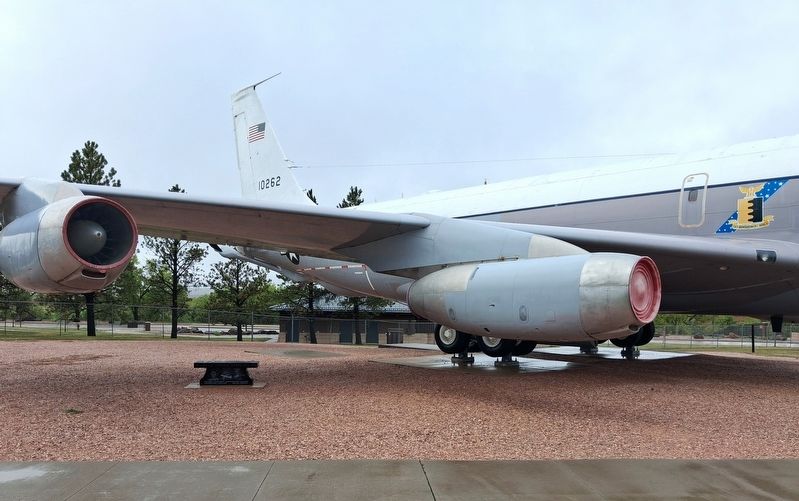
4th Airborne Command Control Squadron Memorial Bench
Painted black, Invaders flew night missions over North
Korea, searching for trucks and trains carrying supplies
to the battlefront. Angling down, the pilot fired the eight
guns in the nose. In some Invaders, a glass nose allowed . . . — — Map (db m313279) HM
It's small compared to the B-1 bomber in front of the
museum, but the Corsair II had a lot in common with that
big machine. The A-7D stayed up a long time without
refueling, carried a lot of bombs, dropped them with great
accuracy, and . . . — — Map (db m313310) HM
In March 2011, under blizzard conditions, the call came:
could the 28th Bomb Wing be ready for action in Libya,
in less than two days? Despite freezing metal and icy
pavement, Airmen began working around the clock. Experts in electronics, . . . — — Map (db m313211) HM
Designed and built to fight a Cold War enemy, the B-1
bomber and its crews adapted to the threat of international
terrorism. Features that made the B-1 effective against
the Soviet Union are now used to directly support ground
troops and to . . . — — Map (db m313147) HM
The Doolittle Raid was the most audacious bomber mission
in history. In April 1942, sixteen B-25s took off from an
aircraft carrier in the Pacific Ocean and bombed Tokyo and
other targets, with plans to land in China. Although seven
crew . . . — — Map (db m313150) HM
Theodore Roosevelt said, "Speak softly and carry a big stick."
In 1948, the Soviet Union stopped ground traffic to West
Berlin. Speaking softly—with unarmed transports—the U.S.
and its allies showed their resolve and ability to keep a . . . — — Map (db m313253) HM
A B-52's crew includes two navigators. They take
stations on the darkened lower deck, constantly
sharing information with the Aircraft Commander,
Co-pilot, and Electronic Warfare Officer on the upper
deck. The Navigator calculates the route . . . — — Map (db m313254) HM
When this plane was built in the 1950s, there was no such
thing as next-day shipping, and more passengers moved
by train than by airplane. To keep national defense moving,
many bases had their own transport planes. Today, it's
much cheaper . . . — — Map (db m313296) HM
Utility aircraft are just as essential to the Air Force
mission as fighters like the F-100 to your right.
Variants of the C-45 trained 90% of our Navigators
and Bombardiers in WWII, carried cameras, or—like
this Expeditor—hauled light . . . — — Map (db m313179) HM
During WWII, C-47s like this one flew over the Himalayas
to supply Americans and Chinese fighting the Japanese.
For three years, daily flights across the world's highest
mountain range were the only way to deliver fuel and
ammunition to . . . — — Map (db m313277) HM
At first, the drone of planes overhead during the Berlin
Airlift (1948-49) reminded Germans of Allied bombing
raids during the recent World War. Then U.S. crews on
approach over the city took to dropping tiny handkerchief
parachutes, . . . — — Map (db m313255) HM
During the Cold War, this plane pretended to be the
enemy. Its bomb bay held electronics that made it
appear on radar like a Soviet bomber trying to sneak
into U.S. airspace. An Electronic Warfare Officer in
the back seat jammed signals and . . . — — Map (db m313294) HM
Crammed with electronics, one of three ALCS from
Ellsworth sat ready for takeoff at all times between 1970
and 1991. If an attack on the United States disrupted
ground-based launch control sites, this plane's crew—from 30,000 feet in the . . . — — Map (db m313209) HM
Ellsworth is home to the 28th Bomb Wing.
Our mission is to provide combat airpower—
anytime, anywhere.
The base has played a vital role in our national
security since 1941. While its facilities and mission
have changed over time to meet . . . — — Map (db m313256) HM
In 1967, a group of F-100 pilots in Vietnam adopted
the call sign Misty and tried something new. They
became Forward Air Controllers (FACs). This job of
flying low to mark targets was usually done by much
slower planes, like our O-2 . . . — — Map (db m313156) HM
Jets like this one—and like the F-102 to your right—served as interceptors: they defended the nation's
borders against aerial attack. But although they were
designed for our Air Force, American aerospace
companies also supplied our allies. . . . — — Map (db m313258) HM
Interceptors like the F-102-and the F-101 to your left-
defended the nation's borders against aerial attack. The
Air Force Reserve and Air National Guard were vital to this
mission. Crews from 23 different Guard squadrons flew and
maintained . . . — — Map (db m313257) HM
When pilots took off in their F-105s to bomb targets
in North Vietnam in the 1960s, they faced some grim
statistics: more than half the Thunderchiefs built were lost
in combat in that war. Their missions—low altitude strikes
on . . . — — Map (db m313302) HM
The United States provided a lot of military aid to
European allies early in the Cold War, including
more than a thousand of these F-84Fs. This
Thunderstreak flew in the French Air Force for 13
years. U.S. military aid helped equip . . . — — Map (db m313299) HM
The FB-111 had Terrain-Following Radar. It could scan
the ground ahead, feed its readings into the autopilot,
and then remain at a constant low altitude without
the pilot's control—at night, at hundreds of miles per
hour. This gave aircrews . . . — — Map (db m313312) HM
In the early 1960s, our leaders suspected the Soviets
had better long-range nuclear weapons. They decided
to install six squadrons of Titan I missiles across
the nation, even given the system's disadvantages.
These missiles stood . . . — — Map (db m313371) HM
Only 17 days after the Titan missiles in South Dakota were
declared operational in the fall of 1962, an Air Force pilot
photographed Soviet nuclear missiles in Cuba, 90 miles
from U.S. shores. Ten days after that, the missile force went
to . . . — — Map (db m313372) HM
Our museum building was originally an
alert hangar complex near the Ellsworth
Air Force Base runway. It held crews and
jet fighters of the 54th Fighter-Interceptor
Squadron. During the Cold War, Soviet
bombers probed American and . . . — — Map (db m313166) HM
During the Cold War, Ellsworth supported two legs of the
nation's nuclear deterrence triad: bombers and land-based
missiles (submarine-launched missiles are the third leg).
For 32 years, the 44th Missile Wing trained to launch and
maintained . . . — — Map (db m313186) HM
Q: When was the last time a nuclear weapon was used?
A: They're used every day, for deterrence.
For 34 years, Ellsworth Airmen kept fields of nuclear missiles
ready to launch. A single Minuteman II could arrive within
half a mile of . . . — — Map (db m313200) HM
Ten years into the Cold War, Ellsworth had hosted the
nation's most effective heavy bombers—the B-29 and the
B-36—and was readying for the B-52. For its protection, the
U.S. Army installed a shield of anti-aircraft missiles around
the base. . . . — — Map (db m313174) HM
This plane flew slow and low over Vietnam, directly
supporting ground troops. Called a Forward Air Controller,
the pilot kept track of friendly forces' locations and marked
enemy positions with smoke rockets, identifying targets
for . . . — — Map (db m313303) HM
With its straight wings and wing-tip fuel tanks, the T-33
was adapted from the very first American jet fighter.
A second seat accommodated the instructor behind
the front seat. Until the swept-wing T-38 Talon was
introduced in 1961, this . . . — — Map (db m313298) HM
At one time, small transport planes like these two
were a common sight on Air Force and Army airfields.
They quickly transported all kinds of passengers and
light cargo. Pilots flew them as an inexpensive way to
keep up their skills. . . . — — Map (db m313309) HM
Air Force UH-1F pilots put in their time rescuing
and evacuating troops in Vietnam in the 1960s. But
the rescue work didn't end when their squadrons
returned to stateside bases. In the summer of 1972,
floodwaters poured out of the Black . . . — — Map (db m313301) HM
This was General Dwight D. Eisenhower's personal
transport in 1944 and 1945, when he led the Allied
Expeditionary Force in retaking northwest Europe
from the Nazis. Eisenhower traveled frequently to
meet with other leaders or to visit troops . . . — — Map (db m313155) HM
This is a beloved plane among Air Force pilots. For over
50 years, Air Force fighter and bomber pilots-tens of
thousands of Airmen-have trained in the Talon. In this jet
they power above the speed of sound for the first time, with
an . . . — — Map (db m313311) HM