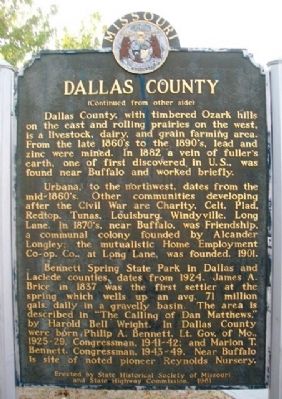
Dallas County, organized 1841, was first called Niangua for the river flowing within its borders, but the name proved difficult and it was changed to Dallas in 1844 for U.S. Vice Pres. George M. Dallas. Settled in the early 1830's by pioneers . . . — — Map (db m62544) HM
[side 1] Here on a scenic hill at the junction of crystal clear Crooked and Hurricane Creeks, Thomas Hamilton laid out Marble Hill after Bollinger County was organized, March, 1851. First called New California, the town was . . . — — Map (db m179953) HM
Opened with burials of William (1785?-1858) and Celia (Lair) Anderson (1791?-1859), Kentuckians who lived on Missouri frontier before following to Dallas County a son, John Lair Anderson (1819-85), a Peters Colony settler of 1846, also buried . . . — — Map (db m150779) HM
Georgia native Trezevant Calhoun Hawpe, a widower, moved from Tennessee to Dallas County with his son. He married Electa Underwood Bethurum in 1848. Elected Dallas County sheriff in 1850, he served two terms. He later was justice of the peace and . . . — — Map (db m159784) HM
In the spring of 1848, the Larkin Newton family arrived in this area from Neosho, Missouri, in response to a 640-acre land grant awarded to them through the Peters Colony. Their contract required them to be on their land with a home constructed by . . . — — Map (db m282992) HM
Clark County was created by the legislature of Missouri Territory on Dec. 15, 1818 and named for the territorial governor, William Clark. It comprised, roughly, all of the present Clark, Hot Spring, Garland, Pike and Dallas counties. Early county . . . — — Map (db m121379) HM
A Bledsoe (1801-1882) arrived in this area in 1846, coming from Missouri, to which he had emigrated from Lancaster, Garrard County, Kentucky about 1830. Stories say his father looked at him when he was born and commented approvingly, "He is a . . . — — Map (db m300516) HM
Thin black lines indicate changes in relevance. Between each pair of lines entries are ordered geographically but all have the same relevance.
* Inflectional forms of words are their plurals, singulars, and possessives as well as gramatical tenses and similar variations.