Following the 1848 establishment of Fort Kearny two miles east of here and the later expansion of overland commerce and emigration, the small commercial center of Kearney City was established here in 1859. The town's more common name, Dobytown, . . . — — Map (db m310084) HM
The Burlington & Missouri River Railroad entered Nebraska at Plattsmouth in 1870 and built west to join the Union Pacific at Kearney Junction (now Kearney city) on September 3, 1872. The railroad bridge into Kearney was used for 104 years. It . . . — — Map (db m58980) HM
The Boom Town played an important role in the West, and few Nebraska towns had such a boom history as Lowell. It was selected as a townsite by the Burlington & Missouri River Railroad in 1871, and its first businesses were soon established. . . . — — Map (db m294237) HM
The Salem Swedish Methodist Episcopal Church was founded in 1883. This area, including portions of Kearney, Phelps, and Harlan counties, once had the largest number of Swedish immigrants in rural Nebraska. The original sod church was built in . . . — — Map (db m287700) HM
Swedish immigrants began homesteading Mirage Township, Kearney County, in 1873. By 1876 these families had formed the Swedish Lutheran Church (Bethany Lutheran), the first church in Kearney County. The tempo of settlement increased with the coming . . . — — Map (db m251236) HM
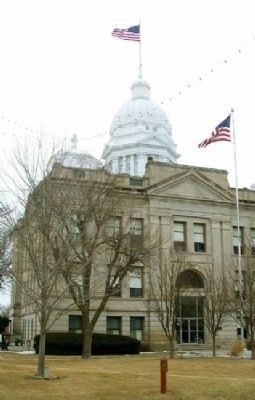
Veterans
of the World War
Kearney County, Nebraska
[Roll of Honored Dead]
Hilmer Anderson · Leo Robert Atwater
William D. Brainard · Thomas J. Geren
Harry A. Hetrick · Reuben N. D. Jensen
Segfred O. Johnson · Frank Leafstedt . . . — — Map (db m58982) HM
Thin black lines indicate changes in relevance. Between each pair of lines entries are ordered geographically but all have the same relevance.
* Inflectional forms of words are their plurals, singulars, and possessives as well as gramatical tenses and similar variations.