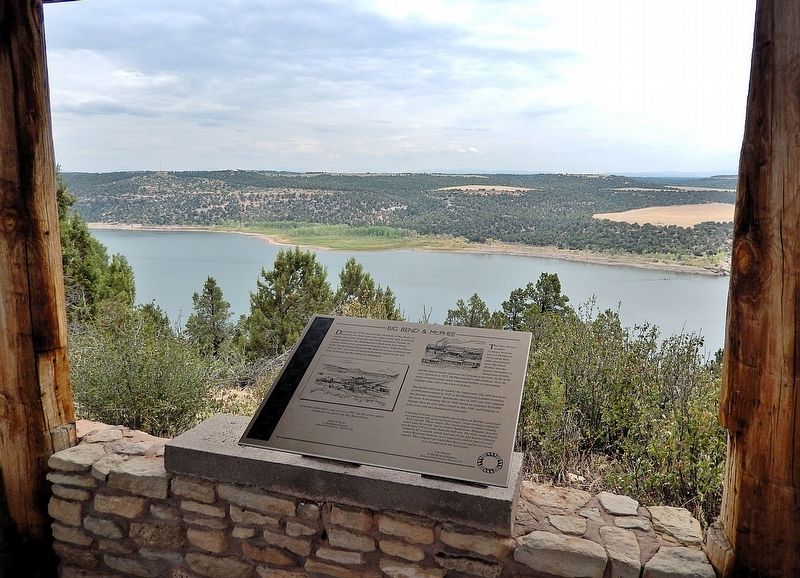
During the late 1870s, the ranching community of Big Bend was founded at the bend in the river valley to your right. Even in its heyday, only about 100 people lived in the community. Despite its meager population, Big Bend boasted a blacksmith . . . — — Map (db m290597) HM
Has been designated a Registered National Historic Landmark Under the provisions of the Historic Sites Act of August 21, 1935 this site possesses exceptional value in commemorating and illustrating the History of the United States. . . . — — Map (db m283800) HM
In the very old days, Sleeping Ute Mountain was a great warrior god. He fought against Evil Ones who were causing much trouble. During a battle between the Warrior God and the Evil Ones, the Warrior God was hurt. He lay down to rest and fell . . . — — Map (db m290490) HM
The McElmo Creek Flume was in use from the 1890s to the 1990s, carrying water for over a
hundred years. After it was abandoned, it remained in good condition until 2006, when a
flash flood carried debris into the trough and damaged the wooden top. . . . — — Map (db m153382) HM
For more than 12,000 years, Native American people have inhabited this area. As the Ice Age ended, these nomadic people hunted bison and mastodons in the valleys, and gathered plants along the edges of glacial lakes and wetlands. . . . — — Map (db m160236) HM
Birds like the magpie, hawk and eagle are commonly seen overhead. Pueblo groups revere them as messengers between the sky beings and the people of the earth. Their feathers are worn as symbols of rank on ceremonial masks and costumes. According . . . — — Map (db m290595) HM
The history of agriculture in the Four Corners includes fruit production going back to Indigenous cultures. When a new wave of settlers arrived in the late 1800s, they brought with them apple trees that were nurtured to become productive orchards. . . . — — Map (db m289099) HM
The yucca-fiber sandals of Ancestral Puebloans, the leather sandals of Franciscan priests, work boots of ranchers and lumbermen, the rubber tires of wheelchairs, and the nylon and leather shoes of visitors today have traversed the landscape of . . . — — Map (db m290395) HM
Originally located one block to the south on the corner of First and Chestnut Streets, the Montezuma County Court House was constructed on this site in 1937.
The designation of Cortez as the County Seat reflected the vision of our pioneer leaders . . . — — Map (db m154905) HM
Thin black lines indicate changes in relevance. Between each pair of lines entries are ordered geographically but all have the same relevance.
* Inflectional forms of words are their plurals, singulars, and possessives as well as gramatical tenses and similar variations.