3 entries match your criteria.
Entries Containing All of the Phrases «reeves county» AND «texas»
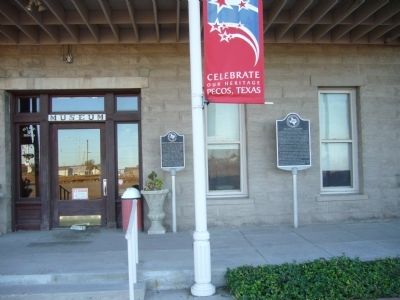
By Bill Kirchner, October 25, 2012
Reeves County-Pecos, Texas Marker
RANKED BY RELEVANCE
1 ► Texas, Reeves County, Pecos — 4227 — Reeves County-Pecos, Texas —  |
| Flat, arid, grassy land with a moderate water supply from the Pecos River and springs in Toyah Valley. Yuma Indians are thought to have done irrigated farming here in 16th century. Mexicans later raised vegetables, grain. Cattlemen moved in . . . — — Map (db m61269) HM | |||
| 2 ► Texas, Harris County, Tomball, Spring Creek Valley Estates — 17900 — Spring Creek County — |
| In early Texas, most citizen interactions with government took place at the county seat, so smaller counties were more convenient for the residents. Prior to 1841, each county had at least one congressman, but since the Republic of Texas . . . — — Map (db m170794) HM | |||
| 3 ► Texas, Reeves County, Pecos — Pecos, Texas — |
| Welcome! A West Texas “welcome” is the friendliest greeting in the whole world; and Pecos is as “West Texas” as it gets! To receive a Pecos welcome, just stop! Stop at the excellent park and zoo, at the authentic frontier hotel that's now a . . . — — Map (db m131694) HM | |||
Thin black lines indicate changes in relevance. Between each pair of lines entries are ordered geographically but all have the same relevance.
* Inflectional forms of words are their plurals, singulars, and possessives as well as gramatical tenses and similar variations.
Nov. 12, 2026