Near Charlottesville in Albemarle County, Virginia — The American South (Mid-Atlantic)
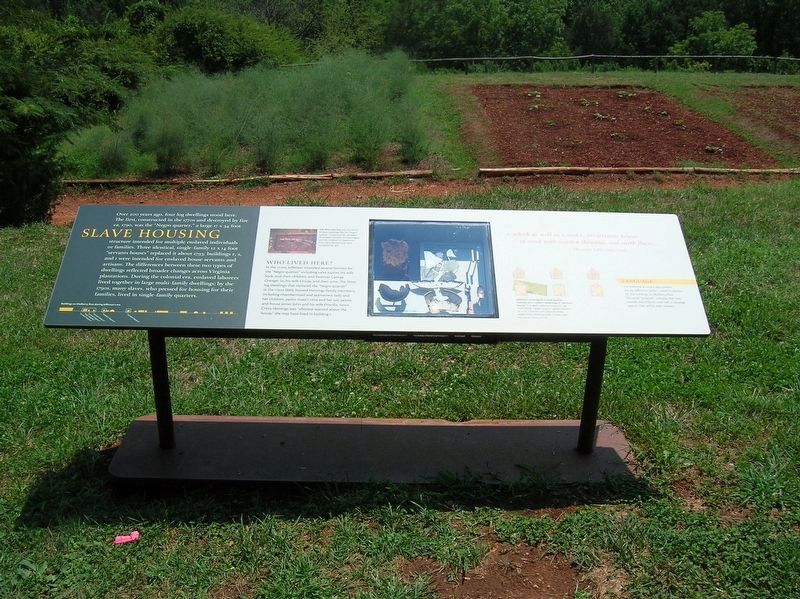
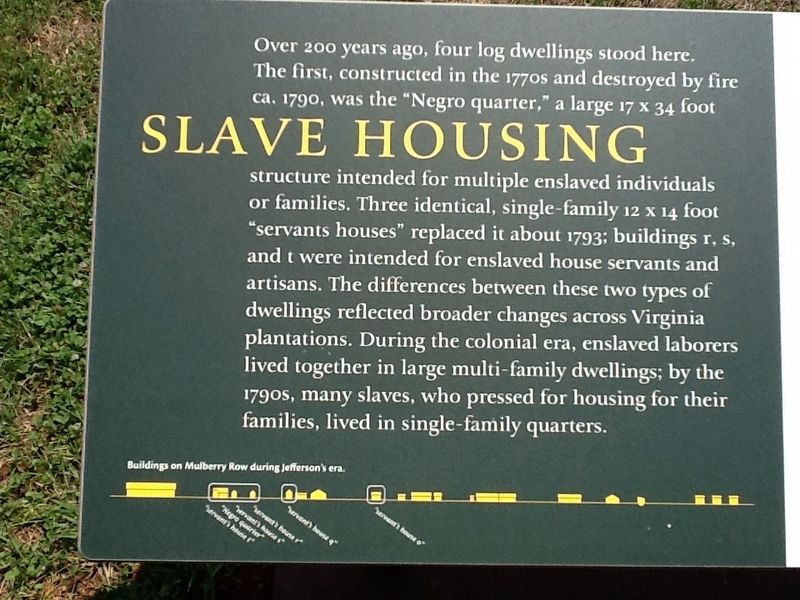
Slave Housing
Photographed by Michael C. Wilcox, August 1, 2012
1. Slave Housing Marker
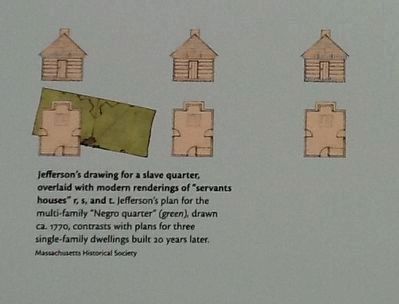
r, which as well as s. and t. are servants houses of wood with wooden chimnies, and earth floors...
Thomas Jefferson. 1796
Who Lived Here?
In the 1770s, Jefferson intended several families for the "Negro quarter," including valet Jupiter, his wife Suck, and their children; and foreman George Granger, Sr., his wife Ursula, and their sons. The three log dwellings that replaced the "Negro quarter" in the 1790s likely housed Hemings
this page online
Language For historical accuracy and context, we use Jefferson's terms—noted in quotes—for the buildings on Mulberry Row. The word "enslaved" indicates that men, women, and children were held in bondage against their will by their masters.
(Marker Number 05.)
Topics. This historical marker is listed in these topic lists: African Americans • Colonial Era • Patriots & Patriotism • Settlements & Settlers. A significant historical year for this entry is 1770.
Location. 38° 0.6′ N, 78° 27.07′ W. Marker is near Charlottesville, Virginia, in Albemarle County. It can be reached from Thomas Jefferson Parkway. Marker is on the grounds of Monticello—entrance fee is required. Touch for map. Marker is at or near this postal address: 995 Monticello Loop, Charlottesville VA 22902, United States of America. Touch for directions.

Regionally, this marker is in the
Photographed by Michael C. Wilcox, August 1, 2012
2. Slave Housing Marker
Other nearby markers. At least 8 other markers are within walking distance of this marker: Mulberry Row (within shouting distance of this marker); Horses & Mules (within shouting distance of this marker); The Stables (within shouting distance of this marker); Textiles (within shouting distance of this marker); Vegetable Garden (within shouting distance of this marker); a different marker also named Mulberry Row (about 300 feet away, measured in a direct line); Sally Hemings (about 300 feet away); Sally Hemings's Life (about 300 feet away). Touch for a list and map of all markers in Charlottesville.
More about this marker. This is marker #05 in the "Mulberry Row at Monticello - Landscape of Slavery" panel series (link to
Photographed by Michael C. Wilcox, August 1, 2012
3. Slave Housing Marker
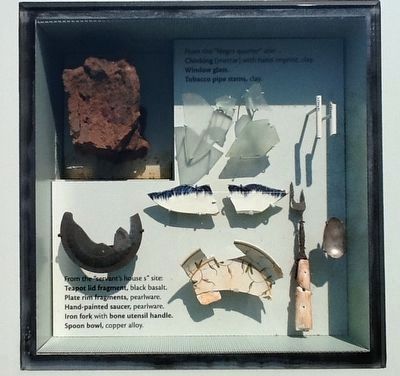
From the "Negro quarter site:
Cinking (mortar) with hand imprint, clay.
Window glass.
Tobacco pipe stems, clay.
From the "servant's house s" site:
Teapot lid fragment, black basalt.
Plate rim fragments, pearlware.
Hand-painted saucer, pearlware.
Iron fork with bone utensil handle.
Spoon bowl, copper alloy.
Cinking (mortar) with hand imprint, clay.
Window glass.
Tobacco pipe stems, clay.
From the "servant's house s" site:
Teapot lid fragment, black basalt.
Plate rim fragments, pearlware.
Hand-painted saucer, pearlware.
Iron fork with bone utensil handle.
Spoon bowl, copper alloy.
Regarding Slave Housing. Since the time these photos were taken, a reconstruction of one of the three slave cabins was completed in 2014 at the site of "servant's house t" and is called the Hemmings Cabin.
Also see . . . Mulberry Row Reassessment. Thomas Jefferson's Monticello website entry (Submitted on January 18, 2023, by Larry Gertner of New York, New York.)
Photographed by Michael C. Wilcox, August 1, 2012
4. Slave Housing Marker
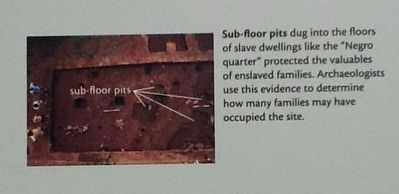
Sub-floor pits dug into the floors of slave dwellings like the "Negro quarter" protected the valuables of enslaved families, Archaeologists use this evidence to determine how many families may have occupied the site.
Photographed by Michael C. Wilcox, August 1, 2012
5. Slave Housing Marker
Jefferson's drawing for a slave quarter, overlaid with modern renderings of "servants houses" r, s. and t. Jefferson's plan for the multi-family "Negro quarter" (green), drawn ca. 1770, contrasts with plans for three singe-family dwellings built 10 years later.
Photographed by Michael C. Wilcox, August 1, 2012
6. Slave Housing Marker
Credits. This page was last revised on February 2, 2023. It was originally submitted on December 4, 2016, by Michael C. Wilcox of Winston-Salem, North Carolina. This page has been viewed 1,142 times since then and 31 times this year. Photos: 1, 2, 3, 4, 5, 6. submitted on December 4, 2016, by Michael C. Wilcox of Winston-Salem, North Carolina.
