
Santiago de Querétaro in Querétaro, Mexico — The Central Highlands (North America)
The Great Convent of San Francisco
Photographed by J. Makali Bruton, November 11, 2016
1. The Great Convent of San Francisco Marker
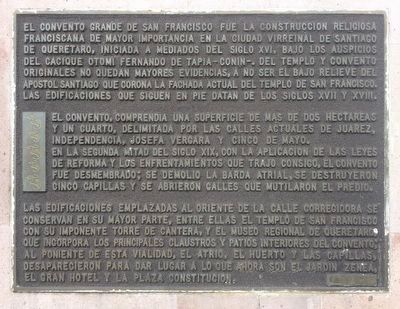
El Convento Grande de San Francisco fue la construcción religiosa franciscana de mayor importancia en la ciudad virreinal de Santiago de Queretaro, iniciada a mediados del siglo XVI, bajo los auspicios del cacique otomí Fernando de Tapia – Conin - , del templo y convento originales no quedan mayores evidencias, a no ser el bajo relieve del apóstol Santiago que corona la fachada actual del Templo de San Francisco. Las edificaciones que siguen en pie datan de los siglos XVII y XVIII.
El convento, comprendia una superficie de mas de dos hectáreas y un cuarto, delimitada por las calles actuales de Juarez, Independencia, Josefa Vergara y Cinco de Mayo.
En la segunda mitad del siglo XIX, con la aplicación de las Leyes de Reforma y los enfrentamientos que trajo consigo, el convento fue desmembrado; se demolio la barda atrial, se destruyeron cinco capillas y se abrieron calles que mutilaron el predio.
Las edificaciones emplazadas al oriente de la Calle Corregidora se conservan en su mayor parte, entre ellas Templo de San Francisco con su imponente torre de cantera, y el Museo Regional de Queretaro que incorpora los principales
this page online
English translation:
The Great Convent of San Francisco was the Franciscan religious building of greatest importance in the viceregal city of Santiago de Querétaro, begun in the middle of the 16th century, under the auspices of the Otomí leader Fernando de Tapia, also known as Conin. Nothing remains of the original temple and convent, except for the image of the Apostle Santiago (St. James) crowning the present facade of the Temple of San Francisco. The associated buildings that are still standing date back to the 17th and 18th centuries.
The convent originally covered an area of more than two and a quarter hectares. It was delimited by the current streets of Juárez, Independencia, Josefa Vergara and Cinco de Mayo.
In the second half of the 19th century, with the application of the Reform Laws and the conflict associated with their implementation, the convent was dismembered. The atrium’s fence work was demolished, five
Photographed by J. Makali Bruton, November 11, 2016
2. The Great Convent of San Francisco Marker
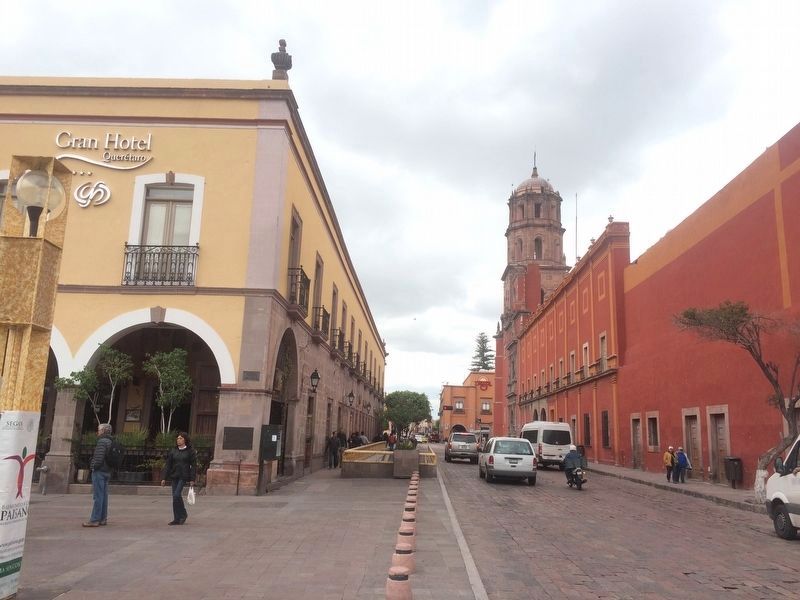
In this view roughly to the north along Calle Corregidora, the marker is to the left of the street on the corner of the Gran Hotel. The buildings that make up the ex-convent (now the Querétaro Regional Museum) are to the right of the street in the distance.
The buildings located to the east of Corregidora Street are preserved for the most part, including the San Francisco Temple with its imposing stone tower, and the Regional Museum of Queretaro that incorporates the main cloisters and inner courtyards of the convent. To the west of this road, the atrium, the garden and the chapels disappeared to give place to what are now the Zenea Garden Park, the Gran Hotel and the Constitution Plaza.
Erected by Instituto Nacional de Antropología e Historia (INAH).
Topics. This historical marker is listed in these topic lists: Charity & Public Work • Colonial Era • Man-Made Features • Religion & Religious Structures.
Location. 20° 35.523′ N, 100° 23.484′ W. Marker is in Santiago de Querétaro, Querétaro. It is on Calle Corregidora 0.1 kilometers north of Calle Independencia, on the left when traveling north. Touch for map. Marker is at or near this postal address: 12 Calle Corregidora, Santiago de Querétaro QUE 76000, Mexico. Touch for directions.

Regionally,
Photographed by J. Makali Bruton, November 11, 2016
3. The Gran Hotel
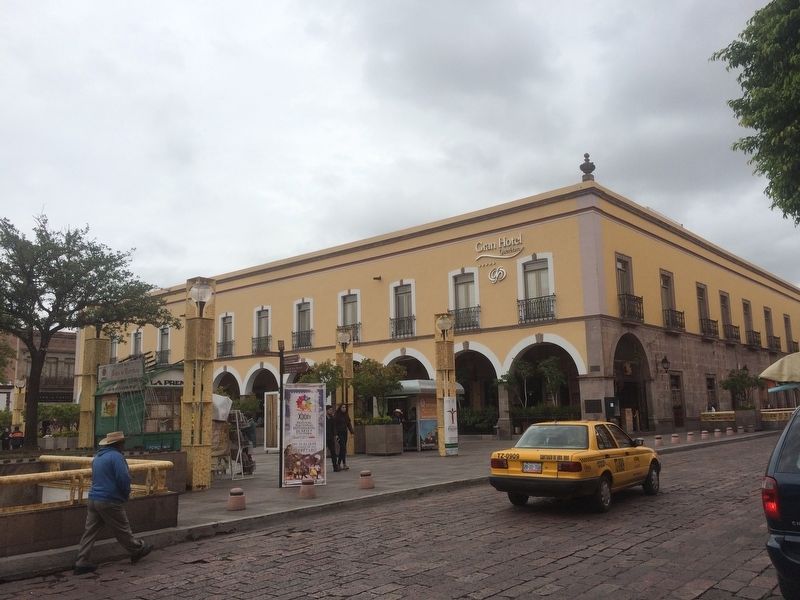
The hotel, as mentioned in the marker text. In front of the hotel is the Constitution Plaza, also mentioned.
Other nearby markers. At least 8 other markers are within walking distance of this marker: Foundations of the Convent of San Francisco (within shouting distance of this marker); José M. Arteaga (about 90 meters away, measured in a direct line); The Royal Inland Road (about 120 meters away); Mexico's Ratification of the Treaty of Guadalupe-Hidalgo (about 120 meters away); Church and Former Convent of San Francisco / Templo y antiguo convento de San Francisco (about 120 meters away); The Flor Baja Fountain (about 150 meters away); Francisco León de la Barra (about 150 meters away); Residence of Epigmenio and Emeterio González (about 180 meters away). Touch for a list and map of all markers in Santiago de Querétaro.
Photographed by J. Makali Bruton, March 26, 2017
4. A model of the Great Convent of San Francisco
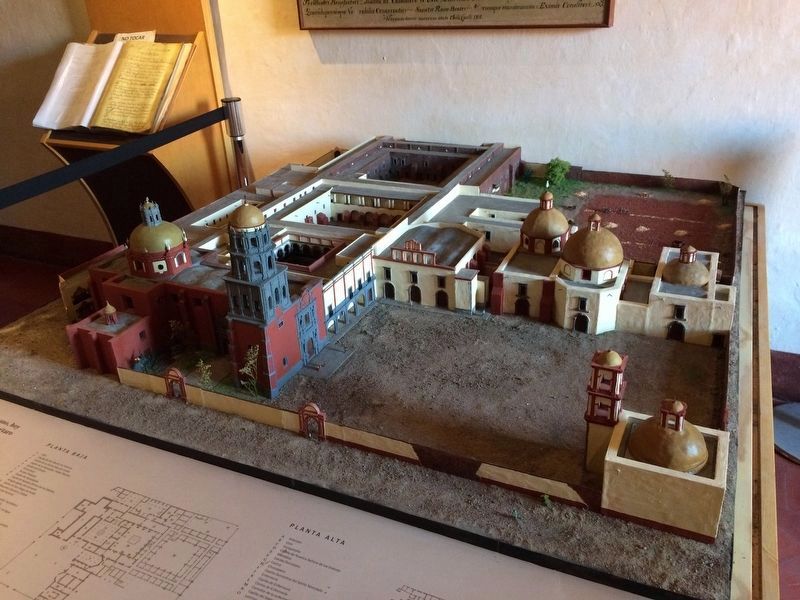
This scale model of the convent is part of a display at the Regional Museum of Querétaro (ex-convent of San Francisco). The model shows how parts of the convent were demolished over time and incorporated into the city, with Calle Corregidora now passing directly in front of the convent's temple.
Credits. This page was last revised on June 8, 2017. It was originally submitted on December 6, 2016, by J. Makali Bruton of Washington, District of Columbia. This page has been viewed 445 times since then and 19 times this year. Photos: 1, 2, 3. submitted on December 6, 2016, by J. Makali Bruton of Washington, District of Columbia. 4. submitted on June 8, 2017, by J. Makali Bruton of Washington, District of Columbia.
