Near Charlottesville in Albemarle County, Virginia — The American South (Mid-Atlantic)
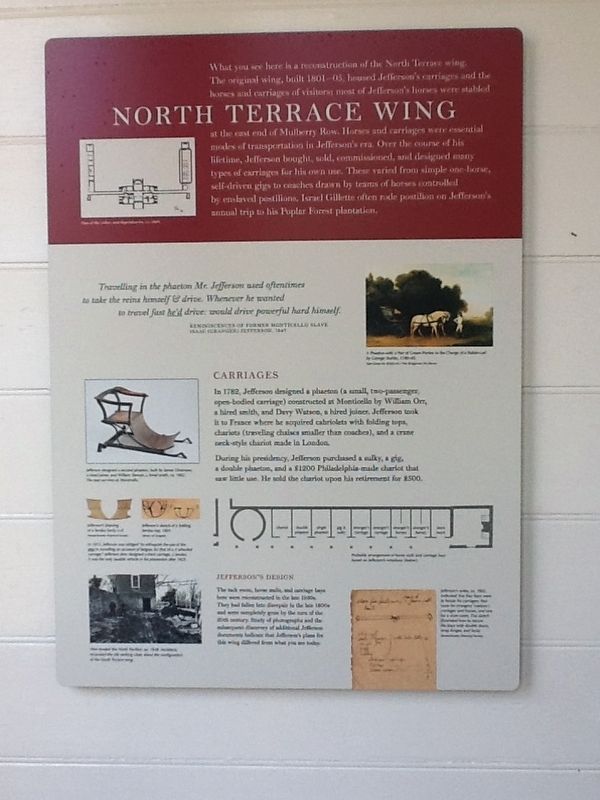
North Terrace Wing
Photographed by Michael C. Wilcox, August 1, 2012
1. North Terrace Wing Marker
Travelling in the phaeton Mr. Jefferson used oftentimes to take the reins himself & drive. Whenever he wanted to travel fast drive he'd drive: would drive powerful hard himself.
Reminiscences of former Monticello slave Isaac (Granger) Jefferson, 1847
Carriages
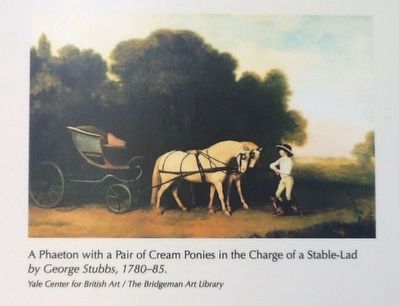
In 1782, Jefferson designed a phaeton (a small, two-passenger, open-bodied carriage) constructed at Monticello by William Orr, a hired smith, and Davy Watson, a hired joiner. Jefferson took it to France
this page online
During his presidency, Jefferson purchased a sulky, a gig, a double phaeton, and a $1200 Philadelphia-made chariot that saw little use. He sold the chariot upon his retirement for $500.
Jefferson's Design
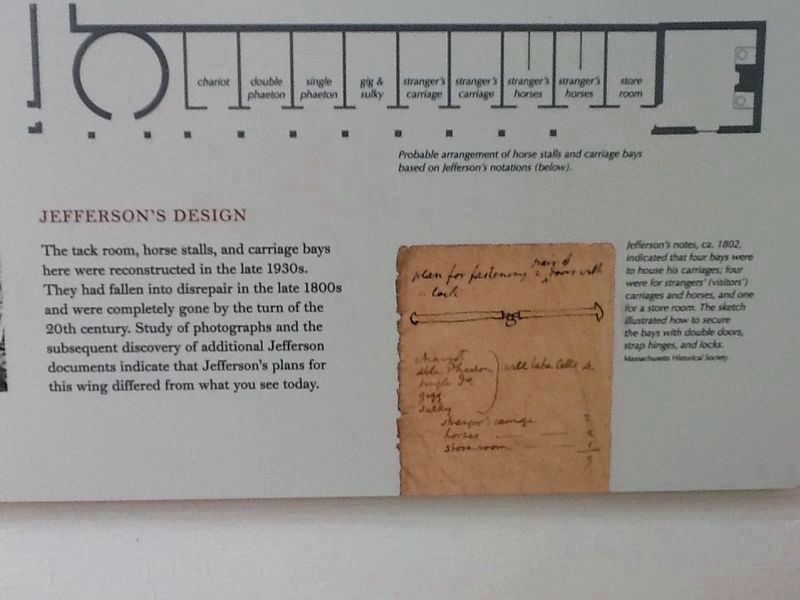
The tack room, horse stalls, and carriage bays here were reconstructed in the late 1930s. They had fallen into disrepair in the late 1800s and were completely gone by the turn of the 20th century. Study of photographs and the subsequent discovery of additional Jefferson documents indicate that Jefferson's plans for this wing differed from what you see today.
Topics. This historical marker is listed in these topic lists: African Americans • Patriots & Patriotism • Roads & Vehicles. A significant historical year for this entry is 1782.
Location. 38° 0.65′ N, 78° 27.16′ W. Marker is near Charlottesville, Virginia, in Albemarle County. It can be reached from Thomas Jefferson Parkway. Marker is on the grounds of Monticello—entrance fee is required. Touch for map. Marker is
Photographed by Michael C. Wilcox, August 1, 2012
2. North Terrace Wing Marker
A Phaeton with a Pair of Cream Ponies in the Charge of a Stable-Lad
by George Stubbs, 1780—85.
Yale Center for British Art / The Bridgeman Art Library
by George Stubbs, 1780—85.
Yale Center for British Art / The Bridgeman Art Library

Regionally, this marker is in the Piedmont and in Central Virginia. It is also in the American South and specifically in the Upper South. Globally, it is in North America, the Western Hemisphere, the Western World, and the Anglosphere. Historically, it finds itself in what was once the territory of the Mississippian Culture, one of the original Thirteen Colonies, one of the Confederate States of America, and the Antebellum South.
Other nearby markers. At least 8 other markers are within walking distance of this marker: Ice House (within shouting distance of this marker); Barrier (within shouting distance of this marker); North Pavilion (within shouting distance of this marker); Making Monticello (about 300 feet away, measured in a direct line); Sally Hemings (about 400 feet away); Sally Hemings's Life (about 400 feet away); A Presidential Scandal: (about 400 feet away); South Pavilion (about 400 feet away). Touch for a list and map of all markers in Charlottesville.
Photographed by Michael C. Wilcox, August 1, 2012
3. North Terrace Wing Marker
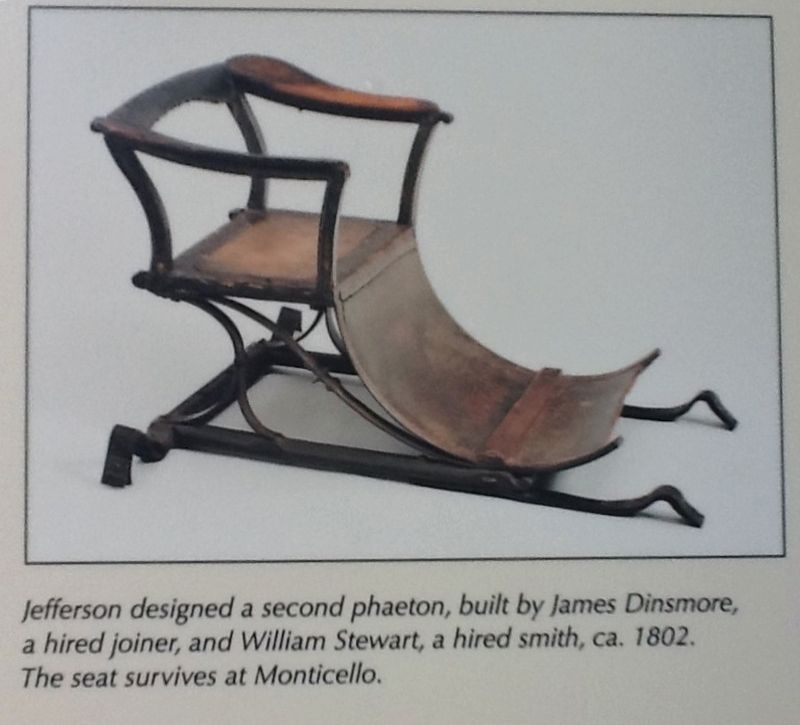
Jefferson designed a second phaeton, built by James Dinsmore, a hired joiner, and William Stewart, a hired smith, ca. 1802. The seat survives at Monticello.
Photographed by Michael C. Wilcox, August 1, 2012
4. North Terrace Wing Marker
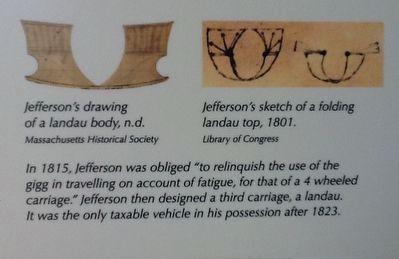
Jefferson's drawing of a landau body, n.d.
Massachusetts Historical Society
Jefferson's sketch of a folding landau top, 1801.
Library of Congress
In 1815, Jefferson was obliged "to relinquish the use of the gigg in travelling on account of fatigue, for that of a 4 wheeled carriage." Jefferson then designed a third carriage, a landau. It was the only taxable vehicle in his possession after 1823.
Massachusetts Historical Society
Jefferson's sketch of a folding landau top, 1801.
Library of Congress
In 1815, Jefferson was obliged "to relinquish the use of the gigg in travelling on account of fatigue, for that of a 4 wheeled carriage." Jefferson then designed a third carriage, a landau. It was the only taxable vehicle in his possession after 1823.
Photographed by Michael C. Wilcox, August 1, 2012
5. North Terrace Wing Marker
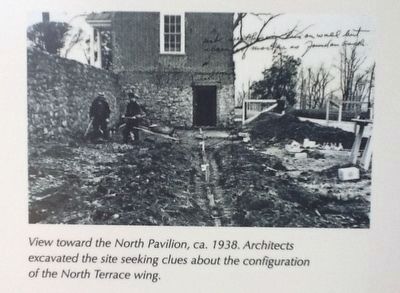
View toward the North Pavilion, ca. 1938. Architects excavated the site seeking clues about the configuration of the North Terrace wing.
Photographed by Michael C. Wilcox, August 1, 2012
6. North Terrace Wing Marker
(Top)
Probable arrangement of horse stalls and carriage bays based on Jefferson's notations (below)
(Lower Right)
Jefferson's notes, ca. 1802, indicated that four bays were to house his carriages; four were for strangers' (visitors') carriages and horses, and one for a store room. The sketch illustrated how to secure the bays with double doors, strap hinges, and locks.
Massachusetts Historical Society
Probable arrangement of horse stalls and carriage bays based on Jefferson's notations (below)
(Lower Right)
Jefferson's notes, ca. 1802, indicated that four bays were to house his carriages; four were for strangers' (visitors') carriages and horses, and one for a store room. The sketch illustrated how to secure the bays with double doors, strap hinges, and locks.
Massachusetts Historical Society
Photographed by Michael C. Wilcox, August 1, 2012
7. North Terrace Wing Marker
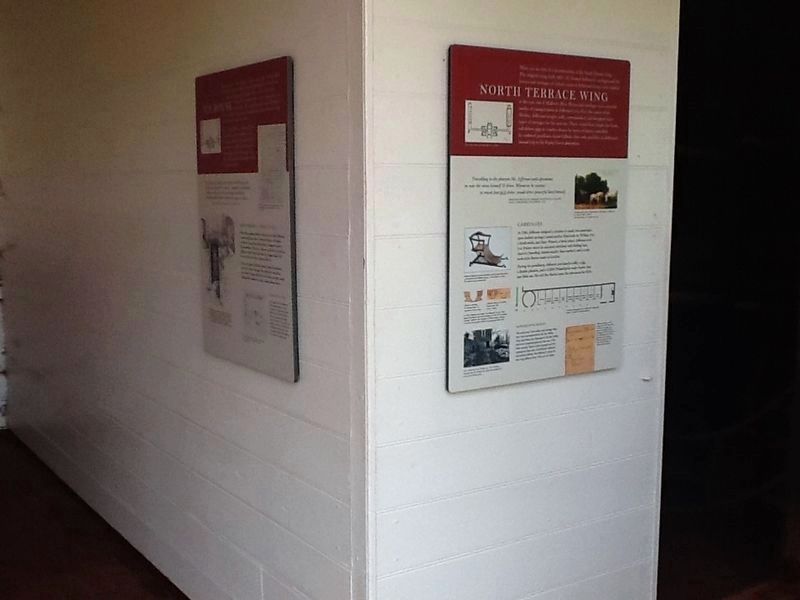
(Note: The Ice House marker is the one around the corner.)
Credits. This page was last revised on February 2, 2023. It was originally submitted on December 16, 2016, by Michael C. Wilcox of Winston-Salem, North Carolina. This page has been viewed 692 times since then and 30 times this year. Photos: 1, 2, 3, 4, 5, 6, 7. submitted on December 16, 2016, by Michael C. Wilcox of Winston-Salem, North Carolina.
